
The best OCR models for tables, charts, and complex structured documents right now are dedicated document parsers, and the strongest of them is OCRia-1, the 4-billion-parameter model that runs inside LlamaParse. It scores 91.5 on ParseBench's table dimension and leads table evaluations on four benchmarks, three of them built outside LlamaIndex.
If your pages are mostly plain text, other picks win on price. AWS Textract and Google Document AI read text for $1.50 per 1,000 pages, and Azure Document Intelligence covers the most printed languages of the three big clouds. Teams that must self-host can run LlamaParse in their own cloud account or data center on an Enterprise plan, or start with open weights like LightOnOCR-3 or Chandra OCR 2.
Plain text is no longer where these models differ. On ParseBench's content faithfulness score, OCRia-1, dots.mocr, and Mistral OCR 4.1 all land at 0.90 in the OCRia-1 technical report. The spread opens on structure: a header spanning three columns, a merged cell in an insurance coverage schedule, a stacked bar chart with no value labels. That's what this ranking measures, and it's where most "best OCR" lists stop looking.
| Model or API | Best for | ParseBench overall / tables | Languages | Hosted p50 latency | List price per 1,000 pages | Integration |
|---|---|---|---|---|---|---|
| LlamaParse (OCRia-1) | Tables, charts, financial and insurance filings | 82.83 / 90.90 (Agentic tier) | Multilingual, no published list | 2.2 s | $3.75 to $4.50 (Cost Effective), $12.50 to $15 (Agentic) | Python and TS SDKs, REST, web UI, VPC or on-prem deploy |
| Extend | Extraction with a review layer | 73.50 / 85.26 | Not published | Not published | $5 to $20 | API, BYOC or hybrid deploy |
| Reducto | Citations with bounding boxes | 70.87 / 80.20 (Agentic) | Not published | Not published | $10 | REST, async jobs, webhooks |
| Mistral OCR 4 | Cheap, fast text-heavy pages | 58.38 / 74.03 | 170 | 1.8 s (4.1) | $4 ($2 batch) | API, Python and TS SDKs |
| Azure Document Intelligence | Language coverage | 56.76 / 85.97 (Layout) | About 300 printed, 12 handwritten | Not published | About $1.50 Read, $10 Layout | SDKs, Studio UI |
| AWS Textract | Plain text inside AWS | 48.31 / 84.46 | 40+ printed (6 for Forms) | Not published | $1.50 text, $15 tables | AWS SDKs, console |
| Google Document AI | Broad language coverage on GCP | 48.66 / 54.95 | 200+ | Not published | $1.50 OCR, $10 Layout Parser | GCP SDKs, Workbench |
| LightOnOCR-3 4B (open weights) | Fast self-hosting | 75.60 / 83.63 | Not published | Self-hosted | GPU cost | Hugging Face, vLLM |
| Chandra OCR 2 (open weights) | Self-hosted table work | 70.59 / 89.20 | 90+ | Self-hosted | GPU cost, or Datalab API | Hugging Face, Datalab API |
ParseBench scores come from the public leaderboard (read November 2, 2026), where "overall" averages five dimensions including visual grounding. Latency is the typical-page p50 from OpenDocRouter's model page. Prices are each vendor's published list price. LlamaParse's range runs from the Pro rate ($1.25 per 1,000 credits) to the pay-as-you-go rate ($1.50). Azure's figures come from Microsoft's language table and Q&A pages because its rate card did not render.
Every Model Reads the Text Now, So We Ranked on Structure
The ranking leans on ParseBench, a benchmark LlamaIndex built and publishes. It covers about 2,000 human-verified pages pulled from insurance SERFF filings, financial reports, and government documents, scored against more than 169,000 test rules with no LLM judge in the loop. It scores five dimensions: tables, charts, content faithfulness, semantic formatting, and visual grounding. We ran every provider on it, including Reducto, AWS Textract, and Claude, through the same harness, and the results live in a public CSV on GitHub. The benchmark, its paper, and the OCRia-1 report are all on our research page.
A vendor grading its own model is a conflict of interest, so we checked every table claim against three OCR accuracy benchmark suites that LlamaIndex didn't build:
- olmOCR-bench from the Allen Institute for AI, with 7,010 pass/fail unit tests across 1,403 pages
- PulseBench-Tab from Pulse, with 1,820 human-annotated tables in nine languages
- fr-bench-pdf2md from Pulsia, with 721 deliberately difficult French pages
We ran every model on all four suites ourselves, at the same rendering for every system, and the launch post's charts are those runs. "Built outside LlamaIndex" means the datasets and test rules are public and not ours, and ParseBench's dataset, scoring code, and results CSV are open too, so every run cited here can be reproduced. The check we had no hand in is Unstructured's benchmarks, which put their own pipelines on top and LlamaParse as the best of the other vendors at 0.835, ahead of Reducto at 0.812. And a reading rule for every number in this piece: a spread of a few points is within the noise between test sets (the same model lands a couple of points apart on different runs), so treat close scores as ties and decide on your own pages.
OmniDocBench is missing on purpose. Its top scores now bunch just above 95 (PaddleOCR-VL-1.6 at 96.3, MinerU 2.5-Pro at 95.69), which makes it a poor tool for separating the leaders, a problem we wrote up in OmniDocBench is saturated.
The other columns follow simple rules. OCR pricing per page is each vendor's published list price, shown per 1,000 pages. Languages appear only where the vendor publishes a count, and latency only where someone measured it on hosted infrastructure. Vendor-run benchmarks show up as context, never as the headline score. One more caveat: OCRia-1's launch numbers average four dimensions and leave out visual grounding, so they get their own table below instead of sharing a column with the leaderboard. One deliberate exclusion beyond OmniDocBench: platform IDP suites (ABBYY Vantage, Hyperscience, Tungsten TotalAgility) sell on enterprise contracts rather than per-page pricing and appear on none of the public leaderboards this ranking draws from, so we left them out.
Best OCR Model for Tables: Where the Scores Separate
Table extraction from PDF is the task where these models stop agreeing. The launch post ran every model through the same harness at the same rendering, so it's the cleanest head-to-head available:
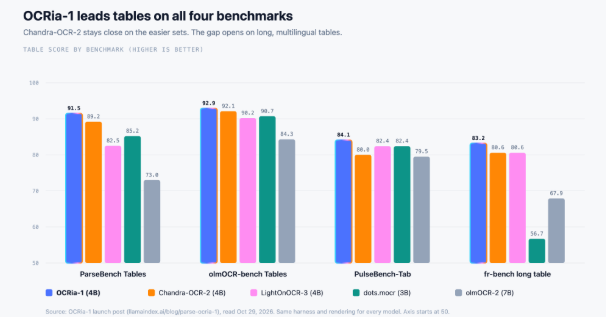
Chandra-OCR-2 deserves credit here. It trails OCRia-1 by 2.3 points on ParseBench tables and 0.8 on olmOCR-bench tables, close enough that a single test set could flip them, though the gap is 6.2 on olmOCR-bench tables at 1,288px. The gap widens as the tables get harder.
Nested Headers, Merged Cells, and Long Tables
A financial statement where "2025" spans three quarterly columns, or a coverage schedule where one deductible applies to four rows, only works if the parser keeps those relationships. Lose one and you get a transcription with every number correct and every comparison wrong. On fr-bench's second long-table category, OCRia-1 scores 81.9 against Chandra's 77.8. On PulseBench-Tab it reproduced 485 of 1,820 tables perfectly, compared with 431 for the runner-up (technical report). We covered the mechanics of this in our post on OCR for tables.
Charts Are Tables Without Gridlines
The widest spread in the whole dataset is on charts. OCRia-1 scores 85.1 on ParseBench's chart dimension, the next model scores 66.1, and dots.mocr and Surya OCR 2 score 0.1 and 1.2. Conventional OCR reads the axis labels and the legend, then drops the bars. OCRia-1 returns an HTML table of the data points, with each value under the right series and label, which is the only form you can actually run numbers against.
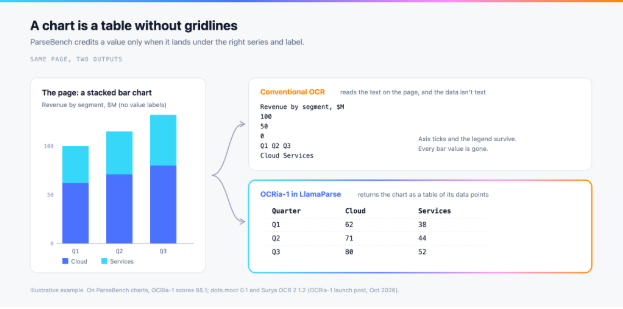
ParseBench gives credit for a chart value only when it lands under the correct row and column headers, so a model can't score by dumping every number it sees. There's more on why this is hard in extracting data from charts.
Formatting That Changes Meaning
Superscripts, strikethroughs, and checkboxes look cosmetic until one goes missing. A footnote marker on a revenue line, a struck clause in a contract, or an unchecked box on a claim form all change what the document says. OCRia-1 keeps these marks in Markdown and HTML and writes math as LaTeX, scoring 83.4 on ParseBench formatting against 67.9 for the next system.
This is the gap legacy OCR and the hyperscaler APIs paper over by charging for structure separately. Textract reads text for $1.50 per 1,000 pages and charges $15 for tables, and on ParseBench its formatting score is 4.65. Layout-aware parsing treats the grid, the chart data, and the inline marks as the output itself, so you don't have to rebuild them afterward.
Managed OCR APIs: What Your Per-Page Price Actually Buys
Most teams buy OCR as an API, so this is the part of an OCR model comparison where a per-page price meets a score. The scores below are ParseBench leaderboard rows. If you're comparing parsers on structure, our top document parsing APIs roundup goes wider on integration details.
LlamaParse With OCRia-1
Best for: tables, charts, and the mixed financial and insurance filings that combine both. OCRia-1 runs by default on LlamaParse's cost_effective tier (3 credits a page, $3.75 per 1,000 on Pro, $4.50 pay-as-you-go) and agentic tier (10 credits, $12.50 or $15 per 1,000) whenever you request version="latest", as described in the tier docs. There's no model name to set and no price change. The exception is a job with a custom prompt, which routes to a general-purpose model instead. On the leaderboard, LlamaParse's Agentic Plus tier (25 credits a page, from $31.25 per 1,000) has the highest overall score of all 155 entries (86.69), and Agentic comes in at 82.83.
Tables come back as HTML inside the parsed output, header rows intact, so they load into a dataframe without regex:
python
from io import StringIO

import pandas as pd
from llama_cloud import LlamaCloud

client = LlamaCloud()  # reads LLAMA_CLOUD_API_KEY from the environment
file = client.files.create(file="10-q-financial-statements.pdf", purpose="parse")
result = client.parsing.parse(
    file_id=file.id,
    tier="cost_effective",  # OCRia-1 runs here and on agentic with version="latest"
    version="latest",
    expand=["markdown"],
)

for page in result.markdown.pages:
    if "<table" not in page.markdown:
        continue
    for table in pd.read_html(StringIO(page.markdown)):
        print(f"page {page.page_number}: {table.shape[0]} rows x {table.shape[1]} cols")
        print(table.head(4).to_string(index=False))
We ran this against a benchmark-results page from the OCRia-1 technical report. It returned both 9-by-10 results tables with every score matching the source. Hosted, median latency is 2.2 seconds a page. On one B200 GPU at 64 concurrent requests, the model sustains 10.21 pages per second, about 860,000 pages a day. For statement-heavy workloads, see the financial statement OCR and insurance document automation pages.
You can also run LlamaParse outside our SaaS. On Enterprise plans it deploys in your own AWS, Azure, or Google Cloud account or in your own data center, installed on Kubernetes with a Helm chart, so documents and results stay in your environment. Inference can be managed by LlamaIndex or run on your own GPUs. With local models, the Cost Effective and Agentic tiers keep every page inside your network, including in air-gapped setups. Our deployment guide walks through each option.
Reducto
Reducto's Agentic tier scores 70.87 on ParseBench, with a weaker 45.4 on formatting. Its strength is traceability, since every parsed chunk carries a position and every extracted value a bounding-box citation. List price is $10 per 1,000 pages. Our LlamaParse vs Reducto page has the side-by-side.
Extend
Extend 2.0 scores 73.50 overall and 85.26 on tables. Its marketing leads with 95.7% field-level Q&A accuracy on RealDoc-Bench, a benchmark Extend runs itself. Parsing costs $5 to $20 per 1,000 pages depending on tier. See LlamaParse vs Extend.
Azure Document Intelligence
Azure Document Intelligence has the longest printed-language list of the big clouds, roughly 300 by our count of Microsoft's support table, but handwriting covers only 12. If published language coverage is the deciding factor, Azure is the pick here: LlamaIndex doesn't publish a language list for OCRia-1, and while LlamaParse does handle handwritten forms (we compared all of these tools in best OCR for handwritten forms), there's no count to put in the table. Its Layout model scores 85.97 on tables and 1.27 on charts. Watch the billing, because Read costs about $1.50 per 1,000 pages and Layout about $10. More in LlamaParse vs Azure Document Intelligence.
Google Document AI
Google Document AI supports 200+ languages and lists Enterprise OCR at $1.50 per 1,000 pages, with Layout Parser at $10. Its 48.66 overall and 54.95 on tables put it near the bottom of the commercial pack for structured documents.
AWS Textract
Textract's 84.46 on tables is respectable, but 4.65 on formatting and 4.47 on charts drag it to 48.31 overall. Text and table extraction cover more than 40 printed languages, but the Forms API stops at six and handwriting is English only. It's a fine choice for plain text inside an AWS pipeline. Compare it in LlamaParse vs Amazon Textract.
Mistral OCR 4.1
Mistral is the price-and-speed pick for text-heavy pages: 170 languages, $4 per 1,000 pages or $2 in batch at OCR 4's list price, and the fastest hosted p50 we found at 1.8 seconds. It scored 67.5 in the OCRia launch run (the leaderboard row in the table above is the older OCR 4), and charts are its weak spot at 40.1.
Unstructured
Unstructured isn't on ParseBench. On its own SCORE-Bench, it puts its own pipelines on top and LlamaParse as the best of the other vendors at 0.835, ahead of Reducto at 0.812 (Unstructured benchmarks). It costs $0.015 per page after 10,000 free pages, and the real reason to pick it is its ETL connectors. See LlamaParse vs Unstructured.
Frontier VLMs Read Tables Well and Bill Like It
General-purpose vision models are better table readers than most lists admit. On the ParseBench leaderboard, Claude Opus 5.5 at high effort scores 94.26 on tables, GPT-6.1 Terra 93.07, and Gemini 3 Flash at high thinking 91.19. For pages that are nothing but a grid, any of them would do.
Real filings mix tables with charts, footnotes, and layout, and that's where the scores fall. Opus 5.5 drops to 70.89 on charts and 60.56 on visual grounding, which pulls its overall score to 78.80 at 6.13¢ a page. GPT-6.1 Terra is cheaper at 1.09¢ but lands at 73.64 overall. LlamaParse's Cost Effective tier beats it at 77.68 for 0.375¢. That's the VLM OCR tradeoff in one chart:
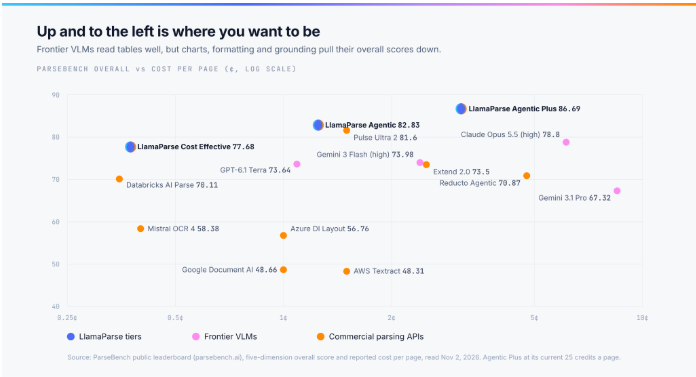
Speed widens the gap. On OpenDocRouter, where OCRia-1 is also available as a standalone model, a typical page takes 2.2 seconds against 11.2 for Opus 5.5 and 13.5 for Gemini 4 Argon. On OpenDocRouter's own ParseBench run, OCRia-1 scored 84.67 at $13.04 per 1,000 pages and Opus 5.5 scored 84.27 at $48.82. Same accuracy, about a quarter of the price. We made the longer version of this argument in LLM APIs are not complete document parsers.
Open-Weight Models Worth Self-Hosting
Most of the ranking pages for this keyword cover only open models. They're a reasonable choice when documents can't leave your network, as long as you account for what self-hosting costs, which includes GPUs, serving, monitoring, and the gaps below. LlamaParse itself can also be deployed in your own VPC or data center when that's the constraint.
| Model | Size and license | ParseBench overall / tables | Notes |
|---|---|---|---|
| LightOnOCR-3 | 4B, Apache 2.0 | 75.60 / 83.63 | Released October 2026, about 3.36 pages/s on one H100 (LightOn-measured) |
| Chandra OCR 2 | ~5B, modified OpenRAIL | 70.59 / 89.20 | Closest open rival on tables; the license has a revenue cap |
| MinerU 2.5-Pro | 1.2B | 69.27 / 77.61 | Best visual grounding of the open set (74.24) |
| dots.mocr | ~3B, MIT | 54.18 / 85.03 | Strong tables, 0.84 on charts |
| PaddleOCR-VL-1.6 | 0.9B, Apache 2.0 | 50.90 / 67.79 | OmniDocBench leader at 96.3, 109 languages |
| DeepSeek-OCR 2 | ~3B, Apache 2.0 | 41.2 / 61.7 | Built for token compression, not table fidelity |
| Tesseract | Apache 2.0 | Not ranked | 100+ languages on CPU, no table structure |
Choosing a document parsing model to self-host is an operations decision as much as an accuracy one. In the launch run, where every model was evaluated on the same harness at the same rendering, OCRia-1's 91.5 on ParseBench tables led every open model by at least six points except Chandra (89.2); dots.mocr scored 85.2 and LightOnOCR-3 82.5. dots.mocr and DeepSeek-OCR 2 also score near zero on charts, a failure that tends to surface in production rather than on a demo page. If open source is a hard requirement, our open-source OCR tools list covers the field more broadly.
For Table-Heavy Documents, the Specialized Model Is Now Also the Cheap One
A year ago, getting complex tables right meant paying frontier-VLM prices and waiting frontier-VLM latencies. A 4B model trained on the tables and charts those models still miss has changed that math. The best OCR models now come down to which tier fits your pages, and the right one depends on what's on them:
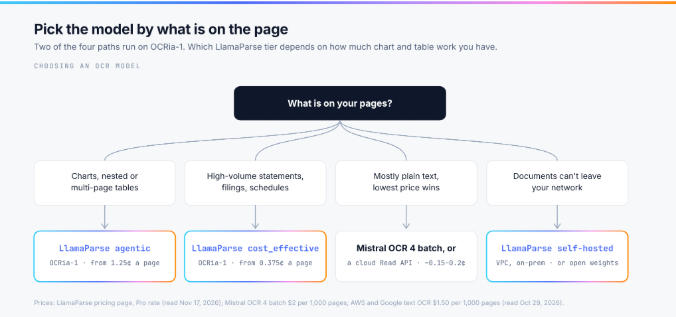
High-volume statements, filings, and schedules belong on cost_effective from 0.375¢ a page. Chart-heavy reports and tables with many levels of nesting are what agentic is for. For finance-specific tooling, see best OCR software for finance. LlamaParse runs OCRia-1 on both tiers today. Its free plan comes with 10,000 credits every month, about 3,333 Cost Effective pages, so you can open a free account and run a real batch of statements through it before spending anything.