Income verification sits at the center of some of the most consequential decisions financial services companies make. Lending decisions, rental approvals, mortgage underwriting, benefits eligibility determinations. Getting it is important, otherwise it creates credit risk, fraud exposure, or regulatory liability.
The problem is that income is genuinely hard to verify at scale. A salaried employee at a large company is the easy case. Their employer is in a payroll system, their pay stubs follow a standard format, and their W-2 lands on schedule every January. The hard cases are everyone else: self-employed individuals, gig economy workers, freelancers, contractors, small business owners, people with multiple income sources, recent job changers, and anyone whose income does not fit the traditional employment model.
The gig economy alone represents tens of millions of workers in the US, and that number is growing. Add the self-employed, the contract workers, and the multi-income households and you are describing a substantial portion of the population that needs financial services but whose income is documented in PDFs, bank statements, tax returns, and manually generated invoices rather than in a payroll API.
This article covers how income verification APIs work, where the document processing layer determines whether the whole system holds up in production, and how to build a verification workflow that handles the full spectrum of income types accurately.
What Income Verification Actually Requires
Income verification is the process of confirming that a person or business earns what they claim to earn, using documentary or data evidence that can be independently assessed. The verification process has three components: data collection, validation, and decision support.
Data collection means getting the income data into the system in a format that can be processed. For a salaried employee this might mean connecting to a payroll provider via API. For a self-employed individual it means processing a tax return or a set of bank statements. For a gig worker it means extracting earnings summaries from platform-specific documents. The data collection method depends entirely on the income type.
Validation means checking that the data is internally consistent, that the documents are genuine, and that the income figures match what the applicant claimed. A pay stub that shows a gross monthly income of $8,000 but a year-to-date total that does not divide cleanly by the number of pay periods is worth flagging. A tax return where the reported income is inconsistent with the bank account deposits shown in supporting statements warrants closer review.
Decision support means structuring the verified income data in a way that downstream systems can use to make informed decisions. A lender's underwriting system does not need a PDF. It needs a structured record with verified gross income, net income, income type, employment status, and the confidence level of the verification. That structured output is what an income verification API should deliver.
The Income Verification API Landscape
There are several categories of income verification solution, each with a different approach, different coverage, and different limitations. Understanding the landscape is important because no single approach covers every income type well.
| Approach | Best For | Limitations | Document Processing Required |
|---|---|---|---|
| Payroll API (Argyle, Pinwheel) | W-2 employees at large employers | No coverage for self-employed, gig, or small employers | Minimal |
| Bank account data (open banking) | Broad income pattern analysis | Does not verify income source or document details | None |
| Manual document review | Any income type | Slow, expensive, inconsistent, does not scale | Full manual review |
| Document extraction API (LlamaParse) | Any income type, any document format | Requires structured downstream logic | Automated, high-accuracy extraction |
| Hybrid: payroll API + document extraction | Broad coverage, high accuracy | More complex integration | Automated for document cases |
Payroll API Connections
Payroll connectivity providers like Argyle and Pinwheel connect directly to payroll systems and HR platforms to retrieve income data programmatically. When a user grants permission, the API pulls their employment status, pay frequency, gross income, and pay history directly from the source. No document submission required.
This is the cleanest approach for salaried employees at employers who are in the payroll network. It is fast, accurate, and eliminates document handling entirely. The limitation is coverage. Payroll networks cover large and mid-size employers reasonably well. They have much weaker coverage for small employers, self-employed individuals, contractors, and anyone whose income comes from platforms that are not in the network. For a lender or landlord trying to verify income across a diverse applicant pool, payroll connectivity alone leaves a significant gap.
Bank Account Data
Open banking APIs provide access to bank account transaction history, which can be analyzed to infer income patterns. Regular deposits at consistent intervals suggest employment income. Irregular but substantial deposits suggest self-employment or contract income. Bank account data has broad coverage because almost everyone has a bank account, regardless of employment type.
The limitation is that bank account data alone does not verify income source or income documentation. A pattern of deposits is evidence of cash flow, not verified income. A lender making a credit decision needs to know not just that money is coming in but where it is coming from, what type of income it represents, and whether it is stable. Bank account data answers the first question but not the second or third. It is most useful as a complement to document-based verification rather than a replacement for it.
Manual Document Review
Manual document review is still the default for many income verification workflows, particularly for complex income types. An analyst receives pay stubs, tax returns, bank statements, or employment letters, reviews them, extracts the relevant figures, checks for consistency, and produces a verification decision.
The problem with manual document review is that it does not scale and it is not consistent. Processing time is measured in days. Cost scales linearly with volume. Analyst quality varies. When verification backlogs build up, approval times stretch and applicant experience degrades. For any organization processing income verifications at meaningful volume, manual document review is a bottleneck that limits growth.
Document Extraction APIs
Document extraction APIs automate the manual document review step by parsing income documents and returning structured data. This is the category where LlamaParse operates, and it is the layer that determines whether an income verification workflow actually holds up in production.
The value of a document extraction API is that it handles income documentation for the full spectrum of income types, not just the ones that have payroll API coverage. Pay stubs, W-2 forms, 1099s, tax returns, bank statements, employment letters, platform earnings summaries, and self-generated income statements all contain income data. A document extraction API reads them all, extracts the relevant fields, and returns structured data that downstream verification logic can process.
The Document Processing Problem in Income Verification
The document processing layer is where income verification implementations most commonly run into trouble in production. The pattern is consistent: the system works well in testing on clean, standard documents and then degrades when real applicant submissions arrive.
Real income documents are messy since pay stubs come from dozens of different payroll software vendors, each with a different layout and different field labels. Tax returns are structured but dense, with income figures distributed across multiple schedules in ways that require understanding the form structure to extract correctly. Gig economy earnings summaries from platforms like Uber, DoorDash, or Upwork each have proprietary formats that change periodically. Bank statements from different financial institutions have completely different layouts, table structures, and account summary formats.
Self-employed income documentation is the hardest case when a sole proprietor might submit a combination of a Schedule C from their tax return, three months of bank statements, and a client invoice showing recurring engagements. Extracting a consistent annual income figure from those three document types requires understanding what each document contains, where the relevant income fields are, how to handle the relationship between gross and net figures, and how to reconcile numbers across documents. A simple OCR pipeline does not do this. A document understanding system does.
Why Traditional Extraction Falls Short
Traditional document extraction tools approach income documents as text extraction problems. They run optical character recognition, return raw text, and rely on downstream logic to figure out what the text means. This works on simple, structured documents with consistent layouts. It breaks on anything more complex.
A pay stub where the gross income figure appears in a table next to a deductions column gets misread because the spatial relationships between columns are lost in flat text extraction. A tax return where line 1a and line 1b of Schedule 1 both contain income figures gets garbled because the form structure is not preserved. A bank statement where income deposits are interleaved with expense transactions requires understanding which transactions represent income, which requires semantic understanding of transaction descriptions, not just character recognition.
How LlamaParse Handles Income Documents
LlamaParse approaches income document processing differently from traditional extraction pipelines. Rather than treating every document as a flat text extraction problem, it uses agentic document parsing to understand document structure and route different content types to the appropriate models.
For a pay stub, this means layout-aware computer vision detects the table structure, identifies column relationships, and preserves the spatial context that distinguishes gross pay from net pay from year-to-date totals. For a tax return, it means understanding the form structure well enough to locate income figures on the correct lines and schedules rather than returning all numbers as undifferentiated text. For a bank statement, it means extracting the structured transaction table with amounts, dates, and descriptions intact so downstream logic can classify transactions by income type.
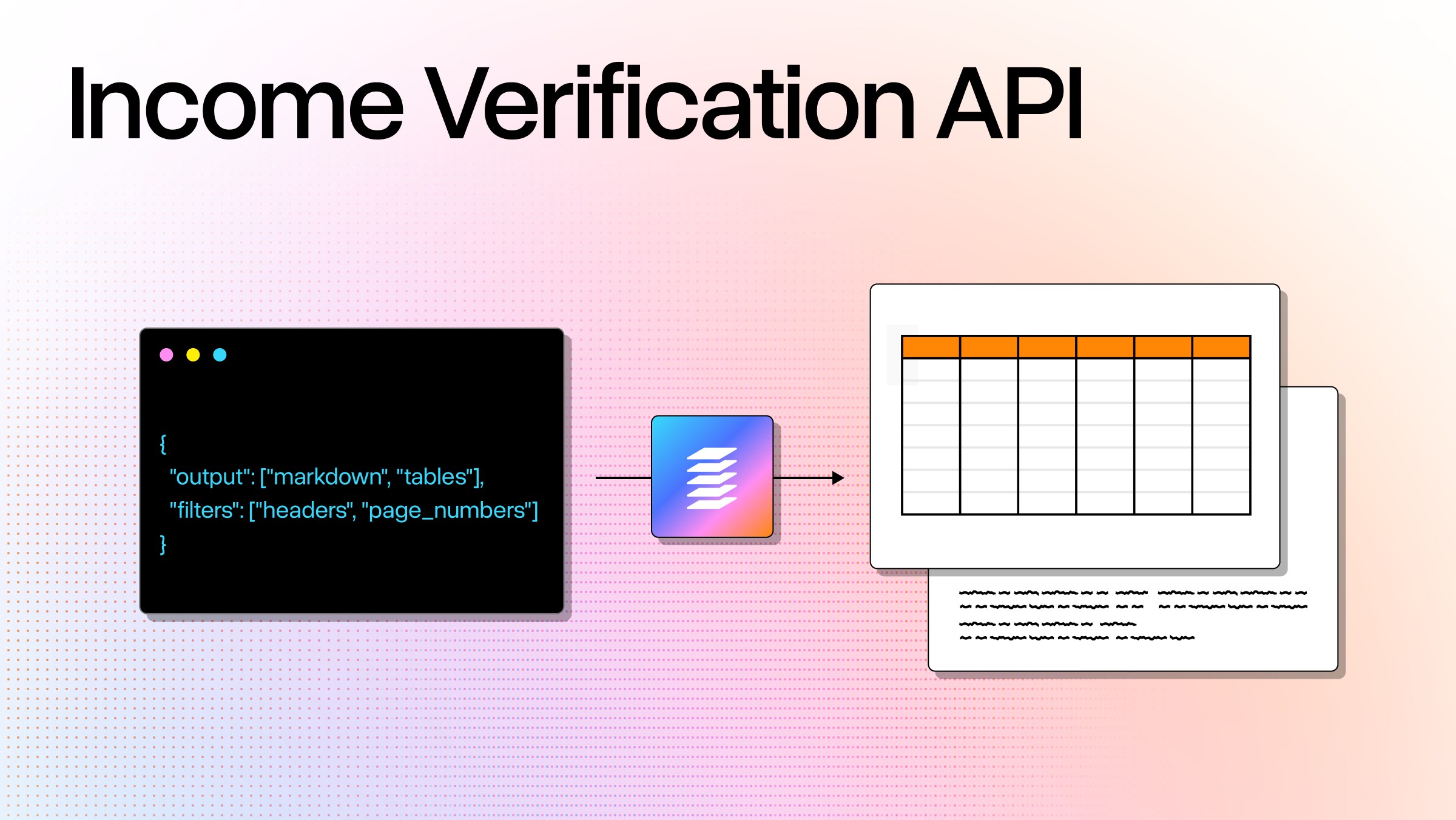
Multiple validation loops check extraction outputs before they are returned. Confidence scores are surfaced at the field level, so the system knows which extractions it is certain about and which should be flagged for review. The output is structured data in JSON or another machine-readable format, not raw text that requires further parsing.
For income verification specifically, this means the relevant fields come out correctly labeled and structured: gross monthly income, net income, pay frequency, employer name, pay period dates, year-to-date totals. Downstream verification logic receives a structured record it can work with rather than raw document content it needs to interpret.
Income Verification for the Gig Economy
Gig economy income verification deserves specific attention because it is one of the fastest-growing income categories and one of the hardest to verify with traditional approaches.
A full-time Uber driver, DoorDash courier, or Upwork freelancer has a legitimate income, often a substantial one, but it does not appear in a payroll system, does not generate a W-2, and does not have a consistent pay stub format. Their income documentation consists of platform-specific earnings summaries, 1099-NEC forms during tax season, and bank statements showing irregular deposit patterns that reflect variable earnings.
Verifying this income requires processing documents that are structurally different from standard employment documentation. An Uber earnings summary has a different layout than a DoorDash earnings statement. Both look different from an Upwork earnings report. The income figures need to be extracted from each format correctly, annualized appropriately given the variable nature of gig income, and structured in a way that allows comparison with the applicant's claimed income.
Payroll API solutions do not cover this. Most gig platforms are not in payroll networks. Open banking data shows the deposit pattern but does not confirm the income source. Manual document review works but does not scale. Document extraction via LlamaParse handles gig economy income verification because it processes each document format as it arrives, extracts the relevant income fields regardless of layout, and returns structured data that verification logic can work with.
The annualization question is worth addressing specifically. Gig income is often seasonal or variable. A food delivery driver earns more in winter months than summer. A freelancer may have had an unusually strong quarter that does not represent their typical income. Accurate income verification for gig workers requires either a full year of earnings data or a methodology for normalizing variable income that is documented and defensible. The document extraction layer needs to preserve enough context about the time periods covered by the documents that downstream logic can make this calculation correctly.
Building an Income Verification API Integration
Building a robust income verification API integration requires thinking about the full pipeline: document collection, extraction, validation, and decision output. Each component has design choices that affect accuracy, speed, and coverage.
Document Collection
The document collection interface determines what arrives in the extraction pipeline. A poorly designed collection flow leads to low-quality document submissions: photos taken at angles, screenshots with partial visibility, PDFs where the relevant pages are missing. Investing in the collection UX reduces the volume of extraction failures downstream.
Practical design principles:
- Give applicants clear instructions about what documents are required and what quality is needed. Provide real-time feedback if a submitted document looks unreadable before it enters the processing queue.
- Accept the formats applicants actually have, not just the formats that are easiest to process. Someone submitting a screenshot of their gig platform earnings summary from their phone is giving you genuine income data. A collection interface that rejects non-PDF submissions is creating friction without improving accuracy.
Extraction and Structured Output
The extraction layer converts manual document submissions into structured income data. The key design requirement is that the output schema is fixed and consistent regardless of the input document type. A pay stub and a tax return should both produce a record with the same fields, even though the source documents are completely different. Downstream verification logic should not need to know what document type it is working with.
LlamaParse supports this through configurable extraction schemas. You define the output structure you need, and the extraction pipeline populates it from whatever document is submitted. Gross monthly income, net income, income type, employer or client name, pay frequency, coverage period. The schema is consistent across document types. The extraction handles the format variability.
Confidence scores at the field level are important here. When a field could not be extracted with high confidence, the downstream logic needs to know that. A gross income figure with a confidence score of 0.6 should trigger a manual review request rather than flowing straight through to a credit decision. Field-level confidence scores make this routing logic straightforward to implement.
Cross-Document Validation
For applicants submitting multiple documents, cross-document validation catches inconsistencies that single-document extraction misses. If an applicant submits both pay stubs and a bank account statement, the system can check whether the deposit amounts in the bank statement are consistent with the net pay figures on the pay stubs. If they are significantly inconsistent, that is worth flagging for review.
This kind of validation requires structured extraction from both document types. Raw text extraction from two different documents does not enable systematic comparison. Structured extraction that produces consistent field names and numeric values from both documents does.
Decision Output
The final output of an income verification API integration should be a structured verification record that downstream systems can act on directly. This means a decision or recommendation, not a pile of extracted data that the downstream system needs to interpret. Verified annual income, income type classification, confidence level, verification method, any flags or exceptions.
For lenders, this record feeds directly into underwriting logic. For landlords, it feeds into an application decision workflow. For benefits administrators, it feeds into eligibility determination. The verification API should be designed to produce output that integrates cleanly with these downstream use cases rather than requiring significant interpretation work at the integration point.
Fraud Detection in Document-Based Income Verification
Document-based income verification creates fraud exposure that payroll API connections do not. A payroll API returns data directly from an employer's system. A document submission can be altered.
The most common forms of income document fraud involve pay stub manipulation (changing the employer name, income figure, or dates on a genuine pay stub template), fabricated documents (using widely available pay stub generators to create plausible-looking but entirely fake documents), and genuine documents from a different period (submitting an old pay stub from a previous job or a period of higher earnings).
Document extraction pipelines can catch some of these. Internal consistency checks flag documents where the numbers do not add up correctly. Cross-document validation catches cases where submitted documents do not agree with each other. Metadata analysis identifies documents where the creation date does not match the purported pay period. Pattern recognition flags documents that match known fraudulent templates.
LlamaParse surfaces the data and confidence scores that make these checks possible. An extracted pay stub where the year-to-date total is inconsistent with the gross pay and pay period gets flagged. A tax return where the line items do not sum correctly gets a low confidence score on the affected fields. A bank statement where the transaction history shows a different pattern than the claimed income figure is structurally flagged in the extraction output.
Complete fraud prevention requires more than document extraction. It requires combining document extraction with cross-reference checks against other data sources: employer verification, bank account ownership confirmation, tax transcript matching where available. Document extraction is the foundation that makes these checks possible by producing structured, machine-readable data from the source documents.
Accuracy and the Straight-Through Processing Threshold
The practical question for any income verification implementation is: what field-level accuracy is required to enable straight-through processing on standard cases?
The answer depends on the decision at stake. A rental application where the income threshold is a straightforward multiple of the rent has a lower accuracy requirement than a mortgage underwriting decision where a 2% error in reported income could affect debt-to-income ratio calculations. Define your accuracy threshold before you evaluate document extraction solutions, and measure performance against that threshold on your actual document types.
The fields that matter most for income verification are gross income, income frequency, and the coverage period of the document. Errors in these fields propagate directly into the verified income figure. Errors in less critical fields like employer address or document ID number have lower downstream impact. Weight your accuracy measurement accordingly.
LlamaParse includes 10,000 free credits on signup. That is enough to process a representative sample of your income document types, including the complex cases that determine whether your straight-through processing rate is viable, before committing to an integration. Testing on your real documents is the only evaluation that tells you whether the extraction accuracy meets your production threshold.
Conclusion
Income verification is a solved problem for the easy cases. Payroll APIs handle W-2 employees at large employers cleanly. The hard cases are where most income verification implementations run into trouble, and the hard cases are a growing share of the applicant population.
The gig economy, the self-employed, the multi-income household, the recent job changer, the contractor whose income comes from five different clients. These applicants have genuine income that is documented in PDFs, tax returns, platform earnings summaries, and bank statements rather than in a payroll system. Verifying that income accurately at scale requires a document processing layer that can handle format variability, extract structured data reliably, and surface confidence scores that enable informed routing decisions.
Building that layer on top of traditional OCR pipelines produces systems that work in testing and degrade in production. Building it on top of agentic document parsing produces systems that handle real-world document variability because they understand document structure rather than just reading text.
The document is the raw material. The verified income record is what downstream systems need. The gap between the two is where income verification implementations succeed or fail, and it is where the document processing layer determines the outcome.