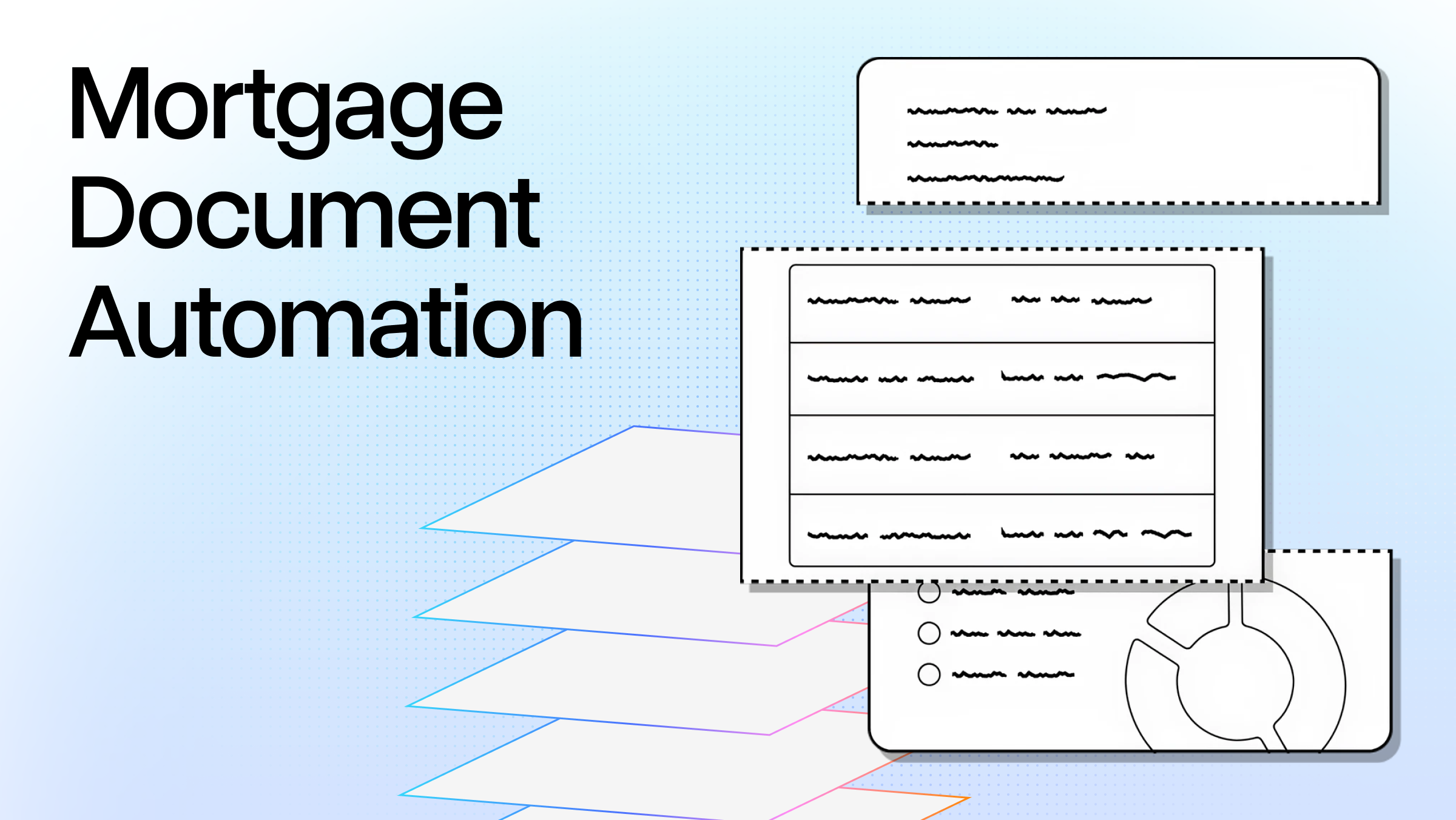
Mortgage lending operations rely heavily on document processing. From initial loan applications to underwriting, verification, and closing, lenders must handle a wide range of documents, including pay stubs, bank statements, tax returns, appraisal reports, and closing disclosures. These documents form the foundation of risk assessment, compliance validation, and loan approval decisions.
Despite the critical role of documentation, mortgage workflows in many organizations still rely on manual processing. Teams spend significant time classifying documents, extracting key data points, validating financial information, and ensuring compliance with regulatory requirements. As loan volumes increase, this manual approach introduces delays, operational inefficiencies, and increased risk of human error.
Mortgage document automation addresses these challenges by transforming document-heavy workflows into structured, machine-driven processes. Rather than treating documents as static files, automation systems convert them into structured data that can be validated, integrated, and used across loan origination systems.
Why Mortgage Document Processing Remains Complex
Mortgage document processing is fundamentally different from standard document workflows because of its variability, regulatory sensitivity, and dependency on structured data accuracy.
Loan files typically contain documents from multiple sources, each with different formats and layouts. A borrower’s financial profile may include bank statements from different institutions, tax forms from multiple years, and employment documents with varying structures. These documents often contain tables, multi-column layouts, and nested financial data that cannot be reliably interpreted through simple text extraction.
Regulatory requirements further increase complexity. Mortgage lenders must maintain audit trails, ensure data consistency across documents, and validate extracted information against underwriting rules. Errors in document processing can lead to compliance risks, loan delays, or incorrect credit decisions.
Traditional approaches rely on manual review or template-based systems. Manual processing is time-intensive and prone to inconsistency, while template-based extraction systems struggle when document formats change. As document variability increases, these approaches become difficult to scale.
This operational reality highlights the need for intelligent document processing systems that can handle variability, preserve structure, and enforce validation logic within mortgage workflows.
The Role of Intelligent Document Processing in Mortgage Automation
Mortgage document automation is built on intelligent document processing, which combines machine learning, computer vision, and structured parsing to convert documents into usable data.
Unlike basic OCR systems that focus on text recognition, intelligent document processing incorporates layout awareness and structural interpretation. Documents are analyzed not only for text content but also for how that content is organized. Tables, headers, key-value pairs, and multi-page structures are reconstructed into schema-aligned outputs.
This approach enables systems to extract meaningful data points such as income figures, transaction histories, loan terms, and borrower information while preserving relationships between fields. For example, values within a bank statement table must remain associated with the correct dates and transaction descriptions. Without structural understanding, extracted data can lose context and become unreliable.
Validation logic is another critical component. Extracted data must be checked against business rules, underwriting criteria, and external data sources. Confidence scoring mechanisms help determine whether extracted values are reliable or require human review. Human-in-the-loop workflows ensure that edge cases and ambiguous documents are handled appropriately.
By combining structured parsing with validation workflows, mortgage document automation systems move beyond text extraction and enable reliable, production-grade document processing.
Mortgage Document Automation Workflow
A production-ready mortgage document automation workflow consists of several interconnected stages that transform raw documents into validated, structured data.
Document Ingestion and Classification
The workflow begins with document ingestion. Mortgage documents are received from borrowers, brokers, or third-party systems through upload portals, email attachments, or document management systems. These inputs include scanned documents, PDFs, and image files captured through mobile devices.
Once ingested, documents must be classified to determine their type. Loan files contain a mixture of document categories such as bank statements, pay stubs, tax returns, and closing documents. Accurate classification is essential because each document type requires different extraction logic and validation rules.
Machine learning models analyze document layout and content patterns to classify documents automatically. This reduces manual sorting and ensures that documents enter the correct processing workflows.
Data Extraction and Structured Parsing
After classification, the system extracts relevant data points from each document. This stage goes beyond basic OCR by incorporating layout-aware parsing and structural reconstruction.
For example, a bank statement contains transaction tables with dates, descriptions, debit amounts, and credit amounts. The extraction process must preserve these relationships rather than treating values as independent text elements. Structured parsing ensures that extracted data aligns with predefined schemas and maintains logical consistency. This stage is critical because incorrect extraction can propagate errors into downstream underwriting and decision-making systems.
Validation and Cross-Document Matching
Extraction alone does not guarantee data accuracy. Mortgage workflows require validation across multiple documents to ensure consistency and compliance.
For example, income reported in a pay stub must align with deposits in a bank statement. Loan amounts must match across application forms and closing disclosures. Tax data must be consistent with reported income figures.
Validation workflows apply business rules, perform cross-document matching, and identify discrepancies. Systems may flag inconsistencies for review or automatically resolve them based on predefined logic. This stage reduces risk and ensures that data used for underwriting decisions is accurate and consistent.
Human-in-the-Loop Review
Despite automation, certain documents require human review. Low-confidence extractions, unclear scans, or unusual document formats can introduce ambiguity.
Human-in-the-loop workflows allow reviewers to validate extracted data, correct errors, and approve documents before they move forward in the pipeline. This ensures accuracy while maintaining operational efficiency. The objective is not to eliminate human involvement but to focus it on exception handling rather than routine processing.
Integration with Loan Origination Systems
Once validated, structured data is integrated into loan origination systems and downstream workflows. This integration enables automated decision-making, faster underwriting processes, and improved borrower experience.
Structured outputs can also be used for compliance reporting, audit trails, and analytics. By transforming documents into structured data, mortgage automation systems enable end-to-end digital workflows.
Challenges in Mortgage Document Automation
Even with advanced automation, mortgage document processing presents several persistent challenges.
- Document variability remains a primary concern. Different lenders, employers, and financial institutions generate documents with varying layouts and formats. Systems must adapt to new document structures without requiring constant rule updates.
- Data accuracy is another critical factor. Financial decisions depend on precise data extraction and validation. Even minor errors can lead to incorrect loan assessments or compliance issues.
- Regulatory requirements add another layer of complexity. Mortgage workflows must maintain transparency, auditability, and compliance with industry standards. Systems must provide traceability for extracted data and validation decisions.
- Finally, scalability is essential. As loan volumes increase, automation systems must handle higher document throughput without compromising accuracy or performance.
These challenges reinforce the need for robust, production-ready document processing systems that combine machine learning with structured validation workflows.
Mortgage Document Automation with LlamaParse
LlamaParse provides a platform for implementing mortgage document automation workflows that combine layout-aware parsing, structured extraction, and validation orchestration.
Within LlamaParse, documents are processed using layout-aware analysis that identifies structural elements such as tables, headers, and key-value fields. This approach ensures that extracted data preserves relationships between fields rather than being reduced to flat text.
Structured parsing enables schema-aligned outputs that can be directly integrated into loan origination systems. Mortgage-specific data points such as income values, transaction histories, and loan details can be extracted in a consistent and reliable format.
LlamaParse also supports configuration-driven workflows. Instead of building document pipelines from scratch, organizations can define extraction behavior, validation rules, and schema mappings through configurable settings. This allows teams to adapt to document variability without redesigning core processing logic.
Because LlamaParse operates within a broader document processing environment, it supports integration with downstream systems, validation layers, and human review workflows. Confidence scoring and structured outputs enable organizations to maintain high data quality while scaling document processing operations.
Best Practices for Implementing Mortgage Document Automation
Successful mortgage document automation requires careful system design and operational alignment.
Organizations should begin by defining document categories and identifying key data points required for underwriting and compliance. Clear schema definitions improve extraction accuracy and reduce ambiguity.
Validation logic should be integrated early in the workflow. Cross-document consistency checks, arithmetic validation, and rule-based verification help ensure data reliability before integration into operational systems.
Human-in-the-loop workflows should be incorporated to handle edge cases and maintain data quality. Automation should reduce manual effort, not eliminate oversight.
Finally, systems should be designed for adaptability. Mortgage document formats evolve, and automation systems must accommodate new layouts without extensive reconfiguration.
Conclusion
Mortgage document automation transforms document-heavy lending workflows into structured, reliable processes that support faster loan processing and improved operational efficiency.
By combining machine learning, layout-aware parsing, and validation workflows, organizations can extract meaningful data from complex mortgage documents while maintaining accuracy and compliance. This shift reduces manual effort, minimizes human error, and enables scalable document processing.
LlamaParse provides a platform for implementing mortgage document automation through structured parsing, validation orchestration, and integration-ready outputs. By enabling configuration-driven workflows rather than requiring pipelines to be built from scratch, LlamaParse allows organizations to operationalize document processing quickly while maintaining production-grade reliability.