Run a scanned financial statement through a vision model and ask it for the table. What comes back is markdown: clean pipes, aligned columns, headers in the right place, every figure formatted consistently. It looks like the best output you've ever gotten out of a document.
Then you count the rows. The page had forty. You have thirty-eight.
There's no gap where the missing rows were and nothing else in the output that distinguishes it from a perfect transcription. Tesseract would never have done this to you. Faced with a page it couldn't read, Tesseract would have handed back visibly broken garbage that a downstream validator would have caught in milliseconds.
LLM OCR is the use of large language models to turn document images into machine-readable text and structured data. Instead of matching glyph shapes against a character set, the model reads a page the way it reads any other input, by predicting the most likely next token.
That change did lower the error rate on hard documents, and the gains are real. It also changed what an error looks like, and twenty years of OCR tooling, all those confidence thresholds and regex validators and character-error dashboards, were built to catch the old kind.
The Term "LLM OCR" Covers Three Very Different Architectures
Vendors apply the term to at least three things that fail in completely different ways. Working out which one you're being sold is the first real decision you make.
OCR-then-LLM post-correction. A conventional OCR engine does the character recognition, and a language model cleans up its output. The model never sees the page. It sees a string, and it repairs whatever looks wrong linguistically. This is what most "we added AI to our OCR" products mean, and it's the architecture behind nearly every vendor explainer of LLM OCR you'll find. It's also the one most likely to launder an error into fluent prose, because a model with no access to the pixels has nothing to check itself against. Hand it a correctly-read but unusual part number and it will cheerfully normalize the thing into a common one.
VLM-native transcription. Vision language models take the page image directly and emit text. There's no separate recognition step to inspect, no intermediate glyph hypotheses, no per-character score to threshold on. The model looks, and it writes.
Agentic orchestration. Segment the page first, route each component to whichever model reads it best, validate the result, reconcile the pieces back together.
The first two are models. The third is a system built around models, and the gap between those is where most of the production pain in this field actually lives.
Why a Language Model Invents Text That Tesseract Would Have Garbled
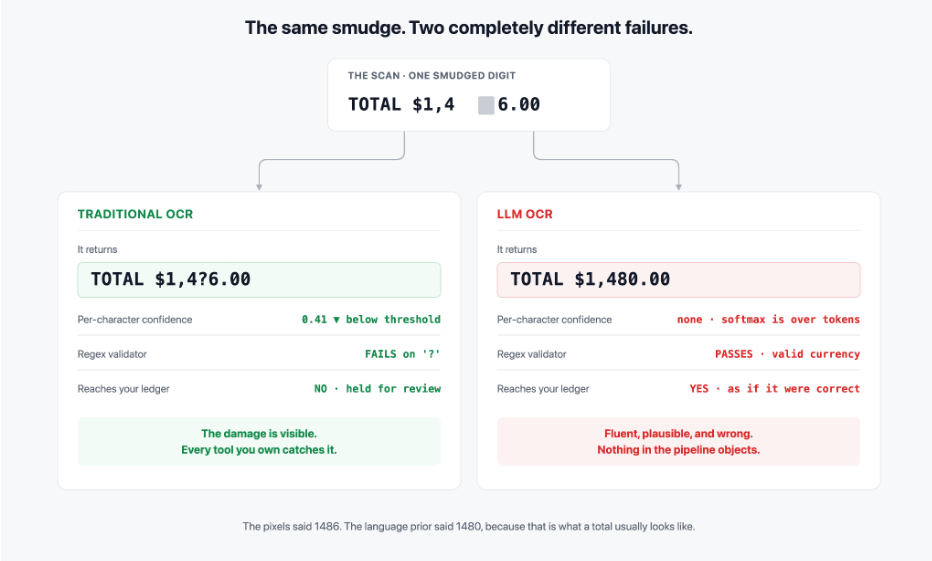
A traditional OCR engine performs constrained pattern matching. It scores glyph hypotheses against pixels, picks the winner, and returns a confidence number for every character it emits. When the ink is smudged, the scores fall, confidence falls with them, and you get either garbled output or an explicit flag. The engine's uncertainty is visible because uncertainty is part of its output format.
A decoder works differently. It samples over a vocabulary, conditioned on the image and on every token it has already produced. When the visual evidence is weak, that evidence gets outweighed by the language prior, and the model emits what is most probable as text rather than what is best supported by the image. It fills the gap with the most plausible thing.
That's why the errors read so well. Fluency is the objective the model was trained against, and there's no competing objective that rewards it for admitting it couldn't see something.
The practical consequence catches a lot of teams off guard: there is no per-character confidence to threshold on, because the softmax is over tokens, not glyphs. Token logprobs are available, and they're tempting, and they measure the wrong quantity. A high logprob on $1,480.00 tells you the model found that string linguistically unsurprising. It tells you nothing about whether those pixels said 1480.
Silent substitution
The model swaps a real-but-unusual value for a common one. Dates get coerced into whichever format dominated training. An account number with an odd check digit drifts toward a familiar pattern.
This lands hardest on precisely the content you care about. Account numbers, invoice totals, NDC and ICD-10 codes, part numbers, and serials are high-entropy strings, which means the language prior over them is weak and close to uniform. The prior is least informative exactly where the model leans on it hardest. Prose is the opposite case, where the prior is strong and the model rarely slips, which is why a demo on a page of body text always looks flawless and tells you nothing about your invoices.
Omission and repetition loops
Long dense tables get truncated. The model produces a well-formed table that is simply shorter than the page, like the forty-row statement above. Nothing marks the missing rows, because the output format has no way to represent "I stopped early."
Dense repetitive content also drives decoders into degenerate cycles, where a row or an n-gram repeats until something cuts it off. This happens often enough that olmOCR-Bench bakes explicit penalties for hallucinated and repeated n-grams into its scoring, and our review of that benchmark covers what it does and doesn't catch. Traditional text extraction has no analogue for either failure. A Tesseract pipeline doesn't decide to stop reading, and it doesn't get stuck in a loop.
Your OCR Metrics Are Measuring the Wrong Thing Now
Character error rate and word error rate assume legible degradation, and they average across a page. That assumption held when errors were roughly uniform noise scattered over the text. Under LLM OCR, errors concentrate in the high-entropy fields, and the average washes them out. A page can post 99% character accuracy and still be worthless, because the 1% was the total.
The metric that survives is field-level accuracy against evidence, meaning every extracted value carries a pointer back to the region of the page it came from, so a reviewer can check it. Page-level string similarity can't tell you the difference between a document read correctly and a document read fluently.
Benchmarks are running into the same wall. Our writeup on OmniDocBench saturation puts GLM-OCR at 94.6% with several models now clustered above 94%, on a dataset of 1,355 pages spanning nine document types. When the leaders sit within a point of each other, the score has stopped discriminating between them, and the few percent still on the table is where your production documents live. The same writeup notes that the benchmark penalizes semantically correct output over punctuation and line-break differences, while leaving out financial presentations, legal filings, insurance claims, and handwriting more or less entirely. Those omissions describe most of the document parsing work anyone is actually paid to do.
That gap is what ParseBench was built to close. It's our benchmark, so weigh the leaderboard accordingly, but the methodology is the part worth borrowing. It scores roughly 2,000 human-verified enterprise pages, insurance filings and financial reports and government documents rather than arXiv preprints, against more than 167,000 test rules instead of string similarity. OmniDocBench, the most diverse option before it, drew 6% of its pages from enterprise content. One of ParseBench's five dimensions is content faithfulness, testing directly for omissions, hallucinations, and reading-order violations, and the best methods reach about 90% there. Even at the top of the field, an agent hits dropped or invented content on roughly one page in ten. Visual grounding is a scored dimension too, which turns the evidence-tracing property above into something you can compare vendors on.
A saturated leaderboard plus an output format that can't be falsified is how a competent team ships a pipeline that is quietly wrong on complex layouts and handwritten text, and doesn't find out for a quarter.
The Bill Nobody Puts in the Demo
The cost curve has a different shape than the one you're used to budgeting for. Traditional OCR is roughly flat per page, CPU-bound, and predictable. A VLM tokenizes the page image, so cost scales with resolution and visual density. Your most expensive pages are high-DPI scans of dense documents, which is the exact category you adopted an LLM to handle in the first place. The pricing surprise arrives with the documents that justified the project.
Latency moves the same direction, from milliseconds to seconds per page, with rate limits sitting on top of it once you're processing at volume.
Then there's non-determinism. The same page and the same prompt can produce two different transcriptions. Temperature zero narrows the spread without closing it, since batching and hardware-level scheduling still introduce variance. In a regulated workflow that matters, because explaining to an auditor why a figure changed between two runs of the same document is not a conversation with a good ending.
All of this argues against a raw model called in a for loop and shipped as a pipeline, which is the case we made in more depth in LLM APIs Are Not Complete Document Parsers. The models themselves are genuinely good. The system you wrap around them is where the remaining work lives.
What Has to Sit Around the Model Before Any of This Ships
Everything above is a structural property of the model, which is why prompt engineering never really touches it. The fix has to live in the system around the model, doing the jobs the model can't do for itself. That's the design LlamaParse is built on, and it's why agentic OCR ends up being a different category rather than a better prompt.
Segment before you read. Layout-aware computer vision detects structure and splits the page into components first, so a table is processed as a table instead of a stretch of text a decoder can wander out of halfway through. Reading order becomes a determination rather than a guess.
Route each element. Agentic orchestration hands each component to whatever reads it best, a dedicated OCR model, an LLM, or a VLM, rather than forcing one model to do every job on the page. A cost optimizer picks the efficient model per task, so you aren't paying frontier-VLM rates to read a paragraph of clean body text. That routing is also what makes the cost curve in the previous section tractable.
Validate in loops. Multiple validation passes, with correction tuned for known hallucination patterns, are the only real answer to the failure modes in this article. A single forward pass has no mechanism for catching itself.
Make the output falsifiable. Citations and bounding boxes tie every value back to the pixels it came from, and confidence scores tell a reviewer where to look. This is what converts human-in-the-loop review from a rubber stamp into an actual control, and it's the thing raw model output structurally cannot give you. In LlamaParse the page number on each parsed page is the provenance anchor; per-field confidence comes from LlamaExtract, which is the right tool when you need to gate on it:
html
import time
from llama_cloud import LlamaCloud
client = LlamaCloud()
uploaded = client.files.create(file="q3-financial-statement.pdf", purpose="extract")
job = client.extract.create(
    file_input=uploaded.id,
    configuration={
        "data_schema": statement_schema,
        "extraction_target": "per_doc",
        "tier": "agentic",
        "confidence_scores": True,
        "cite_sources": True,      # page + bounding box per field, now a plain flag
        "parse_tier": "agentic",   # agentic parse produces tighter bounding boxes
    },
)
# Poll until the job lands, asking for the per-field confidence and citation metadata.
while job.status not in ("COMPLETED", "FAILED", "CANCELLED"):
    time.sleep(2)
    job = client.extract.get(job.id, expand=["extract_metadata"])
field_meta = job.extract_metadata.field_metadata.document_metadata
# Route only the genuinely uncertain fields to a human, with the pixels attached.
# The scores are uncalibrated, so 0.85 is a threshold you tune, not a probability.
# meta["citation"] is a list of hits, each with a page and bounding boxes.
for field, meta in field_meta.items():
    if meta["confidence"] < 0.85:
        queue_for_review(field, job.extract_result[field], meta["citation"])
That loop is the difference between a pipeline that fails loudly and one that fails silently. The difference between parsing and extraction matters here, and picking the wrong one is a common way to end up without the confidence signal you needed.
LlamaParse replaces the OCR pipeline rather than sitting downstream of one. There's no Tesseract pass feeding it. For financial statements and bank statements, where a single transposed figure propagates into a reconciliation break, that architecture is the whole point, and it's why finance OCR tooling is where the accuracy gap shows up first. It's also what moves straight-through processing rates, since a system that can name its uncertain fields sends five documents to review instead of five hundred.
The Frontier Is Knowing When You're Wrong
Models cleared the "can it read this page" bar a while ago, and the leaderboards prove it by no longer being able to tell the leaders apart. The open problem now is whether a system can tell you when it's wrong, and show you where each value came from. That's a question about architecture, not about model quality, and it won't be solved by the next checkpoint.
The teams who get burned by LLM OCR are the ones who evaluated it on the documents it handles well. A page of clean body text will make any vision model look extraordinary. Your worst vendor's densest table will not.
So run the falsification test instead. Take the document your current pipeline gets confidently wrong, the one where the output looked fine and the number turned out not to be, and run it through LlamaParse with citations on. Then check the values against the boxes they came from. Every OCR demo can show you a page it reads well. The only one worth watching is the page it reads badly, and whether it tells you so.