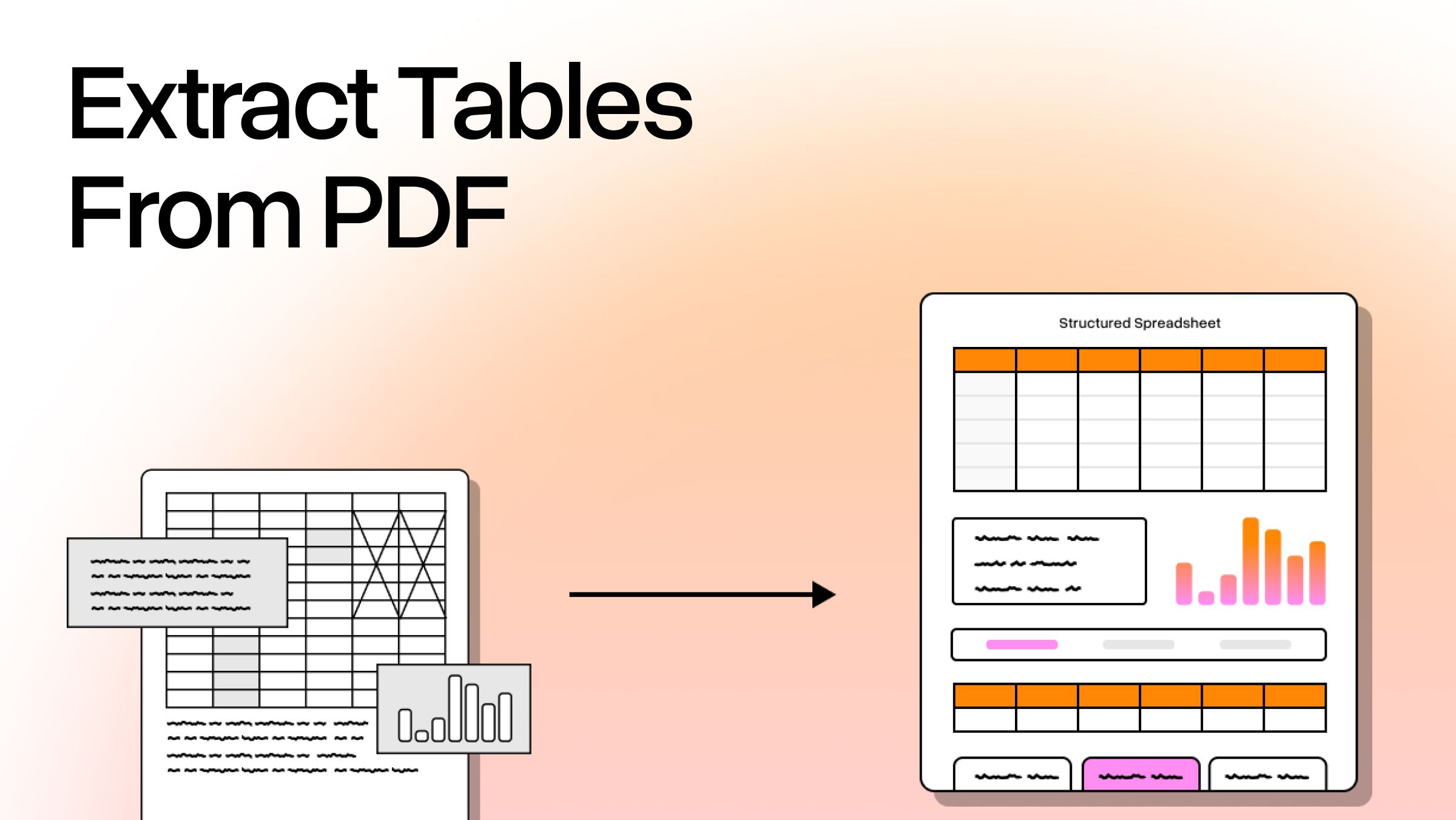
Tables are the hardest part of a PDF to process reliably. Invoices express their charges as line-item tables, bank statements record activity as transaction registers, and financial statements present figures across grouped columns. This disparity is exactly why the ability to extract tables from PDF documents accurately has become a foundational requirement for automation rather than a convenience.
The difficulty is that a PDF does not store a table as a table. In most documents the format records only characters and their coordinates on a page, with no explicit description of which values belong to which row, which cell sits under which header, or where one column ends and the next begins. A human reader reconstructs that structure instantly from visual cues such as alignment and spacing, but a system that reads the file directly sees a stream of positioned text with no inherent grid.
Extracting a table is therefore a matter of reconstructing the row-and-column relationships that give those characters meaning and producing output a downstream system can validate and act upon. This article examines what that requires, why conventional approaches break down on real documents, and how table extraction is engineered and validated with LlamaParse.
Why Extracting Tables from PDF Is Difficult
The core problem in table extraction is that visual structure and stored structure rarely correspond. A generated PDF stores text with positional coordinates, while a scanned PDF stores only an image, and neither records the logical grid that a reader perceives. Reconstructing that grid is where most extraction approaches fail. It is systematic, because the conditions that break naive extraction are present in the majority of documents an enterprise actually receives.
Structure Must Be Inferred, Not Merely Read
When a table has no embedded structural metadata, the boundaries between rows and columns have to be inferred from spatial arrangement. This inference is straightforward when a table has visible ruling lines and consistent spacing, but it degrades quickly under the variations that occur in practice.
Borderless tables rely on whitespace alone to separate columns, which forces a system to decide where a column ends purely from alignment. Multi-line cells, where a single description wraps across two or three lines, are easily misread as separate rows. A cell that is left empty, such as a withdrawal column on a deposit row, must be preserved as an empty position rather than silently collapsed, or every value after it shifts into the wrong column.
Each of these conditions requires the system to reason about layout rather than transcribe text, and a parser that flattens the page into a linear reading order loses the relationships permanently.
Real Documents Break Simple Assumptions
Beyond basic structure inference, production documents introduce complications that compound one another. Tables frequently span multiple pages, with a header appearing only on the first page and continuation rows carrying none, so the system must associate rows on a later page with a header it saw earlier. Merged and spanning cells, common in financial statements where a category header covers several columns, break the assumption that every row has the same number of cells. Nested tables, rotated landscape tables inside portrait documents, and multi-column layouts each impose their own reading-order challenges, and when the document is a scanned image the system must first recover the characters through recognition before it can reconstruct structure at all. These are not edge cases; they describe the ordinary variety of invoices, statements, and reports that arrive every day, which is why reliable table extraction has to be engineered rather than assumed.
Why Traditional Extraction Approaches Fall Short
Most organizations first attempt table extraction with one of a few conventional approaches, each of which encounters limits that become severe at production scale.
Flat Text Extraction Discards the Grid
The most basic approach extracts the raw text layer from a PDF and attempts to recover the table by splitting on whitespace or delimiters. This works on the cleanest documents and fails on everything else, because it treats a two-dimensional structure as a one-dimensional string. When a description wraps to a second line, when a column is right-aligned, or when spacing is inconsistent, the text stream no longer maps cleanly to rows and columns, and the recovered table misaligns.
More fundamentally, flat text extraction produces no explicit model of the table, so there is no representation in which a value is known to be the deposit on a specific dated row. The output is text that resembles a table to a human eye but carries none of the relationships a downstream system requires, which is the same limitation that separates capable document processing software from basic text extraction.
Template and Rule-Based Systems Are Fragile
A more sophisticated conventional approach defines positional templates or extraction rules for a specific document layout. Within the exact layout it was configured for, this approach can be precise.
The difficulty is that it depends on structural stability that enterprise documents do not provide. Vendors revise their invoice templates, banks change statement formats, and every newly onboarded counterparty introduces a layout the rules have never seen. Because the template encodes fixed positions rather than an understanding of structure, any deviation causes silent misalignment or outright failure, and each new format requires manual reconfiguration. The maintenance burden grows in direct proportion to the number of document sources, which is the opposite of what an automation program needs. This fragility is the recurring theme in evaluations of document parsing APIs, which differ substantially in how well they generalize beyond the layouts they were built for.
Recognition Without Structure Is Not Enough
A third assumption worth correcting is that optical character recognition alone solves the problem. Recognition converts pixels into characters, which is necessary for scanned documents, but it does not reconstruct the table: an engine can transcribe every number in a transaction table with perfect character accuracy while giving no indication of which number is a withdrawal, which is a deposit, and which is the running balance on a given row. Recognition is a prerequisite for image-based documents, but only the first stage — the operational value comes from the layout-aware parsing, schema-aligned extraction, and validation built on top of it, which is the distinction explored across analyses of the best OCR software.
How Production-Grade Table Extraction Works
A reliable table extraction system operates as a coordinated pipeline in which each stage reconstructs a layer of meaning the previous stage established. The stages are conceptual rather than strictly sequential, because modern systems increasingly interleave extraction and validation and, in more advanced implementations, revisit earlier stages when analysis reveals ambiguity.
Ingestion and Normalization
The pipeline begins by accepting documents from the channels through which they arrive — email, upload portals, scanning workflows, and third-party integrations — where some are digitally generated PDFs with an intact text layer and others are scanned images or photographs that vary widely in resolution and orientation. A production ingestion layer normalizes these inputs into a consistent representation before any table analysis begins, applying file conversion, orientation correction, and image normalization so that downstream models receive predictable inputs. Normalization matters specifically for tables because the same grid produces materially different results depending on scan quality and skew: a page rotated by a few degrees can cause column boundaries to drift, and a low-resolution scan can blur the whitespace that separates columns in a borderless table. Treating normalization as a core component rather than a preprocessing afterthought is therefore a prerequisite for reliability on real inputs.
Table Detection and Structural Reconstruction
Once a document is normalized, the system must locate the tables on the page and reconstruct their internal structure — the stage that most clearly separates capable table extraction from flat text handling. Layout-aware models, increasingly built on vision-language models that reason over visual and textual structure simultaneously, identify the region occupied by a table and then determine its grid: the number of columns, the row boundaries, the header row, and the association of every cell with its row and column. Rather than flattening the page, this reconstruction preserves the two-dimensional relationships, so that an empty withdrawal cell remains an empty position and a wrapped description remains a single cell. The quality of this stage governs everything downstream, because a value extracted into the wrong cell passes through the rest of the pipeline as confidently as a correct one, and in real documents it must contend with multi-page tables whose headers carry forward, merged cells that violate uniform row width, and borderless tables where the grid exists only in the alignment of the text — which is why layout-aware reconstruction rather than positional rules is what generalizes across formats.
Semantic Extraction and Schema Alignment
A reconstructed table is faithful to the document, but many workflows require specific fields extracted into a defined schema rather than a full transcription of the grid. Semantic extraction interprets the reconstructed table and maps its contents into a predefined structure that downstream systems can consume directly, which is where table extraction delivers its distinctive value: the output is aligned to the consuming system rather than a generic representation. A schema defines the fields to extract, their types, and their relationships, and the extraction model populates it by interpreting the parsed table. For a transaction register, the schema captures each row as a typed record with a date, a description, an optional withdrawal, an optional deposit, and a running balance, which removes the transformation logic otherwise required to convert a raw grid into usable records. This capability underpins operational use cases such as invoice data extraction and broader financial data extraction, where the same logical field must be located reliably across documents that format it differently.
Schema alignment also determines the granularity of extraction: a document-level target returns the full statement as one object containing a list of rows, while a row-level target returns one record per table row, which is often the more natural representation when each row will flow independently into a ledger or ERP system. Choosing this granularity is an operational lever rather than a cosmetic option, because it lets the output match the shape the consuming system expects without additional post-processing.
Validation, Confidence Scoring, and Human-in-the-Loop Review
Extraction alone does not guarantee correctness, and a system that stops at producing structured rows transfers the burden of verification to the teams that consume them. Production table extraction therefore integrates validation directly into the pipeline, and tabular data is uniquely well suited to it because tables usually contain internal arithmetic that can be checked. Type and format validation confirms that a date is a valid date and a monetary value is numeric; cross-field validation confirms internal consistency, such as verifying that each running balance equals the previous balance minus the withdrawal plus the deposit and that period totals equal the sum of the rows; and business-rule validation confirms consistency with external records, such as reconciling a statement against a general ledger.
This layered validation is what allows extracted tabular data to be trusted rather than merely produced, and it is the mechanism through which reliable OCR for accounts payable avoids passing unverified figures into approval workflows.
Confidence scoring accompanies validation and drives routing. Rather than returning every value with equal certainty, a capable system assigns a reliability measure to each value based on recognition quality, structural clarity, and model prediction strength, so that rows passing validation with high confidence proceed automatically while low-confidence rows or rows that fail a check are routed to human review. This is what makes human-in-the-loop review an architectural component rather than a fallback: the objective is not to review every document but to concentrate human attention on the specific rows where it is most valuable, and each correction made during review is recorded alongside the value that was originally extracted, which preserves an auditable history of every change and gives teams concrete evidence for refining schemas and extraction instructions on the document types that generate the most exceptions.
Extracting Tables from PDF with LlamaParse
LlamaParse approaches table extraction as intelligent document processing combined with structured parsing and validation orchestration, rather than as a standalone text-recognition tool. Within LlamaParse, document analysis begins with layout-aware parsing that identifies structural components such as tables, multi-column sections, headers, and key-value relationships, which ensures that extraction follows document structure rather than relying on character recognition alone. This structural fidelity is the foundation for reliable table extraction, because it preserves the row-and-column relationships that give tabular values their meaning. LlamaParse also includes a feature called Cost Optimizer, which lets organizations balance accuracy against cost. It routes text-dominant documents through an economical path, while reserving more thorough reconstruction for documents dense with tables and mixed layouts..
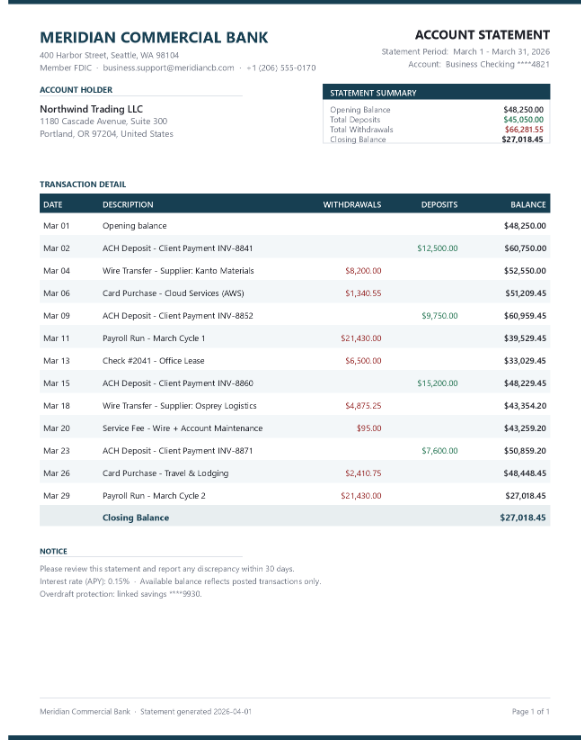
To demonstrate the workflow on a genuinely table-centric document, consider the bank statement shown below. Its core is a transaction register with dated rows, separate withdrawal and deposit columns, and a running balance, along with a summary block of period totals. This is a representative example of the tabular structure that automation depends on and that flat extraction handles poorly.
Parsing the Document into a Structured Table
A minimal parsing workflow illustrates how the document is converted into a faithful structural representation. The current LlamaParse SDK is installed as the llama-cloud package, and the API key is provided through the LLAMA_CLOUD_API_KEY environment variable.
html
from llama_cloud import LlamaCloud

client = LlamaCloud()  # reads LLAMA_CLOUD_API_KEY from the environment

# Upload the document, then parse it into structured content
file = client.files.create(file="./bank_statement.pdf", purpose="parse")

result = client.parsing.parse(
    file_id=file.id,
    tier="agentic",          # cost_effective | agentic | agentic_plus
    version="latest",        # pin to a dated snapshot for reproducibility
    expand=["markdown"],     # return the reconstructed content as markdown
)

print(result.markdown.pages[0].markdown)


Rather than a flattened stream of text, parsing returns the transaction register as an explicit table in which every row and cell is preserved, including the empty withdrawal and deposit positions a naive approach would collapse. The output below is the actual result for this document, abbreviated to the first rows.
## TRANSACTION DETAIL

<table>
  <thead>
    <tr>
      <th>DATE</th><th>DESCRIPTION</th><th>WITHDRAWALS</th><th>DEPOSITS</th><th>BALANCE</th>
    </tr>
  </thead>
  <tbody>
    <tr><td>Mar 02</td><td>ACH Deposit - Client Payment INV-8841</td><td> </td><td>$12,500.00</td><td>$60,750.00</td></tr>
    <tr><td>Mar 04</td><td>Wire Transfer - Supplier: Kanto Materials</td><td>$8,200.00</td><td> </td><td>$52,550.00</td></tr>
    <tr><td>Mar 06</td><td>Card Purchase - Cloud Services (AWS)</td><td>$1,340.55</td><td> </td><td>$51,209.45</td></tr>
    <!-- remaining rows omitted -->
  </tbody>
</table>
The significance of this output is that the table is represented as a table. Each withdrawal, deposit, and balance retains its association with a specific dated row, and the empty cells are preserved as empty positions rather than dropped, which is exactly the property that allows the data to be validated and integrated without manual correction.
Extracting Rows into a Defined Schema
Parsing produces a faithful representation, but most workflows need the table returned as typed records aligned to a schema rather than as marked-up content. LlamaParse's extraction capability addresses this: an organization defines the fields it needs as a schema, and LlamaParse returns validated data aligned to it. The schema functions as a contract between the document and the downstream system, specifying which fields are required and what form they take. For a bank statement, it captures the account-level metadata, the period totals, and the transaction rows as a list of typed records.
html
from llama_cloud import LlamaCloud
from pydantic import BaseModel, Field
import time

client = LlamaCloud()

class Transaction(BaseModel):
    date: str = Field(description="Transaction date, normalized to ISO format")
    description: str = Field(description="Transaction description")
    withdrawal_amount: float = Field(description="Withdrawal amount, 0 if none")
    deposit_amount: float = Field(description="Deposit amount, 0 if none")
    balance: float = Field(description="Running balance after this transaction")
    transaction_type: str = Field(description="Transaction category (e.g. deposit, wire_transfer, payroll)")

class BankStatement(BaseModel):
    account_holder: str = Field(description="Name of the account holder")
    account_number: str = Field(description="Masked account number as printed")
    statement_period: str = Field(description="Statement period")
    opening_balance: float = Field(description="Opening balance")
    total_deposits: float = Field(description="Total deposits over the period")
    total_withdrawals: float = Field(description="Total withdrawals over the period")
    closing_balance: float = Field(description="Closing balance")
    transactions: list[Transaction] = Field(description="All rows in the transaction table")

file_obj = client.files.create(file="./bank_statement.pdf", purpose="extract")

job = client.extract.create(
    file_input=file_obj.id,
    configuration={
        "data_schema": BankStatement.model_json_schema(),
        "extraction_target": "per_doc",   # or "per_table_row" for one record per row
        "tier": "agentic",
        "cite_sources": True,             # attach a source citation to each field
        "confidence_scores": True,        # attach a field-level confidence score
    },
)

while job.status not in ("COMPLETED", "FAILED", "CANCELLED"):
    time.sleep(3)
    job = client.extract.get(job.id)

print(job.extract_result)
The result is a structured object in which every transaction retains its type and its relationship to the rest of the statement, rather than a block of text requiring further parsing. Running this extraction against the statement shown earlier returns the following output, abbreviated to a few representative rows.
html
{
  "account_holder": "Northwind Trading LLC",
  "account_number": "****4821",
  "statement_period": "March 1 - March 31, 2026",
  "opening_balance": 48250.0,
  "total_deposits": 45050.0,
  "total_withdrawals": 66281.55,
  "closing_balance": 27018.45,
  "transactions": [
    { "date": "2026-03-01", "description": "Opening balance",
      "withdrawal_amount": 0, "deposit_amount": 0, "balance": 48250,
      "transaction_type": "opening_balance" },
    { "date": "2026-03-02", "description": "ACH Deposit - Client Payment INV-8841",
      "withdrawal_amount": 0, "deposit_amount": 12500, "balance": 60750,
      "transaction_type": "deposit" },
    { "date": "2026-03-04", "description": "Wire Transfer - Supplier: Kanto Materials",
      "withdrawal_amount": 8200, "deposit_amount": 0, "balance": 52550,
      "transaction_type": "wire_transfer" }
  ]
}
The same extraction, shown in the platform's results view below, makes the transformation explicit: a table locked inside a PDF becomes a set of typed records that a ledger, an ERP system, or an analytics environment can consume without further parsing.
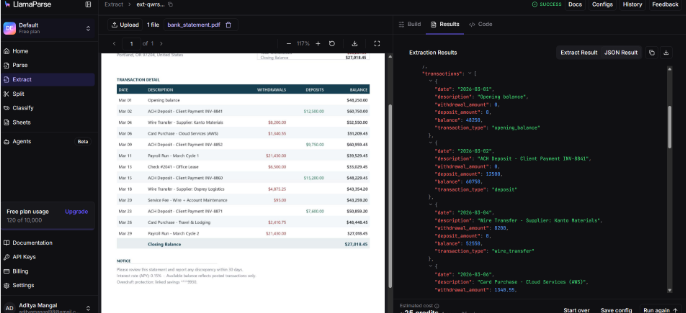
The extraction_target option is particularly relevant here: the per_doc target used above returns the full statement as one object with a nested list of rows, while per_table_row returns one record per row — often the more natural representation when each transaction flows independently into a downstream ledger. The cite_sources and confidence_scores options attach provenance and a reliability measure to extracted fields, which is what lets a workflow accept high-confidence rows automatically while routing uncertain ones for review.
Validating the Extracted Table
Because the output is structured, validation can be applied directly to it, and a transaction table offers unusually strong validation because its internal arithmetic is verifiable. The extracted rows for this statement reconcile exactly against the stated totals and the running balance, which can be confirmed programmatically.
html
data = job.extract_result
rows = data["transactions"]

# 1) Each running balance must equal the prior balance minus withdrawal plus deposit
balance = data["opening_balance"]
for row in rows:
    if row["transaction_type"] == "opening_balance":
        balance = row["balance"]; continue
    expected = round(balance - row["withdrawal_amount"] + row["deposit_amount"], 2)
    assert abs(expected - row["balance"]) < 0.01, f"balance mismatch on {row['date']}"
    balance = row["balance"]

# 2) Period totals must equal the sum of the individual rows
assert round(sum(r["deposit_amount"] for r in rows), 2) == data["total_deposits"]
assert round(sum(r["withdrawal_amount"] for r in rows), 2) == data["total_withdrawals"]

# 3) Closing balance must reconcile with opening balance and net activity
assert round(data["opening_balance"] + data["total_deposits"]
             - data["total_withdrawals"], 2) == data["closing_balance"]
These checks pass against the real extracted data, which is the operational point that separates a prototype from a production system: the value is not only that the rows were captured, but that they can be verified against one another before any of them enter a financial system. This example also shows a real detail of production extraction — the model captured the statement's closing-balance line as an additional summary row, the kind of artifact that schema design and validation must anticipate rather than treat as a defect. The same reconciliation underlies the reliability expectations in guidance on OCR for financial statements and bank statement OCR, where a captured figure is only useful once it has been reconciled.
Because extracted data is produced in an integration-ready structured form, it flows directly into ERP systems, accounting platforms, and analytics environments without additional transformation logic, and version pinning lets a workflow lock to a specific processing version so results stay reproducible as the underlying models improve. This combination of layout-aware parsing, schema-aligned extraction, and integrated validation is what allows table extraction to operate as a dependable component of a broader document processing platform rather than an isolated conversion step.
Final Thoughts
Extracting tables from PDF documents is the point at which document automation succeeds or fails, because tables carry the operational information downstream systems depend on and encode it in a structure PDFs do not natively preserve. Reliable table extraction is therefore not a matter of reading characters but of reconstructing the row-and-column relationships that give those characters meaning, aligning them to a schema the consuming system can act upon, and validating them before they enter a financial process. Flat text extraction discards the grid, template-based rules break on the variability enterprise documents guarantee, and recognition alone stops short of structure. Which is exactly why it has to be engineered as a coordinated pipeline of normalization, structural reconstruction, schema-aligned extraction, and validation.
LlamaParse is built to operationalize exactly this: layout-aware parsing that reconstructs tables faithfully, schema-aligned extraction that returns typed records at the document or row level, and configurable confidence scoring and citations that make validation and human-in-the-loop review architectural components rather than manual afterthoughts. To explore how LlamaParse can support table extraction and structured document processing within your workflows, consider requesting a tailored demonstration aligned with your validation and compliance requirements.