Enterprises generate and receive documents faster than they can meaningfully process them. Invoices, purchase orders, contracts, insurance claims, financial statements, and identity records arrive continuously through email, portals, scanners, and third-party integrations, and each one carries operational information that downstream systems depend on. For decades, optical character recognition served as the entry point for digitizing these documents, converting scanned pages and images into machine-readable characters. Character recognition alone, however, no longer meets the requirements of modern automation. Converting a page into text does not tell a finance system which number is the invoice total, whether that total reconciles with the line items, or whether the document should be approved automatically or routed for review.
Intelligent OCR addresses this gap. Often referenced as AI OCR or cognitive OCR, it combines traditional character recognition with machine learning, layout awareness, semantic extraction, and validation logic to transform documents into structured data rather than raw text. Traditional OCR answers the question of what characters appear on a page, while intelligent OCR answers the far more valuable question of what those characters mean within a business context and whether the extracted information can be trusted.
This article examines what intelligent OCR is, why traditional recognition breaks down in enterprise environments, how a production-grade intelligent OCR pipeline is actually engineered, and what organizations must consider when moving these systems from prototype to production. The goal is to move beyond the common definition of intelligent OCR as software that "understands documents" and toward a concrete account of the architecture, validation, and governance that make document understanding operationally reliable.
What Intelligent OCR Actually Means
Intelligent OCR is a document processing capability that extends beyond character recognition to interpret document structure, extract specific fields into a defined schema, validate the results, and express uncertainty in a way that downstream systems can use. Where conventional OCR software produces a flat stream of recognized text, intelligent OCR produces structured output in which each value retains its relationship to the surrounding document. An invoice total remains associated with its currency, its tax component, and the line items that compose it. A policy number remains linked to the policyholder and the coverage terms. This preservation of relationships is what allows extracted data to be validated, reconciled, and integrated without extensive manual correction.
The intelligence in intelligent OCR derives from several capabilities working in combination rather than from any single technique. Machine learning models trained on document structure identify how a page is organized into headers, tables, key-value pairs, and narrative sections. Layout-aware analysis determines reading order and spatial relationships, which is essential for multi-column pages, nested tables, and documents where meaning depends on position. Semantic extraction interprets the content of those regions, distinguishing a billing address from a shipping address even when both appear in similar formats. Increasingly, vision-language models allow these systems to reason over the visual and textual structure of a document simultaneously, which improves reliability on complex layouts, handwritten annotations, and documents that deviate from expected templates.
The Evolution from OCR to Intelligent OCR
Understanding intelligent OCR requires understanding the progression that produced it. The earliest OCR systems performed pattern matching against known character shapes, which worked acceptably for clean, printed, single-column text but degraded sharply on real-world documents. Intelligent character recognition extended this by introducing machine learning capable of interpreting handwritten and stylized text, improving accuracy on forms and annotations that defeated pattern-based recognition. These advances improved the fidelity of character conversion, but they did not address the structural problem of turning recognized text into usable data.
The subsequent stage introduced intelligent document processing, which positioned OCR as one component within a larger pipeline that also included classification, extraction, validation, and integration. In this model, recognition is necessary but not sufficient, because the operational value lies in the structured output rather than the recognized characters. The most recent stage introduces agentic document workflows, in which the system does not merely extract data through a fixed sequence of steps but reasons about a document, verifies its own outputs, resolves ambiguity through additional analysis, and adapts to variability without requiring a new template for every document format.
How Intelligent OCR Differs from Traditional OCR
The practical differences between traditional and intelligent OCR become clear when the two are compared across the dimensions that matter in production. Traditional OCR is fundamentally a recognition technology, whereas intelligent OCR is an interpretation and validation technology built on top of recognition.
| Dimension | Traditional OCR | Intelligent OCR |
|---|---|---|
| Primary output | Flat recognized text | Structured, schema-aligned data |
| Approach | Pattern matching, fixed templates | Machine learning, layout-aware parsing |
| Structure handling | Flattened into linear text | Preserved as tables, key-value pairs, hierarchy |
| Variability | Breaks on unseen formats | Generalizes across layouts |
| Handwriting | Limited or unsupported | Supported through learned models |
| Reliability signal | None | Field-level confidence scoring |
| Correctness | Not evaluated | Validated against rules and related documents |
This comparison is not intended to suggest that traditional OCR has no role. Recognition remains the foundation on which intelligent systems are built, and high-quality character recognition is a prerequisite for accurate downstream extraction. The distinction is that intelligent OCR treats recognition as the first stage of a larger workflow whose purpose is to produce validated, structured, and integration-ready data rather than readable text.
Why Traditional OCR Breaks in Enterprise Workflows
The limitations of traditional OCR are most visible in the environments where document processing matters most. Enterprise document workflows are characterized by variability, volume, and consequence, and traditional recognition systems struggle across all three for reasons that compound one another.
Recognition Without Structure
The core problem is that character recognition does not preserve the relationships between values. A recognition engine may accurately transcribe every number on an invoice while providing no indication of which number is the subtotal, which is the tax, and which is the total, and no linkage between a line item and its corresponding amount. When these values are extracted independently, the resulting data is fragmented and cannot be validated or reconciled, because a finance system cannot confirm that line items sum to the subtotal if it does not know which extracted values are line items. This is why flat text output, however accurate at the character level, is insufficient for automation. The problem is especially acute in tabular documents, where billing rows, quantities, and totals must retain their structural relationships during extraction, as examined in more detail in discussions of OCR for tables.
Template Fragility and Document Variability
Enterprise workflows involve documents produced by many external parties, each following its own formatting conventions, and those conventions change over time without notice. A template-based system configured for one vendor's invoice layout will fail when that vendor revises its template or a new vendor is onboarded. Because traditional systems depend on fixed positional rules, every structural change requires reconfiguration, producing a maintenance burden that grows with the number of document sources. This fragility is most pronounced in sectors such as insurance, where a single claim may involve documents from hospitals, repair vendors, and regulatory bodies, and where reliable insurance document automation depends on generalizing across formats that rigid templates cannot accommodate.
No Signal for Uncertainty
Input quality introduces a further difficulty. Documents frequently arrive as scanned copies, mobile-captured photographs, or compressed files that exhibit skew, blur, shadows, low resolution, or handwritten annotations mixed with printed text. Preprocessing such as deskewing, contrast normalization, and noise reduction improves baseline recognition but cannot eliminate ambiguity, and traditional systems have no mechanism for expressing uncertainty when recognition is unreliable. A conventional engine returns its best guess with no signal indicating whether that guess should be trusted, so errors propagate silently into downstream systems. This absence of a reliability signal is one of the most consequential gaps in traditional OCR, because automation without a measure of confidence cannot distinguish data that is safe to process automatically from data that requires human review. This criterion increasingly separates capable document processing software from basic character recognition.
How Intelligent OCR Works
A production-grade intelligent OCR system operates as a coordinated pipeline rather than a single recognition step. Each stage contributes to reconstructing a document into structured, validated data, and the reliability of the overall system depends on how well these stages are integrated. The stages described below are conceptual rather than strictly sequential, because modern systems increasingly interleave extraction and validation and, in agentic implementations, revisit earlier stages when analysis reveals ambiguity.
Document Ingestion and Normalization
The pipeline begins with ingestion, where documents enter the system through channels such as email, upload portals, scanning workflows, and third-party integrations. These documents arrive in heterogeneous formats, including digitally generated PDFs, scanned images, photographs, and compressed archives, and they vary widely in quality and encoding. A production ingestion layer normalizes these inputs into a consistent representation before extraction begins, applying file conversion, orientation correction, and image normalization so that downstream models receive predictable inputs. Normalization matters because the same document structure can produce materially different extraction results depending on scan quality or file encoding, and without a normalization stage, this variability introduces inconsistency that is difficult to diagnose later in the pipeline.
Layout-Aware Parsing and Structural Reconstruction
Once normalized, the document enters the parsing stage, where layout-aware models analyze how the page is organized. Rather than flattening the document into a linear sequence of characters, layout-aware parsing identifies structural components such as headings, paragraphs, tables, key-value fields, signature blocks, and multi-column regions, and it reconstructs the reading order and spatial relationships among them.
This structural reconstruction is what allows extracted values to retain their meaning, because it establishes where each value sits within the hierarchy of the document. In an invoice, this stage distinguishes the header block containing vendor and buyer information from the line-item table and the totals section, and it preserves the association between each line-item description and its amount.
The quality of this stage largely determines the quality of everything downstream, and it is the capability that most clearly separates intelligent OCR from character recognition. The range of approaches to this problem is surveyed in comparisons of document parsing APIs, which differ substantially in how faithfully they preserve document structure.
Semantic Extraction and Schema Alignment
After the document's structure has been reconstructed, semantic extraction identifies the specific fields the workflow requires and maps them into a predefined schema.. A schema defines the fields to extract, their expected types, and their relationships, and the extraction models populate that schema by interpreting the parsed document. Schema alignment is significant because it removes the transformation logic that would otherwise be required to convert raw extraction output into a usable format.
The importance of schema-driven extraction is easiest to appreciate through the contrast with keyword-based approaches. A payment term may appear under headings such as "Net Terms," "Payment Terms," or "Billing Conditions" depending on the document, and a keyword search for any single phrase will fail on documents that use a different convention. Schema-aligned semantic extraction interprets the meaning of the region rather than matching a fixed string, which allows it to generalize across the drafting variations that occur naturally across vendors and industries. This capability underpins operational use cases such as invoice data extraction and broader financial data extraction, where the same field must be located reliably across documents that express it differently.
Validation, Confidence Scoring, and Human-in-the-Loop Review
Production intelligent OCR integrates validation directly into the pipeline, which operates at several levels.
- Type and format validation confirms that a date is a valid date and that a monetary value is numeric.
- Cross-field validation confirms internal consistency, such as verifying that line items sum to the subtotal and that the subtotal plus tax equals the stated total.
- Business-rule validation confirms consistency with external constraints, such as checking an invoice against a purchase order or verifying that a vendor exists in an approved-supplier registry.
This layered validation is what allows extracted data to be trusted rather than merely produced.
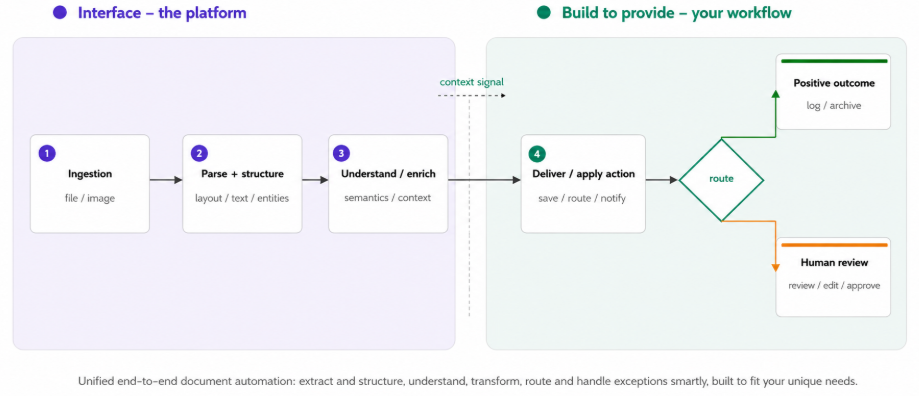
Confidence scoring accompanies validation and is central to operational reliability. Rather than returning every field with equal certainty, intelligent OCR assigns a reliability measure to extracted values based on recognition quality, structural clarity, and model prediction strength. High-confidence fields that also pass validation can proceed through automated processing without intervention, while low-confidence or validation-failing fields are routed to human review. This routing model is what makes human-in-the-loop review an architectural component rather than a fallback. The objective is not to review every document, which would eliminate the benefit of automation, but to concentrate human attention precisely on the cases where it is most valuable. Corrections captured during review also provide a feedback signal that can improve extraction over time, which turns human oversight into a mechanism for continuous improvement rather than a recurring cost.
Agentic Document Workflows
The most advanced intelligent OCR systems extend beyond a fixed pipeline into agentic document workflows, in which the system reasons about a document and coordinates multiple steps to resolve it rather than executing a single predetermined sequence. When an initial extraction produces low-confidence results, an agentic system can reprocess the relevant region at higher fidelity, consult related documents to resolve ambiguity, or apply additional verification before finalizing an output.
This adaptive behavior is particularly valuable for documents that combine multiple formats, contain unexpected structures, or require reconciliation across several files. The shift from fixed pipelines toward reasoning-driven document processing is examined in more depth in the discussion of agentic document workflows, which describes how these systems move beyond isolated extraction toward coordinated document understanding.
Intelligent OCR with LlamaParse
LlamaParse approaches intelligent OCR as intelligent document processing combined with structured parsing and validation orchestration, rather than as a standalone text-recognition tool. Within LlamaParse, document analysis begins with layout-aware parsing that identifies structural components such as tables, multi-column sections, headers, nested fields, and key-value relationships, which ensures that extraction follows document structure rather than relying on character recognition alone. This structural fidelity is the foundation for reliable downstream extraction, because it preserves the relationships that give extracted values their meaning.
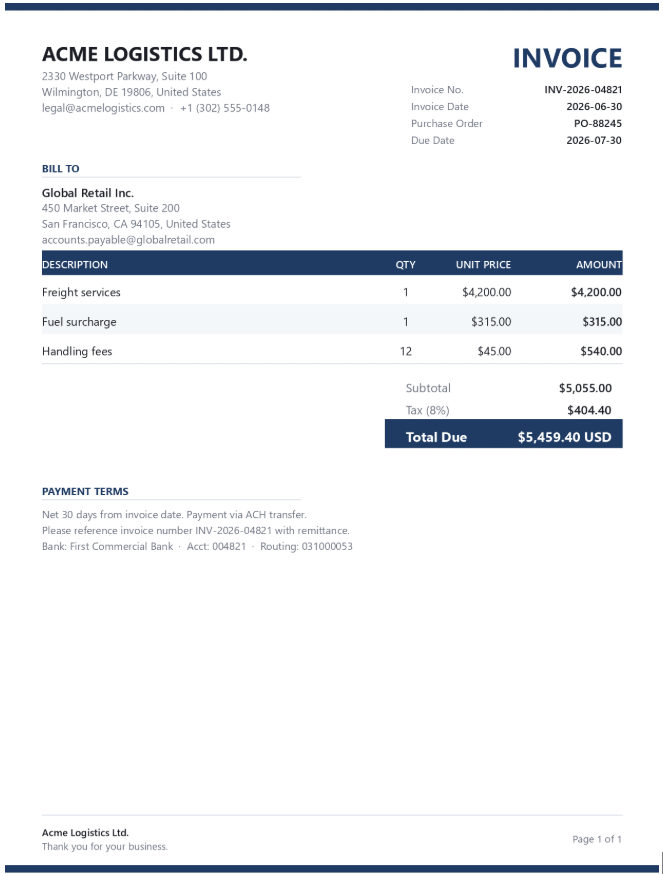
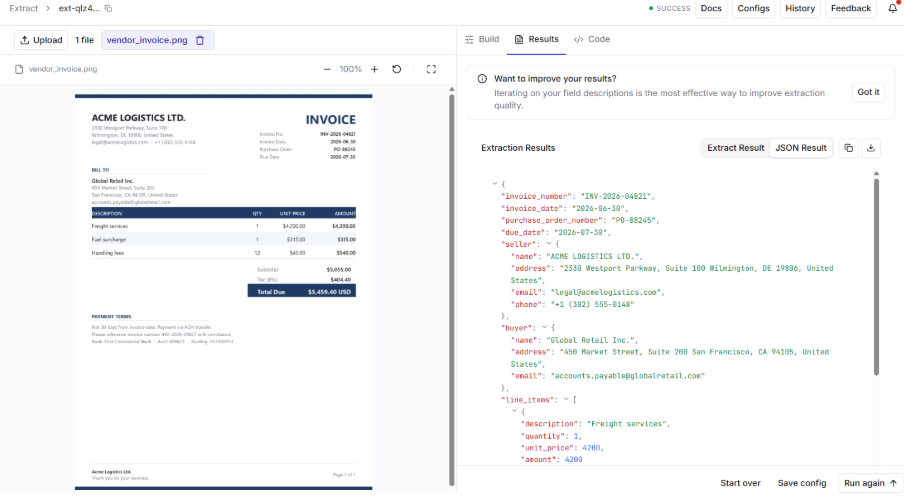
To demonstrate the workflow in practice, consider the vendor invoice shown below. This document serves as the input to the parsing and extraction process, and it contains the header metadata, vendor and buyer details, line items, and financial totals that an accounts payable workflow needs to capture.
A minimal parsing workflow illustrates how a document is converted into structured, machine-readable content. The current LlamaParse SDK is installed as the llama-cloud package, and the API key is provided through the LLAMA_CLOUD_API_KEY environment variable.
html
from llama_cloud import LlamaCloud

client = LlamaCloud()  # reads LLAMA_CLOUD_API_KEY from the environment

# Upload the document, then parse it into structured content
file = client.files.create(file="./vendor_invoice.png", purpose="parse")

result = client.parsing.parse(
    file_id=file.id,
    tier="agentic",          # fast | cost_effective | agentic | agentic_plus
    version="latest",        # pin to a dated snapshot for reproducibility
    expand=["markdown"],     # include "items" or "metadata" for structured blocks
)

print(result.markdown.pages[0].markdown)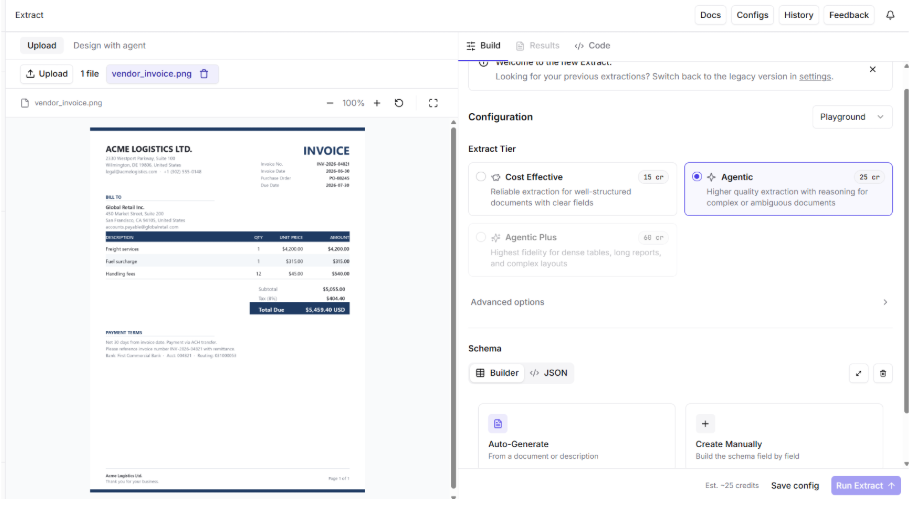
Parsing produces a faithful structured representation of the document, but many workflows require specific fields extracted into a defined schema rather than a full-document transcription. LlamaParse's extraction capability addresses this by allowing organizations to define the fields they need as a schema and returning validated data aligned to that schema. The schema functions as a contract between the document and the downstream system, specifying exactly which fields are required and what form they should take. For an accounts payable workflow, the schema captures the invoice metadata, the vendor and buyer details, the line items, and the financial totals.
html
from llama_cloud import LlamaCloud
from pydantic import BaseModel, Field
import time

client = LlamaCloud()

class LineItem(BaseModel):
    description: str = Field(description="Line item description")
    quantity: float = Field(description="Quantity billed")
    unit_price: float = Field(description="Price per unit")
    amount: float = Field(description="Line total for this item")

class Party(BaseModel):
    name: str = Field(description="Legal name")
    address: str = Field(description="Full postal address")
    email: str = Field(description="Contact email")

class Invoice(BaseModel):
    invoice_number: str = Field(description="Unique invoice identifier")
    invoice_date: str = Field(description="Date the invoice was issued")
    purchase_order_number: str = Field(description="Associated purchase order number")
    due_date: str = Field(description="Payment due date")
    seller: Party = Field(description="The party issuing the invoice")
    buyer: Party = Field(description="The party being billed")
    line_items: list[LineItem] = Field(description="Itemized charges")
    subtotal: float = Field(description="Sum of line items before tax")
    tax: float = Field(description="Tax amount applied")
    total_due: float = Field(description="Total amount due")
    currency: str = Field(description="Currency code")

file_obj = client.files.create(file="./vendor_invoice.png", purpose="extract")

job = client.extract.create(
    file_input=file_obj.id,
    configuration={
        "data_schema": Invoice.model_json_schema(),
        "extraction_target": "per_doc",
        "tier": "agentic",
        "confidence_scores": True,
        "cite_sources": True,
    },
)

while job.status not in ("COMPLETED", "FAILED", "CANCELLED"):
    time.sleep(2)
    job = client.extract.get(job.id)

print(job.extract_result)
The result is a structured object in which every field retains its type and its relationship to the rest of the document, rather than a block of text requiring further parsing. Running this extraction against the invoice shown earlier returns the following structured output.
html
{
  "invoice_number": "INV-2026-04821",
  "invoice_date": "2026-06-30",
  "purchase_order_number": "PO-88245",
  "due_date": "2026-07-30",
  "seller": {
    "name": "ACME LOGISTICS LTD.",
    "address": "2330 Westport Parkway, Suite 100, Wilmington, DE 19806, United States",
    "email": "legal@acmelogistics.com"
  },
  "buyer": {
    "name": "Global Retail Inc.",
    "address": "450 Market Street, Suite 200, San Francisco, CA 94105, United States",
    "email": "accounts.payable@globalretail.com"
  },
  "line_items": [
    { "description": "Freight services", "quantity": 1, "unit_price": 4200.0, "amount": 4200.0 },
    { "description": "Fuel surcharge", "quantity": 1, "unit_price": 315.0, "amount": 315.0 },
    { "description": "Handling fees", "quantity": 12, "unit_price": 45.0, "amount": 540.0 }
  ],
  "subtotal": 5055.0,
  "tax": 404.4,
  "total_due": 5459.4,
  "currency": "USD"
}
Beyond the extracted values, LlamaParse returns field-level metadata that makes validation and human review operational rather than manual. Each extracted field is accompanied by a confidence score and a citation that links the value back to its exact location in the source document, including the matching text and a bounding box on the page. This provenance is what allows a workflow to route uncertain fields for review while accepting high-confidence fields automatically. For the tax amount on this invoice, for example, the returned metadata takes the following form.
html
"tax": {
  "value": 404.4,
  "confidence": 0.93,
  "citation": {
    "page": 1,
    "matching_text": "Tax (8%) $404.40",
    "bounding_box": { "x": 250.8, "y": 171.6, "w": 26.16, "h": 17.28 }
  }
}
Because the output is structured and schema-aligned, validation can be applied directly to it. A cross-field check confirms that the line-item amounts sum to the subtotal and that the subtotal and tax produce the stated total. Teams can then layer their own business rules on top of this structured output — for example, confirming that the purchase order number matches an existing order in their procurement system. . Fields that pass these checks with high confidence can proceed into the approval workflow automatically, while any discrepancy or low-confidence value can be routed for review before the invoice is posted. This combination of structured extraction and integrated validation is what allows intelligent OCR to support accounts payable automation without transferring verification effort to finance teams, and it generalizes to the broader class of financial documents handled by a unified document processing platform.
In addition, LlamaParse allows organizations to configure extraction schemas, validation logic, and workflow behavior without rebuilding pipelines for every document variation. Version pinning further supports production reliability by allowing a workflow to lock to a specific processing version, which ensures that results remain reproducible even as the underlying models improve. Because extracted data is produced in an integration-ready structured form, it can flow directly into ERP systems, procurement platforms, claims systems, and analytics environments without additional transformation logic.
Conclusion
Traditional character recognition remains a necessary foundation, but on its own it produces flat text that cannot be validated, reconciled, or integrated without substantial manual effort. Intelligent OCR closes this gap by combining machine learning, layout-aware parsing, schema-aligned extraction, validation logic, and confidence scoring into a coordinated capability that transforms documents into structured, decision-ready data.
LlamaParse supports this transformation by providing intelligent document processing, structured parsing, schema-aligned extraction, and validation orchestration within a unified platform. Rather than requiring organizations to assemble recognition, extraction, validation, and integration from separate components, LlamaParse allows teams to configure production-ready workflows that preserve document structure, extract data against defined schemas, express uncertainty through confidence scoring, and route exceptions for review.
As document volumes continue to grow and the documents themselves become more varied, the ability to process them as structured, validated data becomes a foundational enterprise capability rather than an efficiency improvement. Intelligent OCR is the mechanism that makes this possible, and LlamaParse provides the platform through which organizations can operationalize it reliably and at scale. To explore how LlamaParse can help, book a demo today. Or sign up and get 10,000 free credits.