
Schema drift is one of those problems that tends to be invisible until it is not. A column gets renamed upstream. A data type changes on a source table. A third-party provider adds a new field to their API response and drops an old one. None of these events announce themselves. They happen during a deployment, a migration, or a supplier update, and the first sign that something changed is usually a broken pipeline, corrupted records, or a downstream report that no longer balances.
This article covers how to catch schema drift before it corrupts data, how to detect it automatically, and how to design data pipelines that degrade gracefully instead of failing silently.
What Schema Drift Actually Is
Schema drift occurs when the structure of a data source changes in a way that diverges from what the downstream system expects. That divergence can be subtle (a column renamed from customer_id to cust_id) or severe (an entire table restructured during a system migration). What makes it problematic is not the change itself but the fact that the consuming system is still running against the old expected schema.
Schema drift is not the same as a data quality issue. Data quality problems affect the values inside a schema: nulls where values are expected, outliers, duplicates. Schema drift affects the structure itself: whether the columns exist, whether they carry the right data types, whether the relationships between tables still hold. Both cause pipeline failures, but they require different detection strategies and different fixes.
The term database drift is sometimes used interchangeably with schema drift, but they are not quite the same thing. Database drift is broader and includes configuration changes, index changes, and permission changes alongside schema changes. Schema drift is specifically about the structural definition of tables and fields. For most data engineering teams, schema drift is the more common and more immediately damaging subset.
The Ways Schema Drift Occurs in Practice
Understanding the taxonomy of schema drift matters because different types require different detection approaches and carry different downstream risk. Here is how drift manifests in real pipelines.
| Type of Drift | What Changes | Common Cause | Severity |
|---|---|---|---|
| Column addition | New column appears in source | Feature release, new data capture | Low to medium |
| Column removal | Existing column disappears | Deprecation, cleanup, refactor | High |
| Data type change | Column type changes (e.g. int to string) | Source system migration, normalization | High |
| Column rename | Same data, different name | Standardization effort, third-party change | Medium |
| Null constraint change | Previously required field becomes optional or vice versa | Business rule change | Medium to high |
| Value range change | Allowed values change (e.g. new status code added) | Product update, new market | Medium |
| Encoding or format change | Date format, string encoding, unit of measure changes | Internationalization, upstream refactor | Medium to high |
Of these, column removal and data type changes are the most damaging, in different ways. If a pipeline expects a column that no longer exists, it will error visibly. If a pipeline expects an integer and receives a string, it may cast silently and produce wrong results without raising an error. Silent corruption is the more dangerous outcome: the pipeline keeps running, the data keeps flowing, and the problem only surfaces when someone looks at the output and notices the numbers are wrong.
Value range drift matters most in document-heavy workflows. If an upstream system adds a new status code, a new document type identifier, or a new categorical value, downstream classifiers and routing logic may silently misbehave on records carrying the new value because none of the existing logic handles it. In document processing pipelines specifically, this shows up as extraction outputs that parse correctly but route to the wrong workflow because the classifier was not trained on the new category.
Why Schema Drift Is Harder to Manage Than It Sounds
The obvious solution to schema drift is version control for database schemas. Track changes, review them, deploy them alongside the application code that depends on them. In a single-team, single-system environment, this works reasonably well. In a real data environment it breaks down quickly.
Most data pipelines ingest from sources that are not under your control. Third-party APIs, partner data feeds, SaaS application exports, legacy systems maintained by a different team. These sources change on their own schedule. They may not version their schema. They may not communicate changes in advance. The first time you know the schema changed is when your pipeline breaks.
Even within a single organization, schema changes in one team's database often do not get communicated to the teams whose pipelines depend on it. The change is logged in the database migration history, but nothing flags the downstream dependencies. A refactor that seems local turns out to affect five pipelines that nobody mapped.
CI/CD pipelines add a specific wrinkle. In a deployment pipeline, schema changes and application changes can arrive at different times. A migration deploys successfully to the live database before the application code that handles the new schema is deployed. During that window, the old application code is running against the new schema, and vice versa after a rollback. The gap is usually small, but the damage can be significant if it coincides with a high-traffic period.
Detecting Schema Drift: Approaches and Trade-offs
There is no single approach to detecting schema drift that works for all pipeline architectures. The right strategy depends on whether you control the source, how frequently the source changes, and how much latency in detection is acceptable.
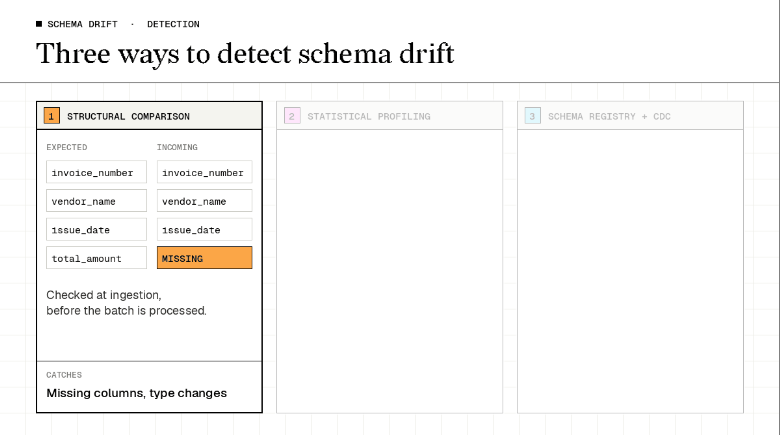
Structural comparison at ingestion
The most direct approach is to compare the incoming data's structure against the expected schema at the point of ingestion. Before processing a batch, check that all expected columns exist, that data types match, and that required fields are not null. This catches hard drift immediately and prevents corrupted data from entering the pipeline.
The trade-off is that strict schema enforcement at ingestion can cause pipelines to stop entirely on minor drift, like a new column being added upstream, that would not actually cause a problem for the downstream logic. A more nuanced approach distinguishes between breaking changes (column removed, type changed) and additive changes (column added) and handles each differently.
Statistical profiling over time
For detecting value range drift and subtle type changes, statistical profiling is more effective than structural comparison. Profile each column across a baseline window: distribution of values, null rate, min and max, cardinality for categorical fields. Then compare each new batch against that baseline and flag significant deviations.
This approach catches the kind of drift that structural comparison misses: a date column that shifts from ISO format to US format, a numeric field whose values start appearing as strings, a categorical field that acquires new values not in the training distribution. It requires more setup and more tuning to calibrate what counts as a significant deviation versus normal variance, but it is the only approach that catches silent corruption.
Schema registry and change data capture
For teams with more mature data infrastructure, a schema registry provides a centralized store of expected schemas and a mechanism for tracking changes. When a source schema changes, the registry records the change and can trigger downstream notifications or validation jobs. Change data capture (CDC) systems that monitor the live database for structural changes can feed directly into a schema registry.
This approach requires more infrastructure investment but provides the most complete picture of schema change across an organization. It is most valuable in environments with many interconnected data sources where manual tracking is not feasible.
Schema Drift in Document Processing Pipelines
Document processing pipelines have their own schema drift problem. When you extract structured data from documents using a defined output schema, that schema represents your expected structure. But the inputs that feed the extraction, the documents themselves, change constantly.
A supplier changes their invoice template. A government form is updated with a new field. A partner's API response adds a nested object that was not there before. An upstream OCR system changes how it formats table output. None of these are schema changes in the traditional database sense, but they all cause the same downstream effect: the data that arrives at your processing logic no longer matches what the logic was written to handle.
LlamaParse handles some of this inherently. Because it reasons about document structure rather than matching against a fixed template, it can handle layout changes in source documents without requiring a new template or retraining. But the output schema it produces still needs to match what your downstream pipeline expects. If a source document drops a field or changes its format, the extracted record can come back with that field empty or in a different type, and your pipeline will carry the gap forward silently unless you have drift detection on the output.
The right pattern for document processing pipelines is to apply schema validation to the structured output of the extraction step, not just to the raw documents. After LlamaParse extracts data from a batch of documents, compare the extracted schema against the expected output schema before passing the results downstream. Flag any batch where the output structure deviates from expectation. This catches cases where the source document changed in a way that left a field empty or changed its type, even if LlamaParse handled the document correctly.
Building Drift Detection into a Pipeline
Here is a working pattern for schema drift detection that applies at the output layer of a document extraction pipeline. It uses the current LlamaParse SDK to extract data, then runs structural and statistical checks against a stored baseline schema before passing results downstream.
python
import time
from dataclasses import dataclass

from llama_cloud import LlamaCloud
from pydantic import BaseModel

client = LlamaCloud()  # reads LLAMA_CLOUD_API_KEY from the environment


# The schema LlamaParse extracts into
class LineItem(BaseModel):
    description: str
    amount: float


class Invoice(BaseModel):
    invoice_number: str
    vendor_name: str
    issue_date: str
    total_amount: float
    line_items: list[LineItem]


# Your expected output schema for an invoice extraction
EXPECTED_SCHEMA = {
    'invoice_number': str,
    'vendor_name': str,
    'issue_date': str,
    'total_amount': float,
    'line_items': list,
}


@dataclass
class DriftReport:
    file_path: str
    missing_fields: list[str]
    type_mismatches: list[dict]
    unexpected_fields: list[str]
    is_clean: bool


def check_schema_drift(
    extracted: dict,
    expected: dict[str, type],
    file_path: str
) -> DriftReport:
    # A field that comes back empty counts as missing
    missing = [k for k in expected if extracted.get(k) is None]
    unexpected = [k for k in extracted if k not in expected]
    mismatches = []

    for field, expected_type in expected.items():
        value = extracted.get(field)
        if value is None:
            continue
        # Accept whole numbers where a float is expected
        if expected_type is float and isinstance(value, int) and not isinstance(value, bool):
            continue
        if not isinstance(value, expected_type):
            mismatches.append({
                'field': field,
                'expected': expected_type.__name__,
                'got': type(value).__name__,
                'value': str(value)[:80]
            })

    return DriftReport(
        file_path=file_path,
        missing_fields=missing,
        type_mismatches=mismatches,
        unexpected_fields=unexpected,
        is_clean=not missing and not mismatches
    )


# Run extraction and immediately check for drift
uploaded = client.files.create(file='invoice_batch/inv_0042.pdf', purpose='extract')
job = client.extract.create(
    file_input=uploaded.id,
    configuration={
        'data_schema': Invoice.model_json_schema(),
        'extraction_target': 'per_doc',
        'tier': 'agentic',
    },
)
while job.status not in ('COMPLETED', 'FAILED', 'CANCELLED'):
    time.sleep(2)
    job = client.extract.get(job.id)

if job.status != 'COMPLETED':
    raise RuntimeError(f'Extraction did not complete: {job.status}')

extracted = job.extract_result
report = check_schema_drift(extracted, EXPECTED_SCHEMA, 'inv_0042.pdf')

if not report.is_clean:
    print(f'Schema drift detected in {report.file_path}')
    if report.missing_fields:
        print(f'  Missing fields: {report.missing_fields}')
    if report.type_mismatches:
        for m in report.type_mismatches:
            print(f'  Type mismatch: {m["field"]} expected {m["expected"]}, got {m["got"]}')
This pattern runs directly after extraction, before any downstream logic touches the data. Missing fields and type mismatches route the record to a review queue. Unexpected fields (a new column the source document started including) get logged but do not necessarily block processing unless your downstream logic is sensitive to extra fields.
Automating Schema Drift Detection in CI/CD Pipelines
Detection at runtime catches drift after it has already hit production. In a well-designed CI/CD pipeline, you can catch at least some schema changes before they reach production by validating schema compatibility as part of the deployment process.
The approach varies by pipeline type. For pipelines ingesting from internal databases, tools like Great Expectations or dbt schema tests can run against a staging environment as part of the CI pipeline and fail the build if expected columns are missing or data types have changed. For pipelines ingesting from external APIs, a schema validation step in the CI pipeline can call the API and compare the response structure against the stored expected schema, failing the build if breaking changes are detected.
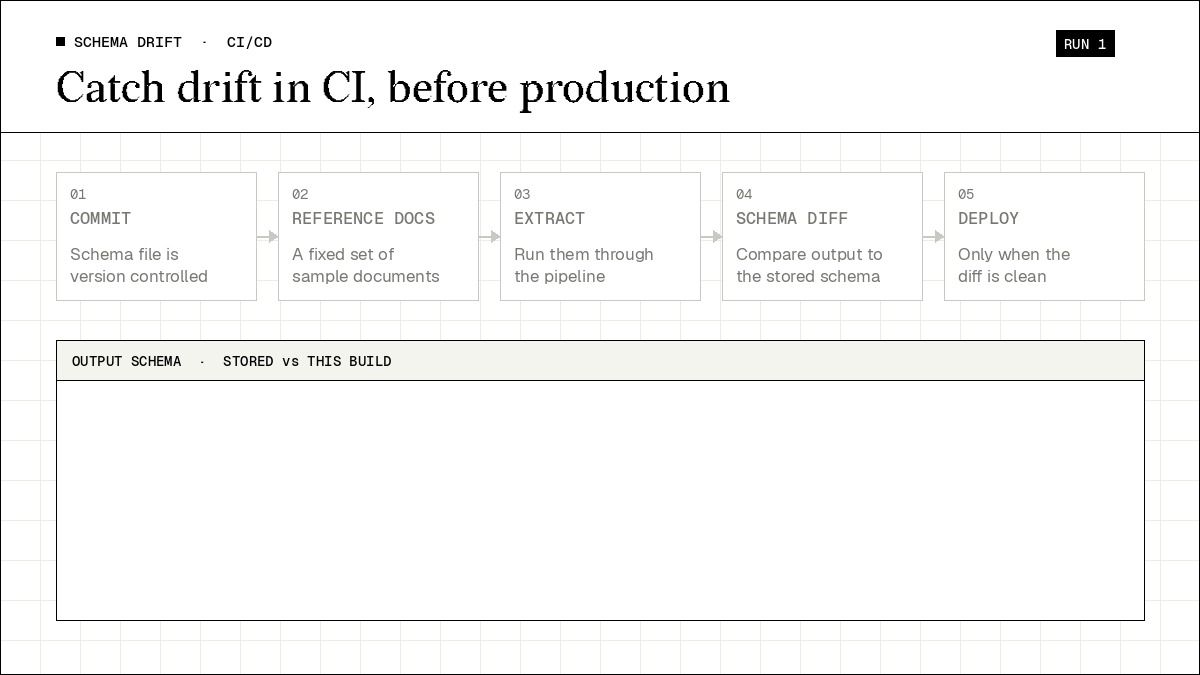
For document processing pipelines specifically, CI/CD schema validation is harder because the inputs are documents rather than structured data sources. A reasonable approach is to maintain a set of reference documents that represent your expected document corpus and run them through the extraction pipeline as part of each deployment. If the output schema of the extraction changes across a deployment, the reference document tests catch it before the change reaches production. Teams that self-host LlamaParse in their own VPC, an option on Enterprise plans, also decide when the platform upgrades, so a parser update can run through the same reference document tests before it reaches production.
Version controlling your extraction schemas is the other side of this. If your expected output schema is stored as a file in your repository, any change to it goes through code review and is tracked in version history. When a schema change is intentional, it gets reviewed and documented. When it is accidental, the diff makes it visible.
Handling Drift Gracefully Rather Than Failing Loudly
Not all schema drift should cause a pipeline to stop. The right response depends on whether the drift is breaking or additive, and on how critical the affected pipeline is.
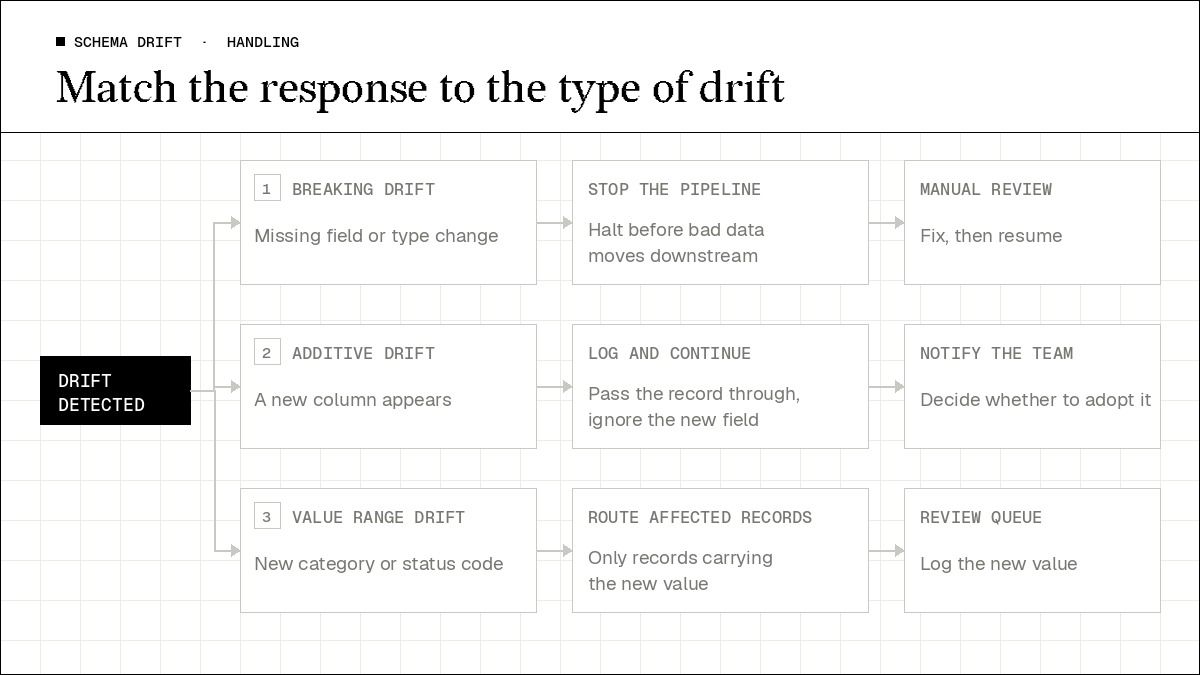
For breaking drift (a missing required field or a type change that corrupts values), stopping the pipeline and routing to manual review is usually the correct response. Letting corrupted data flow downstream is worse than a temporary halt, especially in financial, healthcare, or compliance contexts where data integrity guarantees matter.
For additive drift (a new column appearing in the source data), the right response is usually to log the unexpected field, pass the record through without using the new field, and surface a notification to the engineering team so they can decide whether to incorporate the new field into the expected schema. Failing the entire pipeline because an upstream system added a useful new column is unnecessarily disruptive.
For value range drift (new categorical values or changed enumeration members), the appropriate response depends on how the downstream system uses those values. If a new document type appears in your extraction output that your classifier does not handle, routing those records to a review queue and logging the new value gives your team visibility without cascading failure.
The underlying principle is that drift detection should be actionable. A detection system that flags everything as a critical error trains the team to ignore the alerts. A system that categorizes drift by severity, routes each type to the appropriate response, and provides enough context to diagnose the issue quickly is one that the team will actually use.
Where Schema Drift Fits in a Broader Data Quality Strategy
Schema drift is one component of data quality, not the whole thing. A pipeline can have perfect schema consistency and still produce unreliable output if the values within the schema are wrong. Conversely, a pipeline with robust value-level quality checks can still fail silently when a structural change causes a field to mean something different than it did before, even though the column still exists with the same name.
The most robust data pipelines treat schema validation and value-level profiling as complementary controls. Schema checks at ingestion catch structural problems before they reach the processing logic. Statistical profiling over time catches distributional shifts that schema checks miss. Confidence scores on extracted data, which LlamaParse provides at the field level, give the downstream logic a signal about where to trust the output and where to apply additional scrutiny.
Data integrity over the long term requires treating the expected schema as a living artifact rather than a fixed assumption. When drift is detected and addressed, update the stored expected schema to reflect the new reality. Version each change so the history of what the schema was, and when it changed, stays accessible. Over time, that history becomes a diagnostic tool: when a pipeline starts producing unexpected output, the schema change log is one of the first places to look.
Practical Starting Points
If you are dealing with schema drift in a live pipeline and need to start somewhere, the most useful first step is to audit what you currently do, or do not do, when a schema change hits production. If the answer is that you find out from a broken pipeline or a confused end user, that is the gap to close first.
Adding structural validation at the ingestion boundary of your most critical pipeline is a one-day implementation that immediately improves your visibility. Logging unexpected fields and missing fields on every batch costs almost nothing and gives you a record of how frequently your sources actually drift. That record is usually more frequent than people expect, and it makes the case for investing in more comprehensive detection.
For teams building or maintaining document processing pipelines with LlamaParse, schema validation on the extraction output layer is the place to start. The extraction produces structured data with confidence scores. Running that output through a schema check before it reaches downstream logic adds a thin but valuable safety layer that catches the category of failures that are otherwise invisible until they compound.