Nov 14, 2025
Document AI: The Next Evolution of Intelligent Document ProcessingPersona
Industry
Use cases
Document Processing API
[ Document Processing API ]

Use LlamaParse to turn messy PDFs into structured JSON with layout-aware accuracy and confidence metadata.
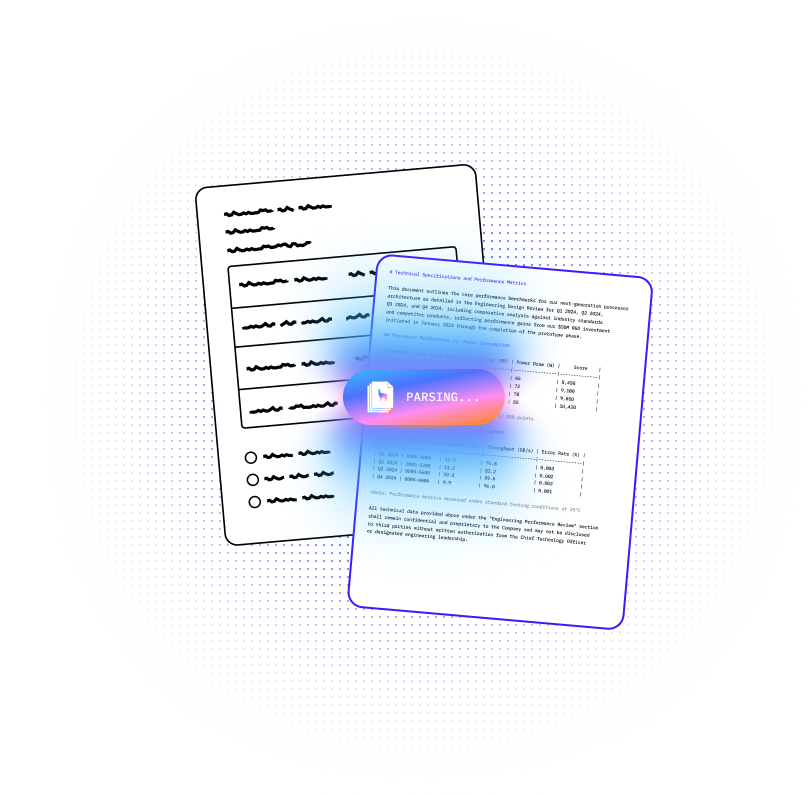
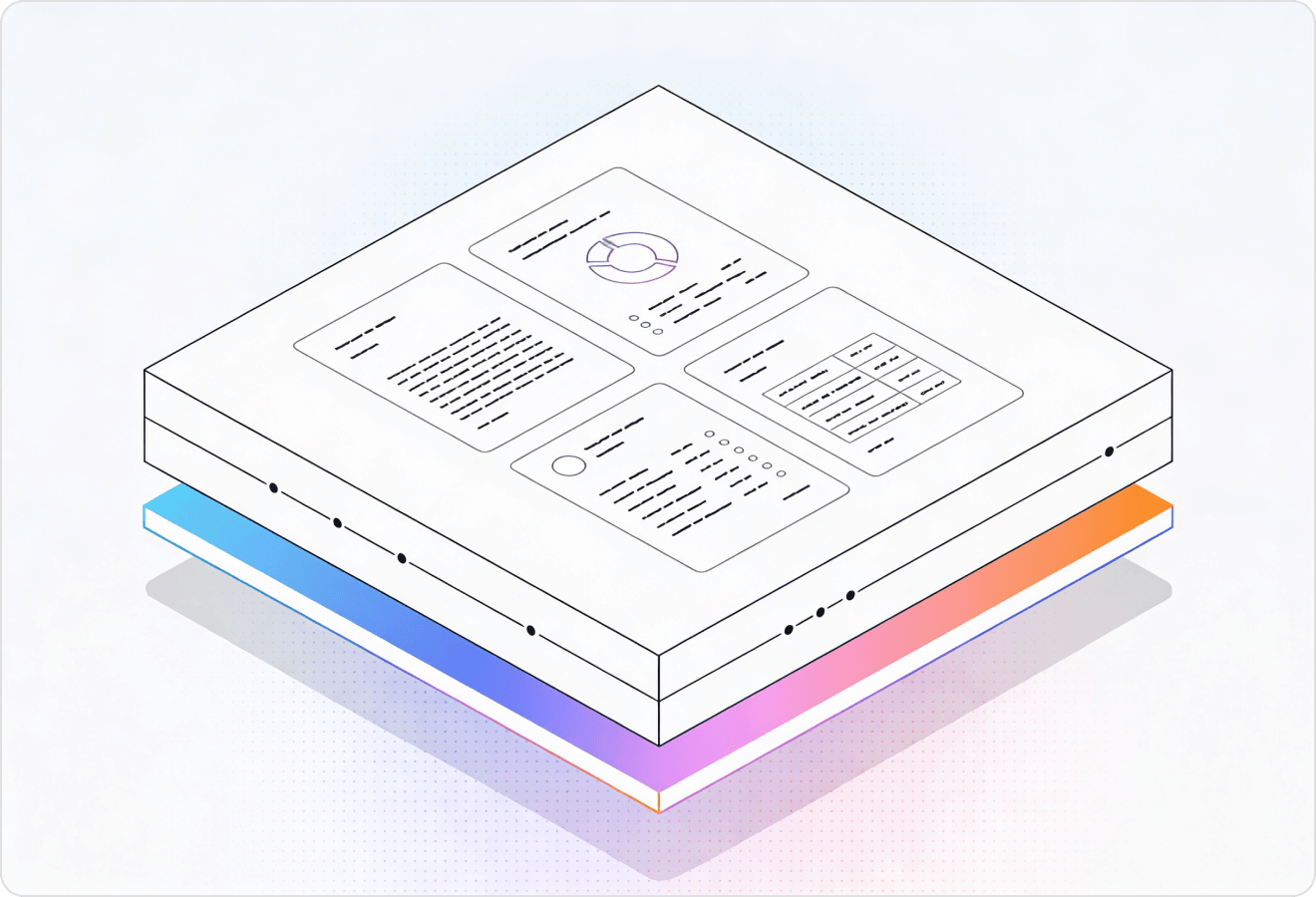

LlamaParse turns messy PDFs, scans, and forms into structured Markdown or JSON your apps and agents can actually trust and use. It understands layout, tables, and embedded visuals, then adds validation loops and citations so teams ship faster with fewer manual checks.
Best-in-Class Accuracy

TShip customer-facing document workflows (uploads, onboarding, summaries) without building brittle PDF parsing code by using LlamaParse to turn messy decks, invoices, and contracts into clean Markdown/JSON. Natural-language parsing instructions let your team iterate extraction and schema changes in hours, while tier-based agentic processing keeps accuracy high without blowing up unit economics.

Extract structured fields from FNOL forms, adjuster reports, and loss run PDFs into JSON with page-level traceability so reviewers can verify every value fast. LlamaParse handles mixed layouts, attachments, and scanned documents using agentic parsing with correction loops, reducing rework and speeding up straight-through processing.

Convert Certificates of Analysis, inspection reports, and supplier spec sheets into JSON schemas that map directly into QMS/ERP records, even when data is buried in multi-column tables. LlamaParse captures table structure and key metadata so you can automate lot-level checks, deviations, and audit-ready evidence without manual rekeying.

Transform contracts, pleadings, and exhibit PDFs into structured JSON for clause extraction, timeline building, and matter search without losing section hierarchy or exhibit references. LlamaParse uses layout-aware parsing to keep headings, footnotes, and cross-references intact, making downstream review and drafting workflows reliable.
The Solution
01
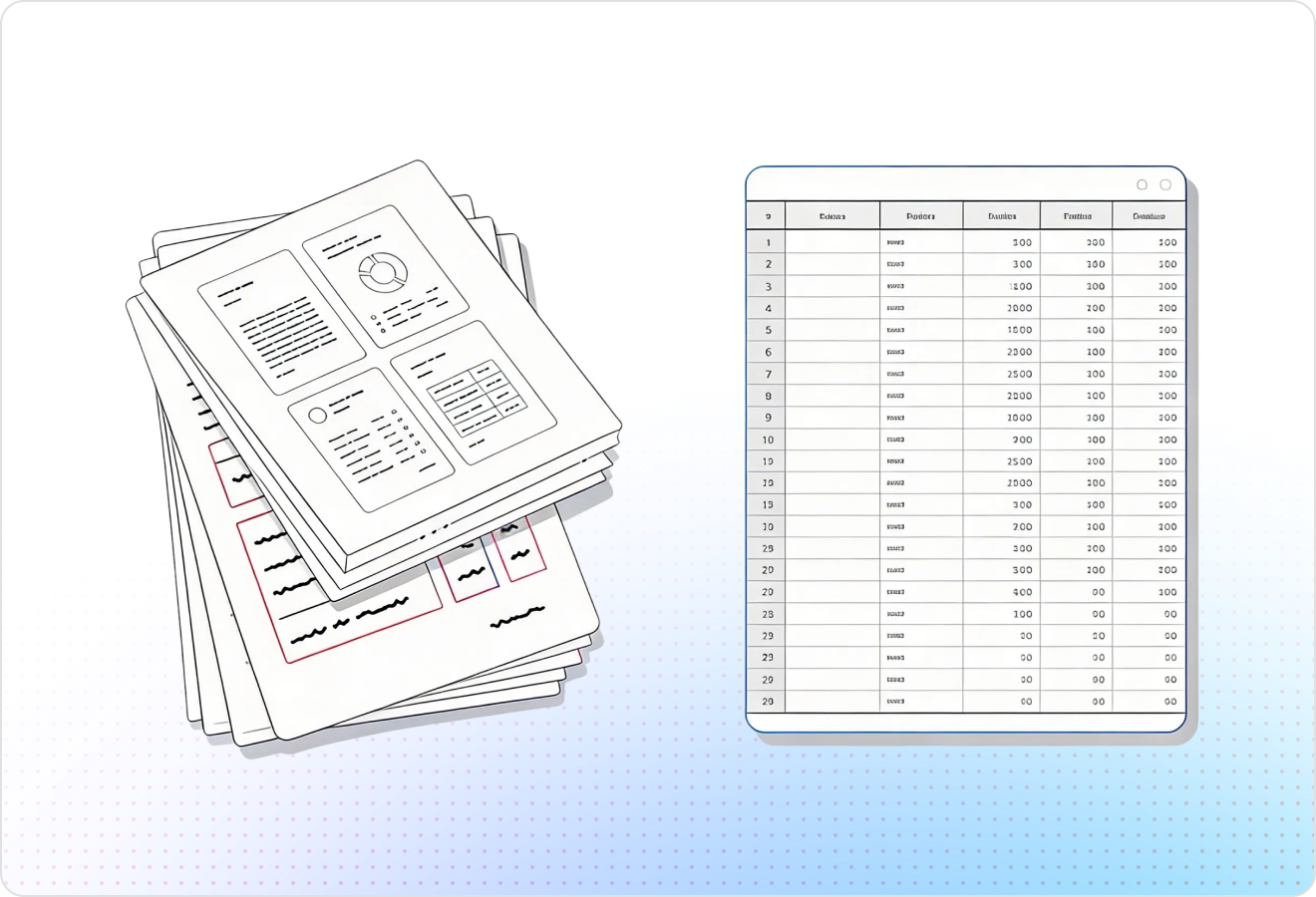
LlamaParse can return clean, structured JSON that’s easy to persist, validate, and serve directly from your own PDF-to-JSON API. This avoids brittle post-processing scripts and gives you consistent keys and object shapes across messy real-world PDFs.
02
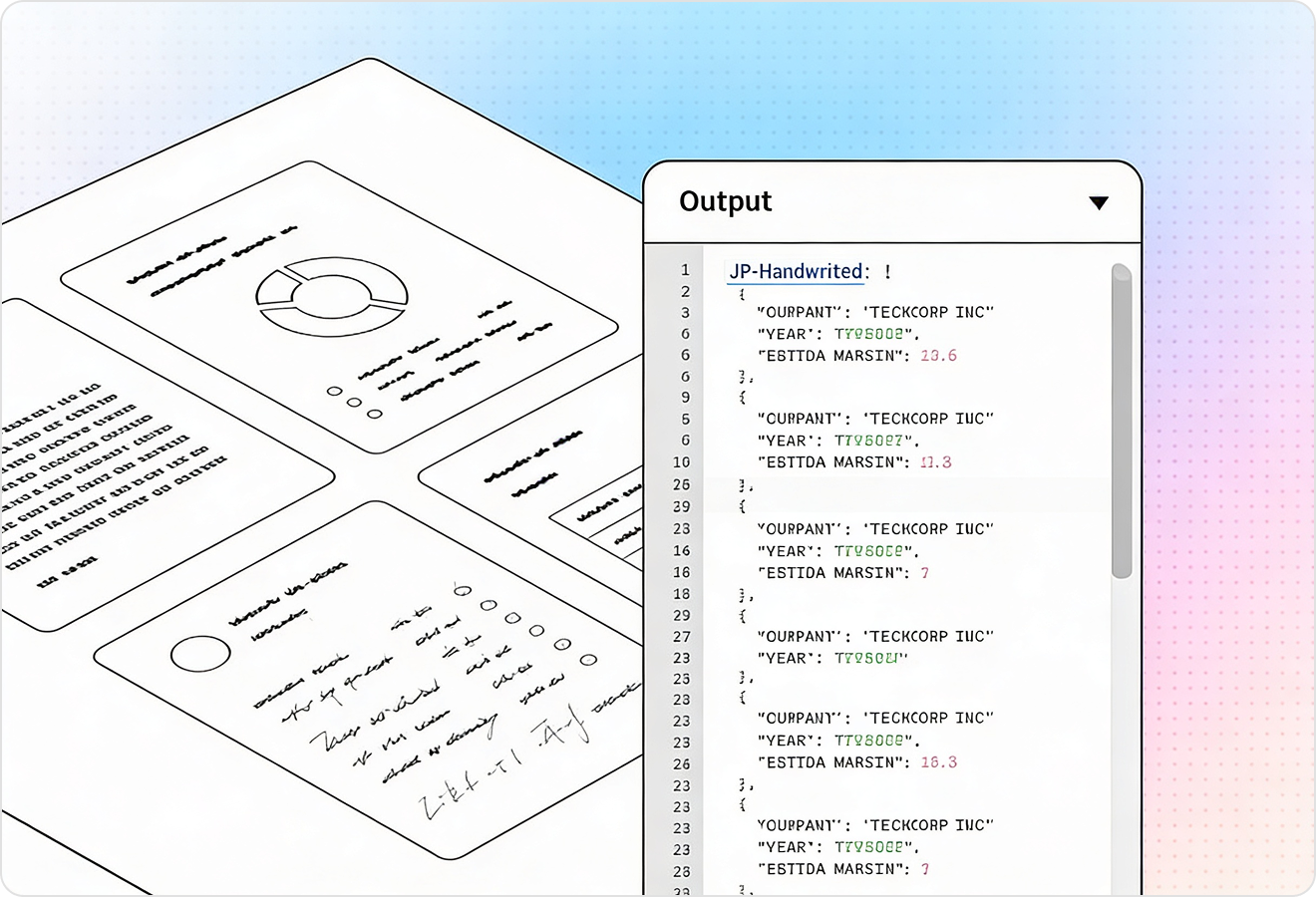
LlamaParse understands page layout so tables, multi-column sections, and nested blocks don’t get scrambled when converted into JSON. You get reliable row/column boundaries and reading order, which is critical when your API needs predictable structured fields.
03
LlamaParse can interpret charts, images, and math and convert them into machine-readable representations that can be stored in JSON alongside text. That means your PDF-to-JSON API captures the full document payload, not just whatever plain text happens to be extractable.
04
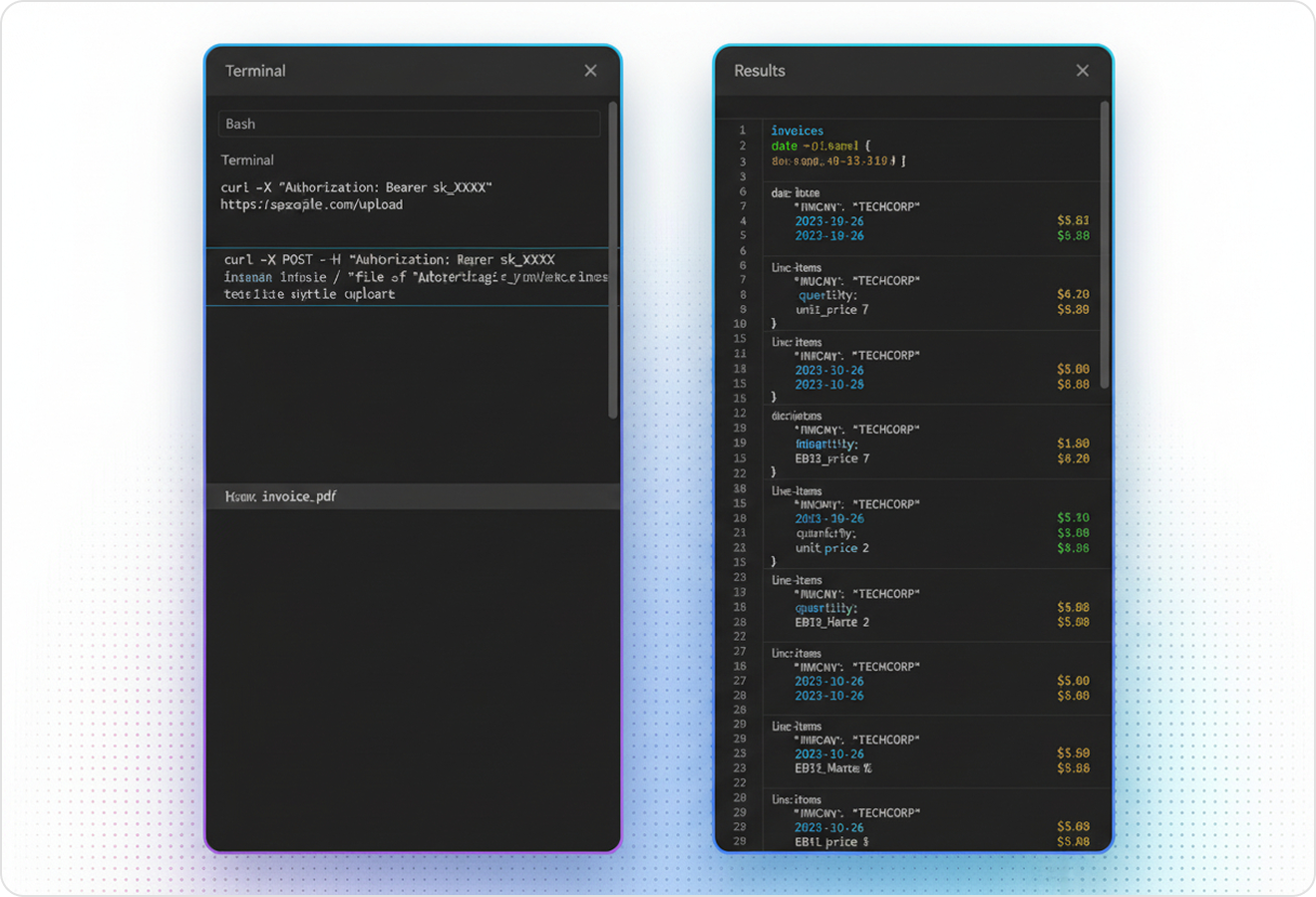
LlamaParse attaches granular metadata like page references, element types, and spatial coordinates to extracted content. In a PDF-to-JSON API, this makes outputs auditable and debuggable, and it enables downstream workflows like highlighting sources or building human review tools.
Technical OCR documentation
Explore our developer guides to easily connect your document pipelines to LlamaParse.
Explore the documentation
Our AI catches the typos that tired eyes miss.

Export to Excel, JSON, XML, or directly via API.

SOC2 Type II compliant with end-to-end encryption.

Train the tool on your specific forms in minutes, not days.

Average processing time of <3 seconds per page.
LlamaParse’s support of a wide variety of filetypes and its accuracy of parsing made it the best tool we tested in our evaluations. The LlamaIndex team was very responsive and we were off to the races within a day.
Common FAQs
01
Our PDF to JSON API returns clean, JSON-ready structured output with consistent keys and object shapes—even on messy real-world PDFs. That means fewer one-off parsers per vendor and far less brittle post-processing. You can persist and validate the results confidently in your pipeline.
02
No—layout-aware extraction preserves reading order and reliable row/column boundaries, even in multi-column pages and nested table structures. This helps your downstream logic stay predictable, so you’re not rebuilding tables from broken text. It’s designed for production APIs that need stable structured fields.
03
It supports multimodal visual understanding, so charts, images, and math can be interpreted and converted into machine-readable representations alongside text. This lets you store the full document payload in JSON instead of losing critical information. It’s especially useful for reports, invoices with logos, and technical PDFs.
04
Can I trace each extracted field back to the exact location in the PDF?
Yes—outputs include verifiable metadata such as page references, element types, and spatial coordinates. This makes results auditable and much easier to debug when something looks off. It also enables reviewer tools like highlighting the exact source region for any JSON field.
05
How do you handle noisy PDFs like scans, inconsistent formatting, or mixed layouts?
The API is built to handle messy inputs by using layout understanding and structured extraction rather than relying on fragile text heuristics. You get more stable JSON even when PDFs vary across pages or vendors. If you have edge cases, you can verify outputs using citations and metadata instead of guessing.
06
How fast can we integrate this into our existing workflow and start shipping results?
Because the output is already JSON-ready, most teams can plug it into their storage, validation, and serving layers without writing custom cleanup scripts. The structured schema and predictable table handling reduce integration time and ongoing maintenance. You can start with a small set of documents and scale confidently as coverage grows.