If you are evaluating intelligent document processing platforms, you have probably already read the same five articles explaining what IDP is: a technology that combines OCR, machine learning, and NLP to extract structured data from documents. That definition is not wrong. It is just not useful when you are trying to decide which platform to buy.
What is actually useful is understanding where IDP platforms fail in production, what separates genuine capability from demo performance, and what the architecture looks like in a system that holds up when real documents arrive. That is what this article is about.
What IDP Platforms Are Supposed to Do
The core job of an intelligent document processing platform is to take a document in any format, understand what it contains, extract the relevant data, and deliver that data in a structure that downstream systems can use. No human in the loop for standard cases. No custom template required for each document type. No degradation in accuracy when a vendor changes their invoice layout.
That description sounds straightforward. In practice, most platforms deliver part of it. The part they deliver in demos is usually not the part that determines whether the system actually works at scale.
A typical IDP platform includes five functional layers:
- Document Ingestion, which handles intake from email, scanners, APIs, and cloud storage in whatever formats documents arrive;
- Classification, which identifies document type and routes to the appropriate processing logic;
- Extraction, which pulls the relevant data fields from the document content;
- Validation, which checks extracted data for internal consistency and flags anomalies;
- Integration, which delivers structured data to downstream systems.
The quality of each layer varies enormously between platforms, and vendors are not always transparent about where their ceilings are.
Where Most IDP Platforms Actually Break
The honest answer to where IDP platforms fail is almost always the same: document variety. Every platform performs well on the document types it was designed and trained for. Performance degrades when documents arrive that look different from what the system expected.
This is not a fringe edge case. It is the central operational reality of document processing at scale. Your vendor invoices do not all look the same. Your customers submit documents in quality you do not control. Suppliers change their templates. Regulations require new form types. The question is not whether your document corpus will include variation. It is whether your IDP platform handles that variation gracefully or breaks and escalates to manual review.
The Template Dependency Problem
Legacy IDP systems are template-based. To process a new document type, you build a template that tells the system where to find each field. When a vendor changes their invoice layout, you update the template. When a new supplier appears, you build a new template. At a small scale this is manageable. At scale it becomes a maintenance burden that consumes the efficiency gains the system was supposed to deliver.
The template dependency problem compounds over time. A document processing team that starts with 20 templates will have 200 within two years as document variety grows. Each template requires testing, maintenance, and updating when the source document changes. The total cost of template ownership is rarely factored into IDP platform evaluations, but it is often the largest ongoing operational cost of running a legacy system.
The Non-Text Content Problem
Most IDP platforms were built for text. The assumption is that documents are primarily text, with perhaps some tables, and that extracting the text is most of the job. That assumption breaks on the documents that actually matter most in high-value workflows.
A financial statement has charts that carry data not present anywhere in the text. A technical specification has diagrams that show component relationships. A medical report has images that are clinically significant. An insurance adjuster report has photos embedded alongside narrative text. A legacy IDP system ignores all of this. The chart is not in the extracted data. The diagram is not in the structured output. The image is missing. Downstream systems make decisions on incomplete information.
The Accuracy Gap Between Demo and Production
This is the most common failure mode and the hardest to catch during evaluation. Vendor demos use clean, well-formatted documents that represent the best-case scenario for their system. Production documents are different: scanned at varying resolution, submitted as phone photos, received as fax images, annotated with handwritten notes, or just formatted in ways the vendor's training data did not include.
The accuracy gap between demo conditions and production conditions is often 10 to 20 percentage points. A system that extracts at 98% accuracy on clean PDFs may extract at 82% on your actual intake. That 18% gap is your manual review queue, and it is the gap that makes the ROI calculation for IDP implementations so often disappointing.
The right evaluation methodology is simple: test on your actual documents, not the vendor's test set. Take 50 to 100 documents from your real intake, including the messy ones, and measure field-level accuracy on the fields that matter for your downstream process. That number tells you what your actual straight-through processing rate will be. The vendor's benchmark number does not.
What Modern IDP Looks Like: Agentic Document Processing
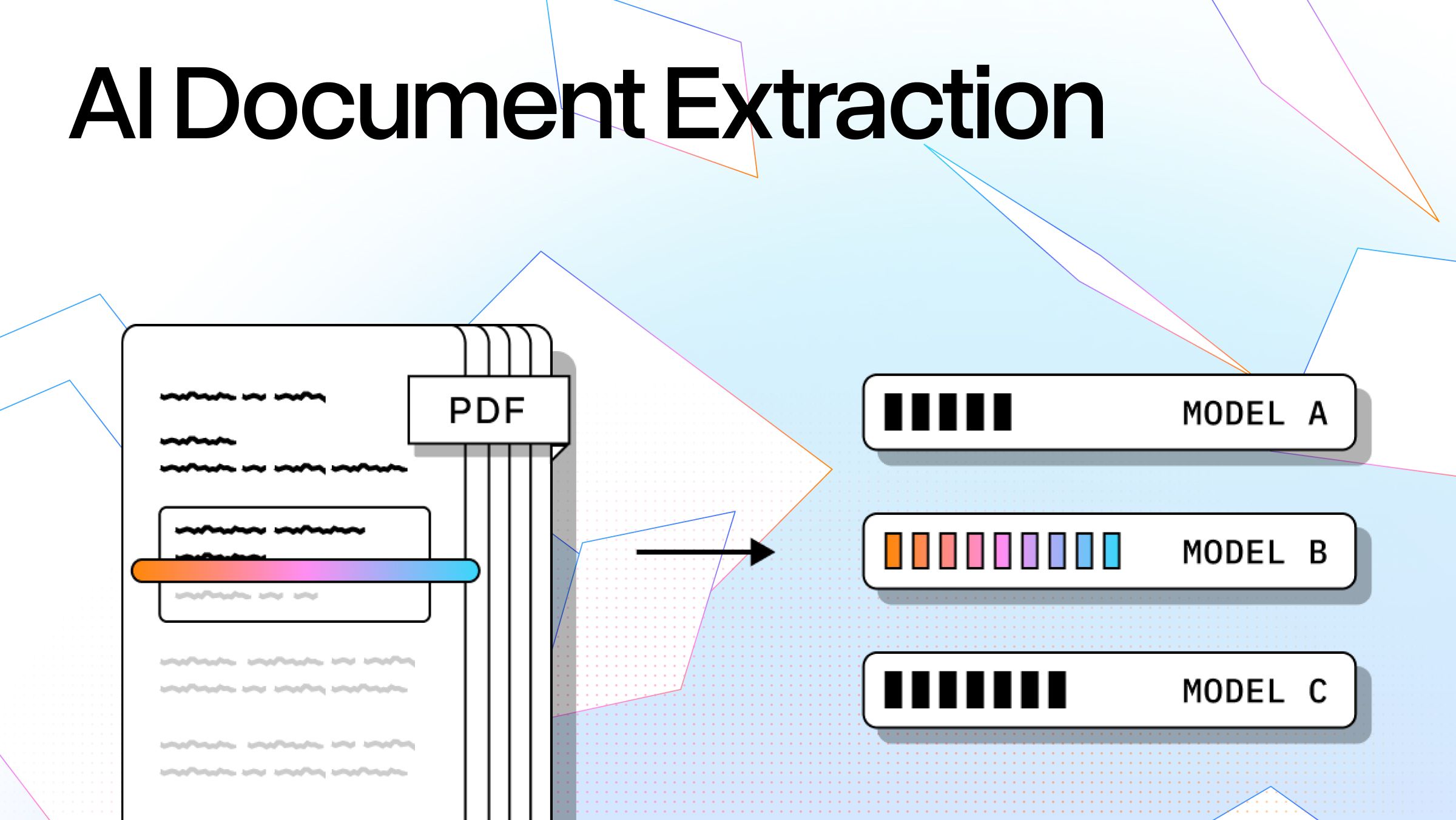
The generation of IDP platforms that addresses these problems uses a fundamentally different architecture. Rather than a single extraction pipeline that every document passes through, an LLM orchestration layer analyzes each document and routes different elements to the models best suited for them. Text goes to an OCR engine. Tables get processed by layout-aware extraction. Charts and images go to vision-language models. Mathematical content gets parsed into structured representations.
This is what LlamaParse does. It is not a traditional IDP platform with a better OCR engine. It is an agentic document parsing system where the intelligence layer decides how to process each element of each document, validates the outputs through correction loops, and reconstructs everything into a single structured result in your chosen format: Markdown, JSON, or HTML.
The practical difference shows up on the documents that break legacy systems. A scanned invoice from a new vendor with an unusual layout: a legacy system needs a template, LlamaParse reasons about the structure and extracts correctly. An annual report with embedded charts: a legacy system returns only the text, LlamaParse processes the charts through a vision model and includes them in the output. A handwritten form: a legacy system degrades significantly, LlamaParse applies appropriate models for handwritten content and returns confidence scores that indicate which fields need verification.
Legacy IDP vs. Agentic Document Processing: A Direct Comparison
| Capability | Legacy IDP | Agentic Document Processing (LlamaParse) |
|---|---|---|
| Document ingestion | Pre-configured formats only | Any format: PDF, image, scan, Word, Excel, HTML |
| Layout handling | Template-based, breaks on layout changes | Layout-aware CV detects structure without templates |
| Non-text content | Ignored or poorly handled | Charts, images, tables processed by specialized VLMs |
| Extraction accuracy | High on trained formats, degrades on outliers | Industry-leading across diverse real-world documents |
| New document types | Requires retraining or new template | Zero-shot handling via LLM reasoning |
| Output format | Flat text or basic structured fields | Markdown, JSON, or HTML with confidence scores |
| Human-in-the-loop | Manual exception queue, no confidence signal | Field-level confidence scores enable targeted review |
| Downstream integration | Custom connectors per system | API-first, built on widely adopted API conventions, connects to any stack |
| Scalability | Template maintenance scales with document variety | Model-agnostic, no retraining as documents change |
The comparison above is not exhaustive, but it captures the architectural differences that matter in production. The core distinction is template dependency versus reasoning-based processing. A legacy IDP platform gets more expensive and more fragile as your document variety grows. An agentic document processing platform handles new document types without new templates because it reasons about document structure rather than matching against stored patterns.
How to Evaluate an IDP Platform: A Practical Framework
Evaluation frameworks for IDP platforms are often too focused on feature checklists and not focused enough on the specific failure modes that determine whether a platform actually works in your environment. The table below reframes evaluation around the questions and red flags that matter.
| Evaluation Criterion | What to Ask | Red Flag |
|---|---|---|
| Accuracy on your documents | Can I test on my actual corpus before buying? | Vendor only demos on their own curated test set |
| Layout flexibility | How does the system handle new vendor formats? | Answer involves retraining or template creation |
| Non-text content | How are embedded charts and tables handled? | Charts described as 'not currently supported' |
| Confidence scoring | Is confidence surfaced at the field level? | Only document-level or no confidence output |
| Integration | Does the API follow widely adopted conventions? | Proprietary SDK only, no standard API |
| Human-in-the-loop | What does the exception queue look like? | No confidence-based routing, everything goes to review |
| Pricing model | Is it per page, per document, or per token? | Opaque enterprise pricing with no self-serve option |
The single most important item in that table is the first one: the ability to test on your own documents before buying. Any vendor confident in their production accuracy should welcome this. A vendor who redirects you to their benchmark results rather than letting you test on your corpus is telling you something important about the gap between their demo and their production performance.
Use Cases Where the Platform Choice Matters Most
Not all document processing workloads expose the differences between platforms equally. For simple, high-volume, single-format workflows where document variety is controlled, a legacy IDP system may be entirely adequate. The platform choice becomes critical in workloads where document variety is high, accuracy requirements are strict, or the cost of manual review is significant.
Let’s take a look at the most popular use cases:
- Financial services is the clearest example. Loan processing involves dozens of document types from hundreds of different sources: W-2 forms, tax returns, bank statements from every bank with their own format, pay stubs from dozens of payroll software vendors, business financial statements with non-standard structures. A platform that handles common formats well but requires templates for the rest will constantly encounter documents that generate exceptions. An agentic platform handles the variety without template overhead.
- Healthcare creates similar challenges. Patient records, lab results, EOBs, prior authorization forms, referral letters: each from a different system, each with a different layout, each requiring accurate extraction for clinical or billing decisions. The non-text content problem is acute here: lab results include reference range tables, imaging reports include structured data alongside narrative, and some documents arrive as scanned paper with variable quality.
- Legal document processing has a different flavor of the same problem. Contracts, filings, and regulatory documents are text-heavy but semantically complex. The relevant information is not in labeled fields. It is in clauses, in defined terms, in cross-references between sections. Extracting it correctly requires understanding document structure and legal language, not just finding fields in known positions.
In all three cases, the platform choice determines whether the system that looked compelling in the evaluation actually delivers the straight-through processing rate the business case required.
What Straight-Through Processing Rate Actually Tells You
Straight-through processing rate (STP rate) is the percentage of documents that flow from intake to downstream systems without any human intervention. It is the single most important operational metric for an IDP implementation and the number that most directly determines ROI.
A platform with an 85% STP rate sounds good until you do the math. At 10,000 documents per month, 15% going to manual review is 1,500 documents requiring human handling. At five minutes per document, that is 125 hours of manual work per month that the automation was supposed to eliminate. The business case assumed a different number.
The STP rate you achieve in production is determined by field-level extraction accuracy on your actual document corpus, confidence threshold calibration (how the system decides what goes to review), and how well the platform handles the document types at the edges of your distribution. Vendors will quote STP rates from their best customers on their cleanest document types. The number you should care about is the one you measure on your own documents during a properly structured evaluation.
The Integration Question Most Evaluations Skip
IDP platforms are not standalone systems. Their value is determined by how well the structured data they produce connects to the systems that need it. An accurate extraction that requires significant post-processing before it can enter your ERP, your claims management system, or your loan origination platform has delivered only part of the value the implementation promised.
The integration questions worth asking during evaluation: Is the output format genuinely structured, with typed fields and consistent schema, or is it formatted text that requires further parsing? Is there an API that your engineering team can integrate without a professional services engagement? Does the API follow standard patterns, such as REST and widely adopted request and response conventions, or require a proprietary SDK? What does the integration look like for your specific downstream systems?
LlamaParse outputs Markdown, JSON, or HTML with field-level confidence scores and source citations. The API is straightforward to integrate into any existing stack. For teams building document workflows that connect to multiple downstream systems, the output format and integration story determine as much of the implementation cost as the extraction accuracy itself.
Where to Start
If you are evaluating intelligent document processing platforms, start with the documents that create the most manual processing time in your current workflow. Not the ones that are easiest to demo, and not the ones with the cleanest format. The ones that actually cause bottlenecks.
Build a ground truth set of 50 to 100 representative documents, including your worst-quality cases. Define the fields that matter for your downstream process. Run each platform you are evaluating against that set. Measure field-level accuracy on the fields that feed your systems. Calculate what the STP rate would be at different confidence thresholds. That evaluation will tell you more than any benchmark comparison or vendor reference call.
LlamaParse includes 10,000 free credits on signup. That is enough to run a real evaluation on your actual document corpus before writing a single line of integration code. The platform handles the format variety, the non-text content, and the confidence scoring that determines whether your STP rate lands where the business case requires.