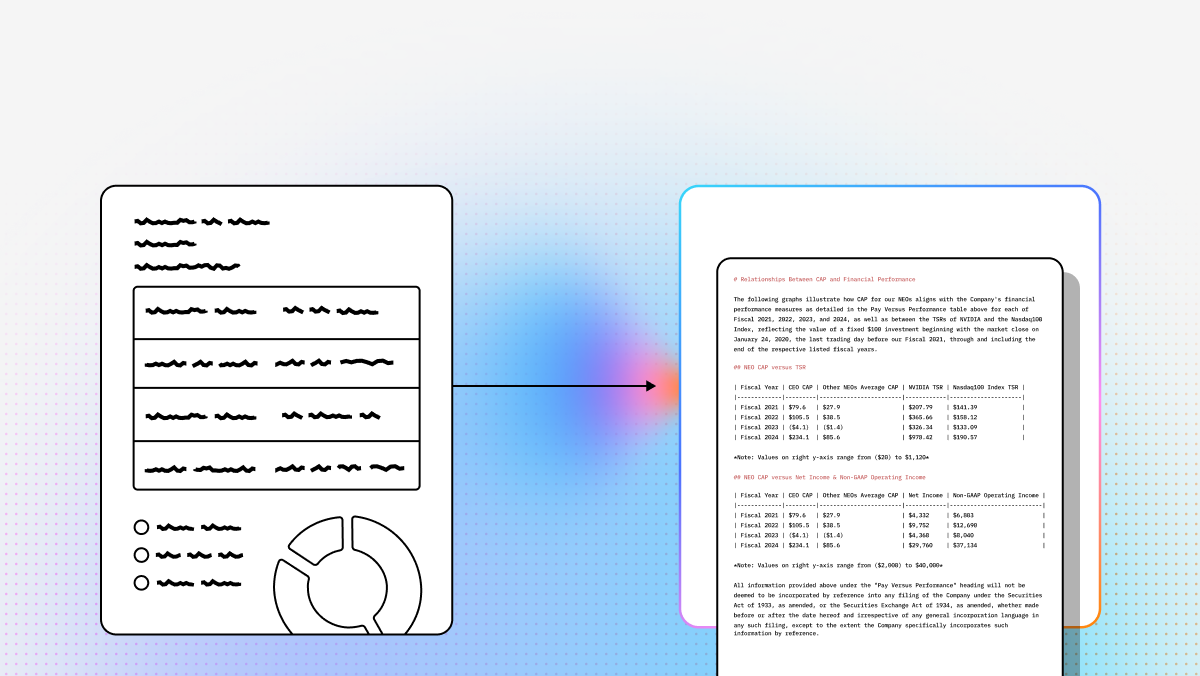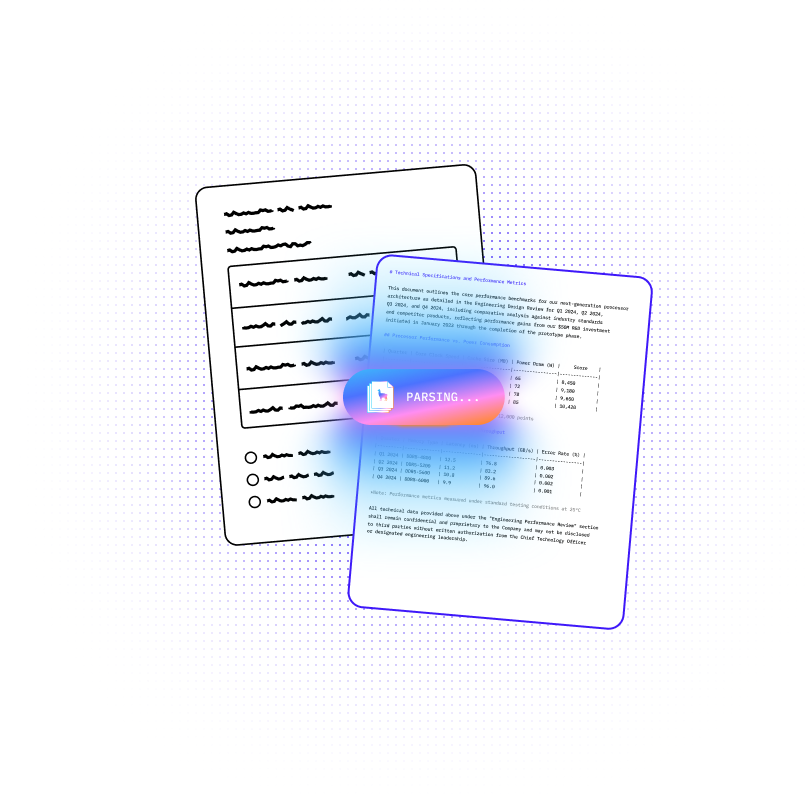
The insurance industry is moving from brittle, template-driven OCR to agentic document processing. Historically, extracting data from ACORD forms required fixed templates, bounding boxes, and custom models—approaches that break when layouts change, scans degrade, or packets include attachments and handwritten notes.
Modern AI platforms aim to understand document structure and meaning, not just detect text. For engineering teams building claims automation, underwriting workflows, compliance pipelines, or broker intake systems, this shift determines whether you can achieve straight-through processing (STP) or end up with fragile post-processing and large manual review queues.
This guide compares top ACORD processing platforms for technical buyers: where each fits best, what it’s optimized for, and key tradeoffs.
| Platform | Capabilities | Best Use Cases | APIs / Integration Style |
|---|---|---|---|
| LlamaIndex (LlamaParse & LlamaExtract) | Semantic parsing; schema-based extraction w/ confidence + citations; multimodal (tables/images/handwriting); agentic workflows | Claims assistants, compliance, fraud monitoring, underwriting support, AI-native doc pipelines | Dev-first Python/TS SDKs; API-first; modular pipelines; cloud or self-hosted |
| Amazon Textract | OCR + forms/tables/checkboxes/handwriting; high throughput; JSON with bounding boxes + confidence | High-volume ACORD intake; digitization; baseline extraction feeding downstream logic | AWS-native APIs; integrates with S3/Lambda/Comprehend/Bedrock; needs mapping logic |
| Google Cloud Document AI | Specialized parsers; HITL review; classification/entity extraction; PII redaction; multilingual | Intake/routing, multilingual processing, compliance/redaction, review-heavy workflows | GCP processors + APIs; console review tools; integrates with Gemini extraction |
| ABBYY FlexiCapture | Template-based extraction; validation rules; mature verification UI | Stable layouts, legacy/BPO ops, controlled form workflows | Enterprise platform; less API-native; strong for template deployments |
| Azure Document Intelligence | OCR + layout + tables; prebuilt insurance models; query-based retrieval; genAI via Azure AI Studio | Microsoft-centric claims/intake/compliance tied to SharePoint/Dynamics/Power Platform | Azure APIs/SDKs; best in Azure ecosystem; Power Automate orchestration |
| Hyperscience | Strong on messy scans + handwriting; QC + learning from corrections; STP-optimized | Massive intake volumes, handwriting-heavy forms, operations-led labor reduction | Platform-oriented; on-prem/sovereign options; less modular dev tooling |
| UiPath Document Understanding | Extraction inside RPA; hybrid OCR engines; low-code automation | End-to-end workflows across legacy systems lacking APIs | RPA-first (robots/orchestrator); supports 3rd-party OCR; Autopilot-assisted builds |
1. LlamaParse (LlamaIndex)
Summary
Moves beyond coordinate-based OCR toward semantic, agentic document processing. Instead of “reading boxes,” it reconstructs the document’s logical structure so extraction is more robust across layout variation and complex packets.
Best For
Developer-led teams building AI-native workflows: claims copilots, underwriting assistants, fraud/compliance checks, RAG pipelines.
Key Benefits
- Resilient to layout changes (semantic understanding)
- Produces schema-aligned JSON (not just OCR text)
- Auditability via confidence + citations
- Composable components (parse → extract → index → workflows)
Core Features
- LlamaParse for complex PDFs, tables, dense layouts
- LlamaExtract for structured schema extraction w/ citations
- Multimodal handling (tables/images/handwriting)
- Agentic workflows for validation/routing/exception handling
- Indexing for retrieval over doc collections
Limitations
- Developer-first (less turnkey for ops teams)
- No native HITL UI out of the box (you may build one)
- Less aligned to services-led procurement expectations
2. Amazon Textract
Summary
A scalable OCR/extraction engine ideal for teams already on AWS. Strong throughput and infrastructure integration, but typically needs downstream mapping and validation.
Core Features
- OCR + handwriting + tables + key-value + checkboxes
- JSON output with bounding boxes + confidence
- Integrates with S3/Lambda/Comprehend/Bedrock
Best For
High-volume standardized ACORD intake, digitization, and OCR pipelines feeding later enrichment.
Limitations
- Can be brittle with significant layout variation
- Limited contextual reasoning without additional LLM/rules layer
- Often requires heavy post-processing to normalize into insurance schemas
3. Google Cloud Document AI
Summary
Sits between OCR and full doc intelligence: extraction + NLP + built-in review tooling. Strong for regulated workflows, multilingual needs, and redaction.
Core Features
- Specialized parsers
- Human-in-the-loop (HITL) review tools
- Classification/entity extraction + PII redaction
- Multilingual + Gemini-powered extraction options
Best For
Enterprise intake and routing, compliance/redaction, and workflows that require manual validation for low-confidence fields.
Limitations
- Pricing can get complex with multiple processors + HITL
- Requires meaningful GCP expertise
- Some brittleness remains vs fully semantic approaches
4. ABBYY
Summary
A classic enterprise OCR leader: best for stable layouts, strong validation, and mature manual verification operations.
Core Features
- Template-based extraction with precise field control
- Strong validation rules/business logic
- Mature verification station for operators
Best For
Legacy ACORD processing with predictable templates and established review/BPO teams.
Limitations
- High maintenance when layouts change
- Less adaptable to mixed packets/unstructured docs
- More legacy/template-centric than API-first platforms
5. Azure Document Intelligence
Summary
Strong choice for Microsoft-native organizations. Works well as one component in broader Azure/Power Platform automation.
Core Features
- OCR + layout/table extraction; prebuilt models
- Query-based field retrieval
- Integrates with Azure AI Studio + Power Automate
Best For
SharePoint/Outlook/Dynamics-driven intake, policy lifecycle automation, and Azure-centric document workflows.
Limitations
- Best in Azure (potential lock-in for multi-cloud)
- GenAI extraction may require iteration/prompt tuning
- Advanced modes can introduce latency
6. Hyperscience
Summary
Optimized for STP and operational economics at scale, especially for low-quality scans and handwriting-heavy documents.
Core Features
- Strong on messy scans + handwriting
- QC + learning from human corrections
- On-prem/sovereign deployment options
Best For
High-volume enterprise intake where accuracy improvements directly reduce labor costs.
Limitations
- Higher entry cost and enterprise implementation model
- Upfront configuration/process alignment needed
- Less developer-centric/modular than API-first tools
7. UiPath Document Understanding
Summary
Best viewed as part of an RPA platform: connects document extraction to automation across legacy systems without APIs.
Core Features
- Extraction embedded in RPA workflows
- Hybrid OCR engine support
- Low-code end-to-end automation + orchestration
Best For
Claims and intake workflows that require “moving data” through old portals/desktop apps, not just extracting it.
Limitations
- Heavier infrastructure footprint than API-first tools
- Licensing can get expensive at scale
- Better for workflow automation than pure document intelligence
Here are the FAQs for your ACORD form processing listicle, designed to address the specific pain points of insurance carriers, MGAs, and insurtech developers.
Frequently Asked Questions: ACORD Form Processing
What is ACORD form processing?
ACORD form processing is the automated extraction of data from standardized insurance documents (like the ACORD 25 Certificate of Liability or ACORD 125 Commercial Application). Because these forms are often submitted as flattened PDFs, scans, or faxes, AI-powered tools are required to turn image data into structured JSON or XML for systems like Policy Administration Systems (PAS) or CRMs.
Why is traditional OCR failing for ACORD forms in 2026?
Traditional OCR relies on "zonal" templates—looking for data at specific coordinates. If a broker uses a slightly different version of a form, or if a scan is skewed, the template breaks. Modern Agentic Document Processing uses Vision Language Models (VLMs) to understand the meaning of labels (e.g., "Policy Effective Date") regardless of where they appear on the page, making it far more resilient to layout shifts.
How do these platforms handle handwriting on ACORD forms? Top-tier platforms like LlamaParse, Hyperscience, and AWS Textract use specialized deep learning models trained specifically on medical and insurance handwriting. Instead of just guessing characters, they use context to "reason" what a handwritten limit or name should be based on the surrounding text.
What is the difference between OCR and "Agentic" Document Processing?
- OCR: Simply converts pixels into a string of text. You still have to write complex code to figure out which text belongs to which field.
- Agentic Processing: Uses AI to "read" the document like a human. It can identify tables, handle multi-page attachments, verify that signatures are present, and even flag inconsistencies (like a mismatch between a per-occurrence limit and an aggregate limit) before the data ever hits your database.
Can these tools process ACORD forms with custom attachments?
Yes, but performance varies. Tools like LlamaParse excel here because they are "layout-aware." They can distinguish between the standardized ACORD form and the unstructured "Schedule of Locations" or "Driver List" attached to it, maintaining the relationship between the two.