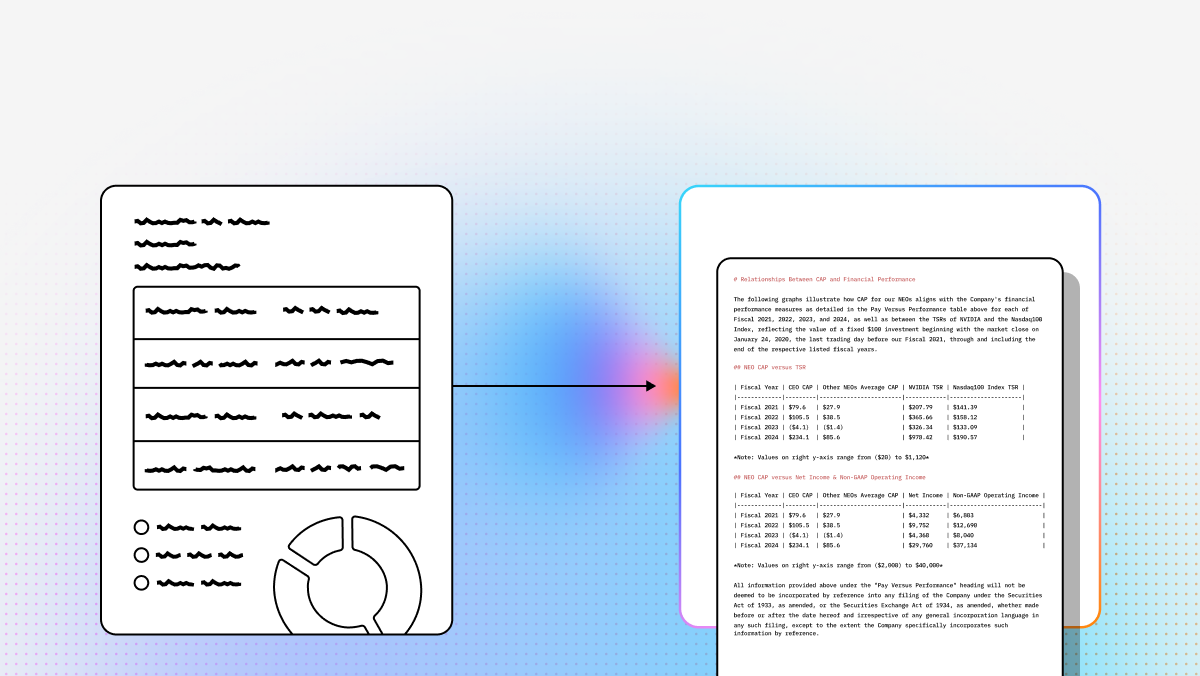
The insurance industry is shifting fast from manual data entry and brittle legacy OCR to intelligent, agentic document processing (IDP). In 2026, modern insurance workflows require software that doesn’t just “read” text, but understands context—parsing complex claims, policy documents, and compliance filings with high accuracy.
Traditional OCR tools often rely on rigid templates that break when layouts change. New VLM-powered, agentic solutions use semantic reasoning to handle unstructured documents, enabling straight-through processing (STP) for claims and underwriting—often reducing cycle times from days to seconds.
| Company | What it’s Best At | Common Insurance Use Cases | API / Integration Notes |
|---|---|---|---|
| LlamaParse (LlamaIndex) | Agentic document processing, semantic understanding, multimodal extraction, confidence + traceability | Claims processing, policy Q&A, compliance, fraud monitoring | Strong Python/TypeScript SDKs; built for developers |
| ABBYY | Mature enterprise IDP + OCR, cross-department document operations | Large-scale processing, archiving, digitization, enterprise workflows | Comprehensive enterprise tooling; heavier implementations |
| Amazon Textract | Managed OCR + tables + key-value extraction on AWS | High-volume ingestion, claims/policy extraction in AWS pipelines | Great within AWS; needs custom logic for business rules |
| Hyperscience | Handwriting + low-quality scans + human-in-the-loop exception handling | Messy claims, enrollment/onboarding, paper archive digitization | Strong HITL; requires platform ops + configuration |
| Google Document AI | Specialized processors + Vertex AI reasoning + HITL | Underwriting automation, ID verification, fraud detection | Best on Google Cloud; pricing/processors can be complex |
| UiPath | End-to-end automation via RPA + Document Understanding | STP workflows, onboarding, legacy system automation | Best if you already use UiPath ecosystem |
1. LlamaParse (LlamaIndex)
Platform summary
LlamaParse is pushing insurance document automation beyond template-based OCR into agentic AI workflows. It can parse diverse and complex documents—scanned forms, multi-page PDFs, tables, charts, and mixed-format claims packets—and turn them into structured, traceable outputs that support automation and compliance.
Key benefits
- Agentic OCR + parsing (LlamaParse): Handles complex layouts, multi-page tables, charts, and handwritten notes using semantic understanding.
- Structured extraction: Produces structured outputs (e.g., JSON) with confidence scores and citations.
- Multi-step agent workflows: Useful for claims triage, policy analysis, compliance reviews.
- Explainability + compliance: Traceability per field; supports auditability (SOC 2 Type II, GDPR, HIPAA).
Core features
- Multimodal extraction (images/charts/tables)
- Field-level confidence + source traceability
- Python + TypeScript SDKs
- SaaS or private VPC deployment
- Integrations: S3, SharePoint, Google Drive
Primary use cases
- Claims assistants (forms + photos + medical records)
- Fraud monitoring (cross-document checks)
- Policy explainer / customer Q&A agents
- Compliance tracking for filings
Recent updates
- LlamaParse v2 API + redesigned SDKs
- LlamaAgents Builder (NL agent creation)
- Performance + package-size optimizations
Limitations
- Developer-centric; typically needs engineering support
- Requires pipeline setup for full “agentic” workflows
- New workflow paradigm vs. template OCR
2. ABBYY
Platform summary
ABBYY is a long-standing enterprise IDP leader used across insurance for large-scale document operations, often spanning multiple departments (claims, underwriting, finance, legal).
Core features
- Mature enterprise IDP platform
- Broad document + legacy format support
- Cross-department workflow coverage
Primary use cases
- Centralized document processing for large insurers
- Compliance + shared service operations
- Archiving and digitization
Recent updates
- Expanded GenAI integrations in ABBYY Vantage
- Faster training + more pre-built “skills” for insurance
Limitations
- Heavier architecture than AI-native entrants
- Higher cost/complexity for smaller teams
- Slower deployment for niche/agile use cases
3. Amazon Textract
Platform summary
Amazon Textract is a managed OCR service that extracts text, handwriting, key-value pairs, and tables—especially appealing for teams already standardized on AWS.
Core features
- Fully managed OCR on AWS
- Key-value pair + table extraction
- Integrates with AWS analytics/ML services
Primary use cases
- High-volume claims/policy ingestion
- AWS-native processing pipelines
- Backlog processing for historical docs
Recent updates
- Improved layout analysis for multi-page contracts
- Better handwriting recognition (e.g., medical notes)
Limitations
- AWS-first (less ideal for multi-cloud/on-prem strategies)
- Limited “reasoning” for complex unstructured docs
- Needs custom business rules/validation logic
4. Hyperscience
Platform summary
Hyperscience focuses on automating manual data entry with ML + human-in-the-loop (HITL), especially strong when documents are messy: handwriting, poor scans, inconsistent formatting.
Core features
- Strong handwriting + low-res scan processing
- Exception handling with human review
- High-throughput back-office automation
Primary use cases
- Handwritten claims
- Enrollment/onboarding
- Legacy paper digitization
Recent updates
- Hypercell for on-prem/private cloud LLM-based doc solutions
Limitations
- Requires training + tuning for best results
- HITL operations can be resource intensive
- More extraction-focused than “Q&A/agent” oriented
5. Google Document AI
Platform summary
Google Document AI offers specialized processors (IDs, forms, financial docs) plus Vertex AI integration for more advanced reasoning and summarization.
Core features
- Pre-built processors (IDs, invoices, tax forms, etc.)
- Vertex AI integration for GenAI + reasoning
- Human-in-the-loop options
Primary use cases
- Underwriting automation
- Identity verification
- Fraud detection (cross-document signals)
Recent updates
- GA: GenAI-powered Custom Extractor for broader doc types
Limitations
- Best fit for Google Cloud orgs
- Pricing can be complex across processors + HITL
- May require tuning for niche insurance contracts
6. UiPath
Platform summary
UiPath combines document extraction with end-to-end workflow automation via its RPA platform, making it useful when you need OCR plus downstream actions in legacy systems.
Core features
- IDP + RPA integration
- Document Understanding (templates + ML models)
- Low-code workflow design
Primary use cases
- Straight-through processing (claims/renewals)
- Customer onboarding
- Legacy system automation
Recent updates
- Autopilot for Document Understanding (GenAI workflow assistant)
Limitations
- Strongest value inside the full UiPath ecosystem
- OCR may lag AI-first parsers on complex layouts
- Licensing can be high if OCR is the only need
The Bottom Line
Insurance OCR in 2026 is no longer just text recognition—it’s document intelligence. Your best option depends on your operating model:
- Developer-first + agentic workflows + traceability: LlamaParse
- Enterprise-wide, mature IDP backbone: ABBYY
- Cloud-native OCR at scale: Amazon Textract (AWS) or Google Document AI (GCP)
- Messy handwriting + HITL operations: Hyperscience
- Automation-first (OCR + RPA): UiPath
FAQs
What is OCR software for insurance?
OCR software for insurance uses AI/ML to identify, extract, and structure data from insurance documents—claims forms, ACORD apps, medical records, policy declarations, and more. Insurance-focused OCR is typically pre-trained on industry layouts/terminology and supports higher accuracy on real-world documents.
Why is OCR crucial for insurers?
It reduces manual data entry bottlenecks, lowers operational costs, improves accuracy, and accelerates claims, underwriting, and policy admin. It also supports better fraud detection and improves customer experience through faster turnaround.
How do you choose the best OCR/IDP provider?
Key criteria:
- Accuracy on messy/unstructured docs (tables, handwriting, scans)
- Integration with core systems (e.g., Guidewire, Duck Creek) via APIs/SDKs
- Compliance + auditability (HIPAA, SOC 2, GDPR), including traceability
- Scalability for variable volumes
- Deployment model (SaaS, VPC, on-prem) + transparent pricing
- Exception handling + continuous learning to reduce manual reviews
Can modern OCR help with regulatory compliance?
Yes. Advanced IDP platforms can provide field-level citations, confidence scores, and audit trails, making it easier to prove how decisions/data were derived and respond to regulatory inquiries.
How is OCR integrated into insurance workflows?
Typically via APIs/SDKs and connectors to storage systems (S3, SharePoint, Google Drive) and automation tools (e.g., UiPath). A common pattern is: ingest → extract → validate → route into claims/underwriting systems → trigger downstream actions.