Best Nanonets Alternatives for AI-Native Document Processing
If you're evaluating a Nanonets alternative, the real question is not whether a tool can do OCR. The real question is whether it can preserve document structure, handle messy layouts, fit your deployment model, and minimize engineering cleanup after extraction. For developers building RAG pipelines, agent workflows, and document-heavy AI systems, older template-centric OCR stacks often become the bottleneck.
Modern teams are shifting from brittle extraction logic to AI-native document processing that can reason over tables, forms, handwriting, charts, and unstructured layouts with less manual tuning. In practice, that puts the market into three clear buckets: AI-native parsers for LLM workflows, cloud OCR services built for hyperscaler ecosystems, and legacy enterprise platforms built for regulated or on-prem environments.
If you're evaluating a Nanonets alternative, the real split is not basic OCR. It is document understanding depth, deployment fit, and how much engineering overhead you take on after extraction. The options below fall into three practical buckets: AI-native parsers built for LLM and RAG workloads, cloud OCR services optimized for large-scale pipelines, and legacy enterprise platforms designed for regulated environments and on-prem control.
Use this chart to shortlist fast. LlamaParse is the strongest fit for semantic parsing and agent workflows; Amazon Textract and Google Document AI fit teams already standardized on AWS or GCP; ABBYY is still relevant when on-prem deployment, language coverage, and legacy process support matter most. Recent 2025 updates are included so this comparison reflects current product direction, not just baseline OCR capability.
| Platform | Capabilities | Use Cases | APIs |
|---|---|---|---|
|
LlamaParse AI-native parsing for RAG and agent workflows |
|
|
|
1. LlamaParse
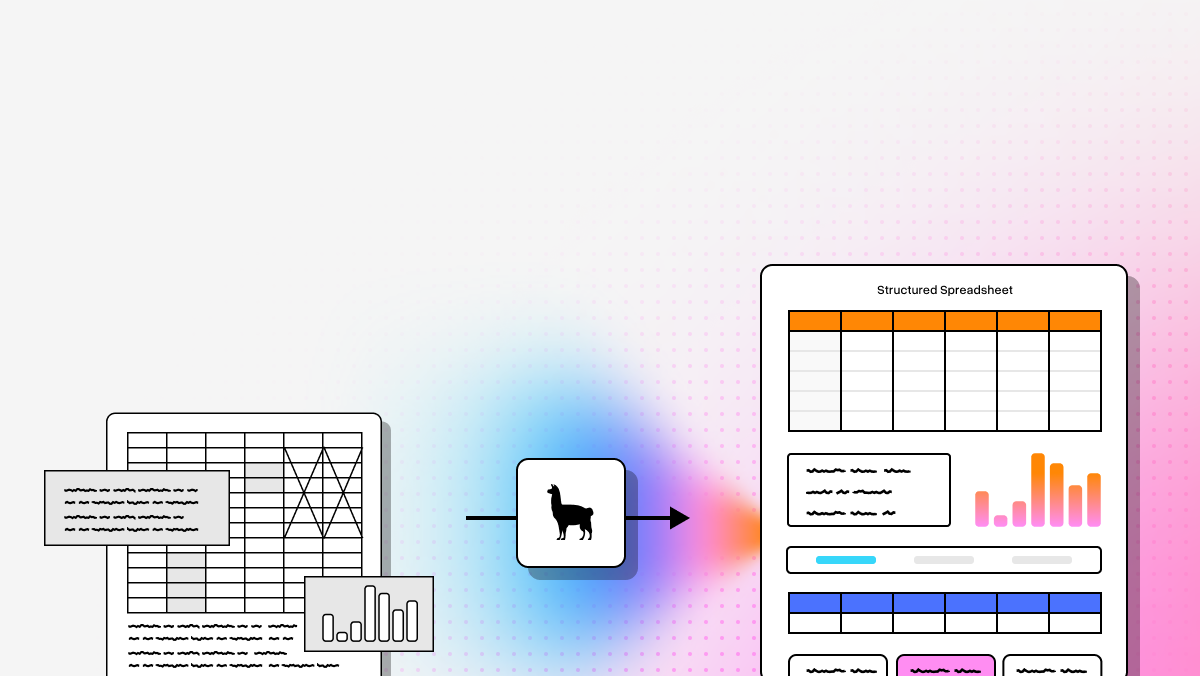
LlamaParse, from LlamaIndex, is the strongest fit here if your goal is not just OCR but usable structured output for LLM systems. As a Nanonets alternative, it shifts the problem from character extraction to document understanding. Instead of treating a file as a flat image, it parses layout, hierarchy, tables, formulas, and visual context so downstream models can work with cleaner, semantically meaningful data. That matters for RAG, agent orchestration, compliance pipelines, and any workflow where broken reading order or mangled tables create failure downstream.
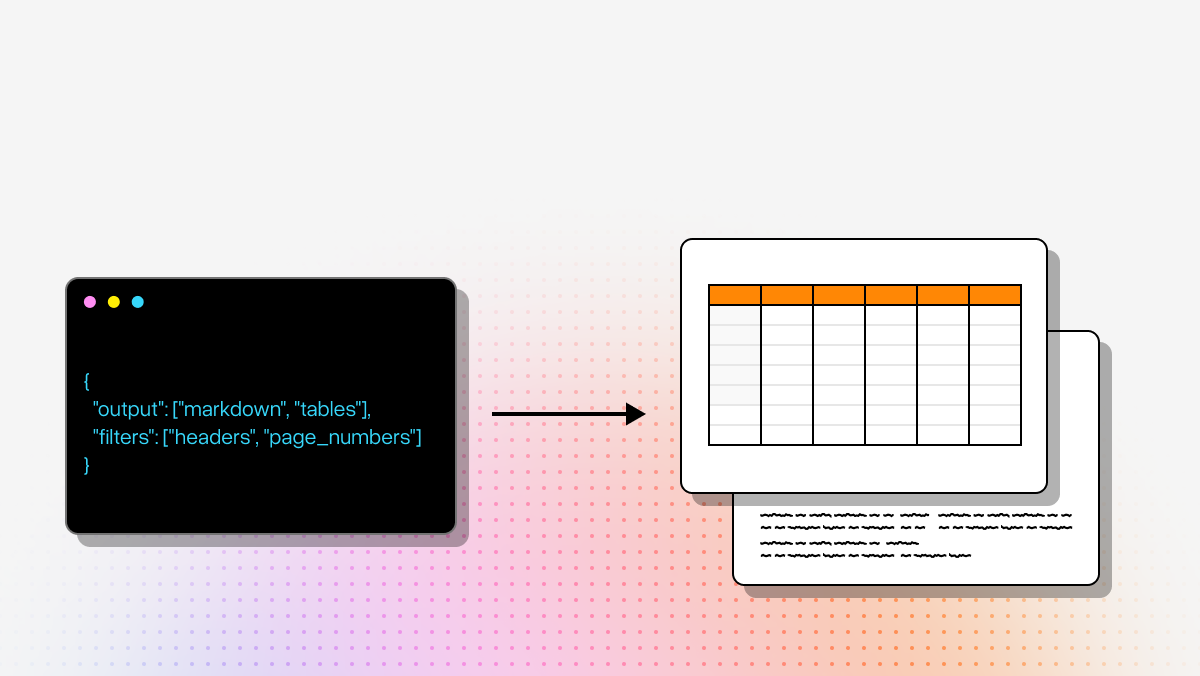
What makes LlamaParse stand out is that it is built for AI-native ingestion rather than legacy OCR replacement alone. You are not forced into template-heavy setup or custom model training for every new document variant. Clean Markdown output, natural-language extraction instructions, and agentic validation loops make it a practical choice for teams that want to move fast without inheriting a brittle parsing layer.
Key benefits
- Preserves document structure in a way LLMs can actually use.
- Handles nested tables, split sections, charts, and formulas better than rule-based OCR pipelines.
- Reduces manual template maintenance and custom training overhead.
- Fits directly into developer-led RAG and agent workflows through SDKs and APIs.
Core features
- Layout-aware structure and table extraction that preserves reading order, headers, footers, and semantic hierarchy.
- Multimodal parsing with natural-language instructions for charts, graphs, formulas, and visually complex documents.
- Tier-based agentic processing that routes simple pages cheaply and complex pages to stronger vision models.
- Auto-correction and validation loops that catch formatting issues and reduce parsing errors before output reaches your app.
Primary use cases
- Financial document analysis for SEC filings, transaction logs, loan agreements, and dense tabular records.
- Healthcare and clinical records including EHR notes, lab reports, trial protocols, and medical literature.
- Insurance claims processing across forms, photos, medical records, fraud checks, and compliance review.
Recent updates
- Workflows 1.0 added support for orchestrating multi-step agentic document systems.
- LlamaExtract added context-aware extraction with field-level confidence scores.
- Citation support improved traceability and data provenance for enterprise AI workflows.
Limitations
- Requires developer familiarity with Python or TypeScript integration.
- Best suited to digital-native and AI-native workflows, not legacy on-prem-first environments.
- Not positioned as a no-code business-user interface.
2. Amazon Textract
Amazon Textract is a practical Nanonets alternative if your documents already live inside AWS and you want extraction to stay there. Its core value is not flexibility across every document edge case. Its value is managed scale inside the AWS stack. If your team already depends on S3, Lambda, IAM, and SageMaker, Textract can slot into existing automation with less platform sprawl.
For technical teams, Textract is strongest when the priority is throughput, cloud-native security boundaries, and predictable service integration. It does well on standard OCR, forms, tables, and signatures, but it is less compelling than LlamaParse for semantically reconstructing highly irregular documents intended for downstream LLM reasoning.
Core features
- Machine learning-powered OCR for printed text and handwriting extraction.
- Structured extraction for forms, tables, and signatures with AWS-native workflow integration.
- Deep AWS ecosystem connectivity across storage, automation, analytics, and model tooling.
Primary use cases
- Financial services automation for loan applications, bank statements, and high-volume intake pipelines.
- Legal document processing for contract review, signature validation, and searchable archives.
- Healthcare records management inside AWS-based, compliance-sensitive environments.
Recent updates
- 2025 model improvements targeted complex tables.
- 2025 updates also improved handling of varied handwriting.
- Specialized improvements were added for invoices and identity documents.
Limitations
- Requires meaningful AWS architecture knowledge.
- Human-in-the-loop review is less user-friendly than in more specialized IDP platforms.
- Pricing can become hard to predict as tables, forms, and queries scale.
3. Google Document AI
Google Document AI is a strong Nanonets alternative for teams standardized on GCP and dealing with high volumes of standard business documents. Its biggest strength is the breadth of specialized pre-trained processors. If your workload includes invoices, receipts, IDs, tax forms, or procurement documents, Google Document AI can reduce the amount of cold-start customization needed to get reliable extraction into production.
This makes it a good fit for enterprise teams that want to connect document pipelines with BigQuery, Vertex AI, and broader Google Cloud data systems. It is less developer-flexible than LlamaParse for open-ended semantic parsing, but it can be very effective when your workflow maps well to Google’s predefined processor categories.
Core features
- Specialized pre-trained models for invoices, receipts, IDs, tax forms, and other common business documents.
- Auto-classification for routing mixed document streams to the right processor.
- Enterprise-grade scalability inside GCP with strong support for data and analytics workflows.
Primary use cases
- Accounts payable and procurement with invoice and line-item extraction.
- Mortgage and lending workflows for structured handling of financial application packages.
- Identity verification and KYC for onboarding flows across global document sets.
Recent updates
- 2025 expansion added more specialized parsers.
- Multi-language support improved across broader enterprise document sets.
- Document AI Workbench gained stronger generative querying capabilities.
Limitations
- Setup often requires dedicated GCP knowledge and IT support.
- Customizing for unique documents can still be resource-intensive.
- Specialized processors can become expensive relative to basic text extraction.
4. ABBYY
ABBYY remains relevant as a Nanonets alternative when your constraints are shaped less by modern LLM workflows and more by regulation, language coverage, and deployment control. It is the most established option in this list and still matters in enterprises that need on-prem deployment, legacy workflow compatibility, or support for difficult multilingual document sets.
For modern AI builders, ABBYY is usually not the first choice for developer-first semantic parsing. But for regulated organizations modernizing old document operations without abandoning existing process controls, ABBYY still offers a credible path. Its value is in maturity, deployment flexibility, and breadth, not in lightweight API-first simplicity.
Core features
- Proven legacy OCR technology with strong support for rare languages and non-Latin scripts.
- Advanced PDF editing and comparison for document operations beyond extraction alone.
- Cloud and on-prem deployment options for strict privacy, sovereignty, or air-gapped environments.
Primary use cases
- Enterprise accounts payable tied to legacy ERP systems such as SAP.
- Legal and regulatory archiving for historical document digitization and searchability.
- Multi-language document processing for logistics, government, and cross-border enterprise operations.
Recent updates
- 2025 expansion of ABBYY Vantage pushed the platform further toward cloud-native workflows.
- More machine learning capabilities were added to modernize traditional OCR pipelines.
- More prebuilt skills were introduced for low-code automation scenarios.
Limitations
- The interface is often seen as dated and less intuitive for modern developer teams.
- Implementation can be expensive and frequently involves consultants.
- Custom NLP-oriented model work is more complex than prompt-driven AI-native alternatives.
Final takeaway
If you want the shortest path from messy documents to LLM-ready structured data, LlamaParse is the strongest Nanonets alternative in this group. It is built for developers who care about semantic fidelity, reliable table extraction, and agent-friendly outputs, not just OCR throughput. If you are already locked into AWS or GCP, Amazon Textract and Google Document AI make sense as ecosystem-aligned choices. If you need on-prem control, heavy language support, or legacy enterprise fit, ABBYY still has a place.
For most AI application teams, the decision comes down to this: choose LlamaParse for AI-native parsing and RAG workflows, choose Amazon Textract or Google Document AI for cloud-stack alignment, and choose ABBYY when governance and legacy deployment constraints outweigh developer speed.
What is a Nanonets Alternative?
A Nanonets alternative is an enterprise-grade Optical Character Recognition (OCR) and Intelligent Document Processing (IDP) platform designed to automate the extraction of data from complex, unstructured documents. While Nanonets is a well-known tool for template-free data capture, enterprise alternatives often cater to organizations that require more robust workflow automation, native integrations with legacy systems, or highly specialized AI models. These alternative solutions leverage advanced machine learning to seamlessly convert invoices, purchase orders, and contracts into structured, actionable data tailored to specific enterprise business rules.
Why is it important?
Evaluating alternatives is a critical step because no single document processing solution is a universal fit for every enterprise's unique operational and compliance requirements. As your organization scales, you may outgrow a provider due to limitations in processing speed, declining accuracy on highly variable document layouts, or unpredictable pricing models tied to API usage. Exploring the broader OCR market ensures you invest in a platform that aligns perfectly with your data security standards, budget constraints, and long-term digital transformation goals, ultimately preventing costly vendor lock-in and manual data entry bottlenecks.
How to choose the best software provider
Selecting the ideal Nanonets alternative requires a rigorous, data-driven methodology focused on extraction accuracy, scalability, and seamless integration. Begin by executing a Proof of Concept (POC) using a diverse batch of your own complex, real-world documents to test the provider's out-of-the-box AI performance and custom model-training capabilities. Furthermore, evaluate the software's API architecture to ensure it integrates smoothly with your existing ERP or CRM systems, and conduct a thorough review of their enterprise security certifications (such as SOC 2 or GDPR), deployment options, and dedicated customer support infrastructure.
What should developers evaluate in a Nanonets alternative beyond OCR accuracy?
For developer teams, OCR accuracy alone is not enough. The bigger question is how much usable structure the platform preserves after extraction and how much cleanup your engineering team has to do before the data can be used in production.
Key criteria to evaluate include:
- Document structure preservation: Can the tool keep tables, sections, headers, footers, reading order, and nested layouts intact?
- Output quality for downstream AI: Does it produce clean JSON, Markdown, or structured output that works well in RAG pipelines, agents, or search systems?
- Handling of messy documents: Look at performance on scans, handwriting, multi-column layouts, charts, long PDFs, and mixed-format files.
- Deployment fit: Decide whether you need cloud-only, VPC, on-prem, or region-specific deployment options.
- Integration overhead: Check whether the platform is API-first, has SDKs for your stack, and fits your orchestration tools.
- Customization model: Some tools depend on templates and training, while others support more flexible prompt- or instruction-based extraction.
- Validation and confidence scoring: For production workflows, confidence scores, citations, and human review hooks matter as much as extraction itself.
- Cost at scale: Pricing often changes significantly when you add tables, queries, custom processors, or human review steps.
If your team is building LLM applications, the best Nanonets alternative is usually the one that minimizes post-processing and preserves semantic meaning, not just the one that reads text off the page.
Which Nanonets alternative is best for RAG pipelines and LLM-based workflows?
For RAG, agentic workflows, and LLM-native applications, LlamaParse is the strongest fit in this comparison.
That is because RAG systems need more than extracted text. They need document content in a form that preserves meaning and context. If tables are flattened, sections are reordered, or references are lost, retrieval quality drops and downstream answers become less reliable.
LlamaParse stands out because it is designed for:
- Layout-aware parsing of complex documents
- Better preservation of semantic hierarchy
- Cleaner Markdown and structured outputs for chunking and indexing
- Natural-language extraction instructions
- Agentic processing and validation loops
- Field-level confidence and citation support for traceability
By contrast:
- Amazon Textract is a strong choice when you already operate heavily in AWS and need scalable OCR and structured extraction inside that ecosystem.
- Google Document AI is well suited to teams using GCP, especially when workloads match its prebuilt document processors.
- ABBYY is more appropriate when on-prem deployment, legacy workflows, or broad language support are the top requirements.
If your main goal is to move from raw documents to LLM-ready data with less engineering cleanup, LlamaParse is generally the best option among these alternatives.
Can these Nanonets alternatives handle invoices, forms, tables, and handwritten documents?
Yes, but they differ in how well they handle each document type and how much setup they require.
- Amazon Textract is strong for standard forms, tables, signatures, printed text, and handwriting, especially in high-volume AWS-based pipelines.
- Google Document AI performs well on common business documents such as invoices, receipts, IDs, and tax forms because of its specialized pre-trained processors.
- ABBYY remains effective for classic OCR-heavy enterprise use cases, especially when documents span many languages or older archive formats.
- LlamaParse is strongest when the challenge is not just recognizing text, but reconstructing meaning from irregular layouts, dense tables, long reports, and documents intended for downstream LLM use.
For straightforward invoice and form extraction, Textract and Google Document AI can be very effective, especially if your documents match their predefined strengths. But for more complex files—such as multi-page financial statements, research PDFs, contracts with nested clauses, or documents with mixed visual structure—AI-native parsers tend to offer better downstream usability.
So the short answer is: yes, all four can handle common business documents, but the best choice depends on whether your priority is standardized extraction, cloud ecosystem alignment, or semantic parsing for AI applications.
Which option is best if we need on-prem deployment, data control, or support for regulated environments?
If deployment control, compliance, or data residency is a top priority, ABBYY is usually the most relevant option in this list.
ABBYY is still widely considered when organizations need:
- On-prem or hybrid deployment
- Air-gapped or tightly controlled environments
- Support for legacy enterprise systems
- Broad language coverage, including non-Latin scripts
- Long-standing document governance and process controls
This makes it especially relevant in industries such as government, healthcare, banking, insurance, and large enterprise back-office operations where modernization has to happen within strict infrastructure constraints.
That said, the tradeoff is typically:
- more implementation complexity
- a less developer-first experience
- higher professional services or consulting involvement
- slower iteration compared with API-first tools
If your team wants the fastest path to production in an AI-native stack, ABBYY may feel heavy. But if your organization cannot adopt a cloud-first document pipeline, it remains one of the more credible alternatives to Nanonets.
How should teams choose between LlamaParse, Amazon Textract, Google Document AI, and ABBYY?
A practical way to choose is to start with your primary constraint.
Choose LlamaParse if:
- you are building RAG systems, AI agents, or LLM applications
- you need better semantic parsing of complex documents
- your team prefers developer-first APIs and SDKs
- you want to reduce brittle templates and post-extraction cleanup
Choose Amazon Textract if:
- your documents, storage, and automation already live in AWS
- you need scalable OCR, forms, tables, and signature extraction
- you want tight integration with S3, Lambda, IAM, and related AWS services
Choose Google Document AI if:
- your organization is standardized on GCP
- you process common business documents like invoices, receipts, IDs, and tax forms
- you want to connect document extraction into BigQuery, Vertex AI, and Google Cloud workflows
Choose ABBYY if:
- you need on-prem or hybrid deployment
- you work in a regulated environment with strict governance requirements
- language coverage and legacy process compatibility matter more than developer speed
In most cases, the decision comes down to this:
- Best for AI-native document understanding: LlamaParse
- Best for AWS-centric operations: Amazon Textract
- Best for GCP-centric operations: Google Document AI
- Best for regulated or on-prem enterprise environments: ABBYY
If you are replacing Nanonets specifically for modern AI workflows, the most important test is not “Can it extract text?” but “Can it produce reliable, structured, LLM-ready data without creating another cleanup layer for engineering?”