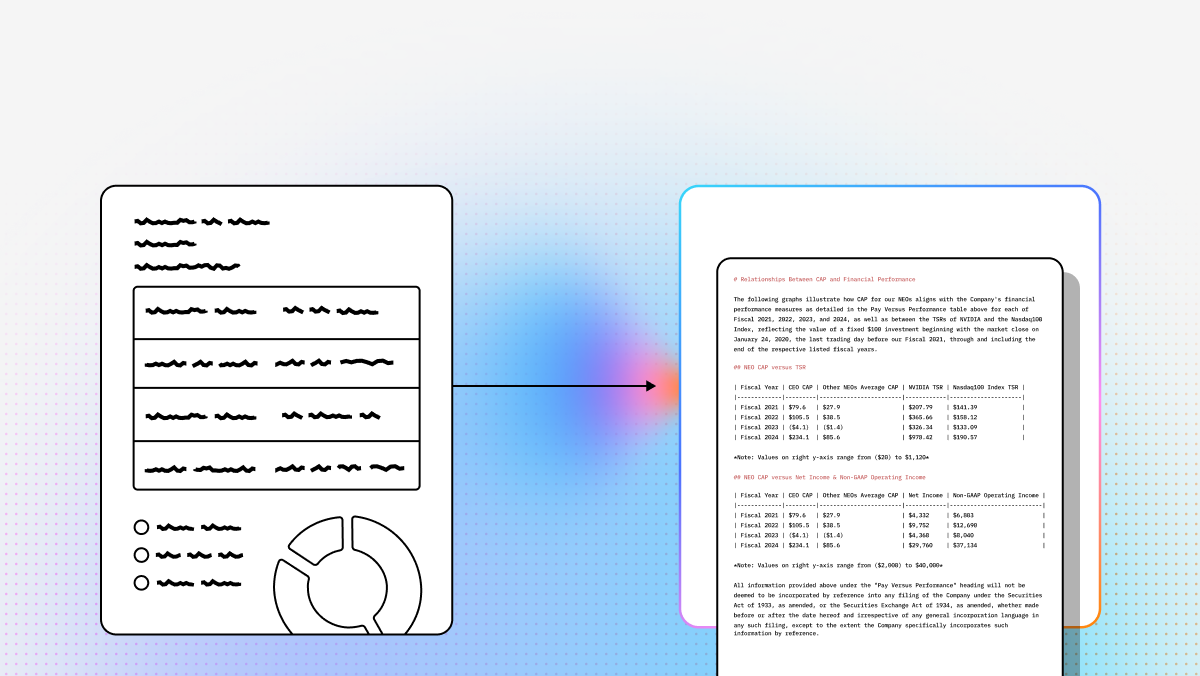
In modern manufacturing, critical information is often trapped in unstructured formats, scanned schematics, handwritten safety logs, ISO compliance reports, and vendor invoices. In 2026, the cost of manual entry shows up as production delays, compliance risk, and lost insights.
OCR has moved past basic “text scraping” into Agentic Document Processing: systems that don’t just read characters, but interpret structure and context (tables, diagrams, technical language, regulatory nuance). This guide compares top OCR tools for manufacturing with an emphasis on accuracy, scalability, and turning messy technical documents into usable data.
| Company | Strengths / Capabilities | Best-Fit Manufacturing Use Cases | APIs / Integration |
|---|---|---|---|
| LlamaParse (LlamaIndex) | Agentic OCR with VLMs, strong parsing + extraction, enterprise scalability/security | Maintenance + repair copilots, compliance extraction, spec navigation/search | Python + TypeScript SDKs, modular/composable |
| Landing AI | OCR + computer vision for factory floor, stamped/embossed text, low-code edge deployment | Line verification, QC branding checks, asset/ID plate tracking | Edge-focused training/deployment environment |
| Azure Document Intelligence | Custom neural models, layout + table extraction, prebuilt procurement models | Invoices/POs, safety & compliance forms, manual indexing | Azure cloud service; Microsoft ecosystem |
| UiPath (Document Understanding) | OCR inside RPA workflows, ERP connectors, human-in-the-loop validation | Work orders, logistics/customs docs, inventory reconciliation | UiPath platform + AI Center |
| DeepSeek-OCR | Multimodal reasoning, LaTeX/formulas, high-res visual input | Blueprint understanding, R&D docs, spec comparison | API-first for RAG pipelines |
| ABBYY | Best-in-class classic OCR, structure preservation, low-quality scan enhancement | Legacy archives/blueprints, audit readiness, doc comparison | Desktop-heavy; some cloud options |
1. LlamaParse (LlamaIndex)
Platform summary:
LlamaParse provides an enterprise platform for AI-powered parsing, extraction, and indexing, designed to be more robust than brittle template-based OCR. It’s well-suited for complex manufacturing documentation (manuals, supplier certs, invoices, dense specs), converting them into AI-ready structured data.
Key benefits
- Agentic OCR for complex, unstructured manufacturing documents
- Semantic understanding of technical content, diagrams, and tables
- Enterprise-grade scalability + security
- Developer-first, modular integration
Core features
- Agentic OCR for complex documents: Uses multimodal LLMs/VLMs to reason about structure, charts, tables, handwriting.
- Parsing and extraction: Layout-aware parsing and schema-based extraction with confidence and traceability.
- Enterprise scalability: Large-volume pipelines with parallel processing + governance.
- Integrations: Connectors for LLMs, data sources, vector DBs.
Primary use cases
- Maintenance/repair copilots that retrieve + summarize manuals and service records
- Supply chain + compliance term extraction from contracts and reports
- Spec navigation: search and pull specific SOPs/diagrams from large libraries
Recent updates
- LlamaAgents Builder: Agent creation via natural language
- Semtools v2: Migration to LlamaParse v2 for more control
- Document Agent Templates: Prebuilt workflows
- LlamaSheets (Beta): Better spreadsheet parsing (merged cells, multi-level headers)
Limitations
- Requires developer resources to implement well
- Advanced features are cloud-native; on-prem needs enterprise setup
- Fast-moving product: teams must track docs/changes
2. Landing AI
Platform summary:
Landing AI (Andrew Ng) focuses on industrial computer vision and excels where OCR meets the physical factory floor—reading serial numbers, barcodes, stamped/embossed markings, and challenging surfaces.
Core features
- OCR + visual inspection in one workflow (text + defects)
- High-precision recognition of embossed/debossed text
- Contextual understanding of text/component relationships
- Low-code deployment to edge devices
Primary use cases
- Assembly line verification of component serials/IDs
- QC checks for branding, symbols, regulatory marks
- Asset tracking via ID plates and equipment labels
Recent updates
- LandingLens LVM: Less labeled data needed; faster rollout across new lines
Limitations
- Narrower document-processing coverage vs “document OCR suites”
- May require specific industrial GPU setups for real-time edge
- Can cost more than generic cloud OCR APIs
3. Azure Document Intelligence
Platform summary:
A strong cloud option for extracting text, key-value pairs, and tables—especially for manufacturers already standardized on Microsoft.
Core features
- Custom neural models for proprietary forms
- Layout analysis (tables, headers, selection marks)
- Prebuilt models for invoices and purchase orders
- Advanced table extraction for complex line items
Primary use cases
- Procurement automation (invoices, POs) at scale
- Safety/compliance tracking (certifications, training docs)
- Indexing technical manuals for search
Recent updates
- Generative AI integration: Natural language querying over extracted data
Limitations
- Cloud dependency (internet + Azure)
- Cross-cloud usage can increase complexity
- High-volume archival runs can create cost variability
4. UiPath
Platform summary:
Best when OCR is part of end-to-end automation. UiPath combines extraction + validation + workflow automation, with strong enterprise connectors (SAP/Oracle, etc.).
Core features
- AI Center for model management + retraining
- Hybrid extraction (templates + AI)
- ERP connectors for “straight-through” processing
- Human-in-the-loop review to reach high accuracy
Primary use cases
- Work order processing (printed + handwritten)
- Logistics, shipping, customs paperwork automation
- Inventory reconciliation workflows
Recent updates
- Autopilot for Document Understanding: LLM-assisted schema suggestions for new forms
Limitations
- Best ROI when you’re using broader UiPath RPA (may be overkill for OCR-only)
- On-prem can require notable server resources
- Learning curve for Studio + DU frameworks
5. DeepSeek-OCR
Platform summary:
A newer “Agentic OCR” style solution using multimodal reasoning—particularly strong for technical drawings, formulas, and dense layouts.
Core features
- Multimodal reasoning across text + visual elements
- LaTeX/formula support
- High-resolution handling for large blueprints
- API-first design for RAG integration
Primary use cases
- Blueprint analysis feeding digital twin workflows
- R&D knowledge capture (lab notebooks, technical papers)
- Spec comparison using reasoning (not just text match)
Recent updates
- DeepSeek-VL2: Better spatial awareness for nested tables + multi-column layouts
Limitations
- Newer ecosystem (fewer enterprise connectors/mature tooling)
- Reasoning-heavy OCR can increase inference cost
- Sensitive IP requires strong data governance
6. ABBYY
Platform summary:
A long-time leader in high-precision OCR and document conversion—especially strong for legacy archives, low-quality scans, and preserving exact layout.
Core features
- ADRT for document structure preservation
- Document comparison for engineering change management
- Image enhancement + scan preprocessing
- PDF/A archiving for long-term retention
Primary use cases
- Digitizing legacy blueprints and technical drawings
- Audit readiness via PDF/A conversion
- Engineering change management through document diffs
Recent updates
- Vantage Platform: “Document Skills” including models for MSDS and CoA
Limitations
- Many features are desktop-centric; cloud scaling can be less seamless
- Enterprise licensing can be costly vs usage-based APIs
- Feature-rich UI may overwhelm non-technical users
FAQ
What is Agentic OCR and how does it differ from traditional OCR in manufacturing?
Agentic OCR uses AI/LLMs to extract text and understand document context and relationships (tables, diagrams, handwriting, regulatory structure).
Traditional OCR primarily converts pixels to characters and often breaks when layouts or formats change.
How do I choose the best OCR software for my manufacturing use case?
Consider:
- Document complexity: manuals/blueprints/handwriting → LlamaParse or DeepSeek-OCR
- Integration needs: ERP/RPA/cloud storage connectors and APIs
- Scalability + security: enterprise governance, volume, audit trails
- Deployment model: cloud vs on-prem vs hybrid
- Primary workflow: factory-floor vision (Landing AI) vs archiving/compliance (ABBYY)
Can OCR software handle handwritten documents and technical drawings common in manufacturing?
Yes—modern multimodal/LLM-based systems increasingly can. Tools like LlamaParse and DeepSeek-OCR are designed for handwriting, diagrams, complex layouts, and formulas.
What are the main challenges of implementing OCR in manufacturing environments?
- High variability in documents and scan quality
- Integration complexity with ERP/MES/compliance tools
- Data privacy/IP protection (especially with cloud inference)
- Accuracy requirements that may demand human validation loops
How does LlamaParse support developers building OCR-powered manufacturing apps?
LlamaParse provides:
- Python + TypeScript SDKs and APIs
- Agentic OCR using multimodal models
- LlamaParse (parsing) and LlamaExtract (schema extraction with confidence + citations)
- Templates/connectors to accelerate RAG and enterprise deployment
- Scalability and security controls for high-volume manufacturing environments