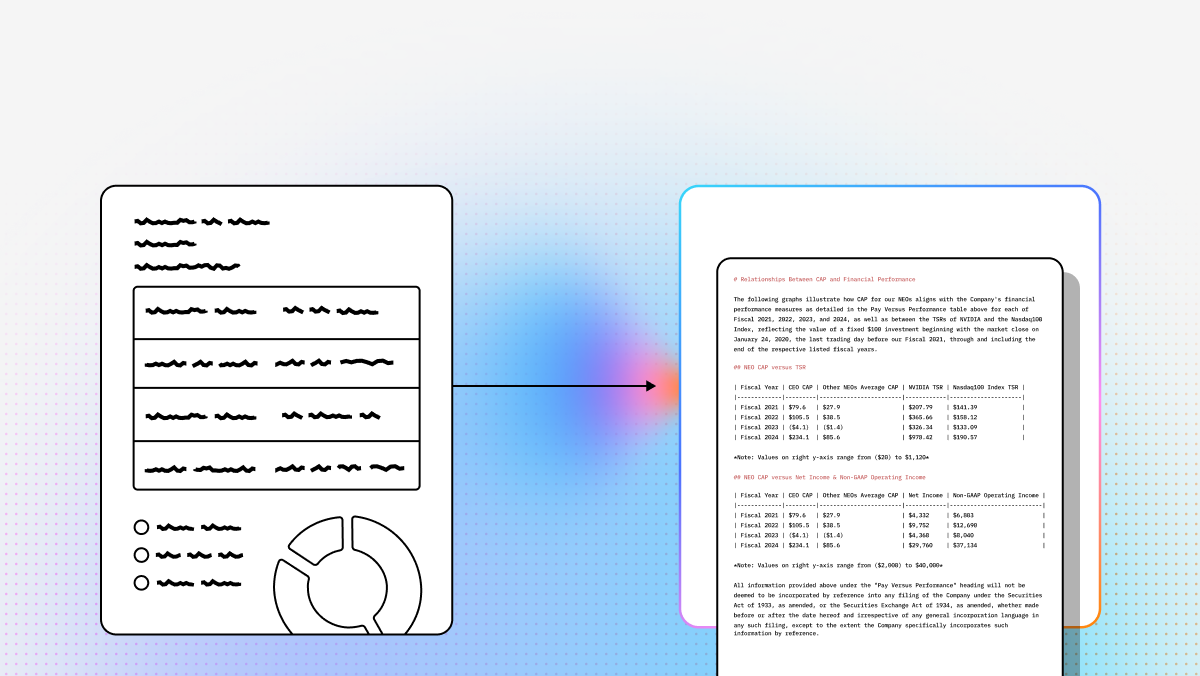
In healthcare, critical data is often trapped in “dark” formats, handwritten clinical notes, faxed lab reports, and complex insurance claims. Traditional OCR helped convert images to text, but modern workflows require more than digitization.
The industry is shifting from basic OCR to Agentic Document Processing: systems that use Generative AI to understand medical context, reason across layouts, and extract structured fields that can flow into EHR/EMR and billing systems.
| Company | Strengths | Best For | Integration / APIs |
|---|---|---|---|
| LlamaParse (LlamaIndex) | Agentic OCR + reasoning; structured extraction; enterprise scalability; developer-first | Clinical note digitization, medical coding, lab report standardization | Python/TypeScript SDKs; LlamaAgents Builder |
| AWS Textract | Strong forms/tables; HIPAA-eligible; “Queries” feature | High-volume claims, fax automation, AWS-native pipelines | Deep AWS ecosystem integration |
| Google Document AI | Healthcare parsers; Human-in-the-Loop (HITL); Vertex AI (Gemini) integration | Intake automation, clinical trial extraction, record summarization | Google Cloud + Vertex AI |
| Azure Document Intelligence | Custom neural models; layout API; enterprise security | Insurance cards, EHR migration, prescription digitization | Azure + Microsoft 365 integration |
| ABBYY | On-prem; mature IDP; batching; Vantage “Skills” | Legacy archives, admin workflows, standardized claims | Vantage platform + low-code training |
| Docling (Open Source) | Fast, layout-aware parsing; markdown export; runs locally | RAG pipelines, research parsing, pre-processing | OSS library—developer integration required |
| Hyperscience | Excellent handwriting; quality control; HITL at scale | Messy intake, complex adjudication, abstraction | Hypercell orchestration + human review |
1. LlamaParse (LlamaIndex)
Platform Summary
LlamaParse takes an agentic document processing approach: instead of brittle templates, it uses advanced AI to understand unstructured/multimodal healthcare documents (clinical notes, lab reports, research PDFs, patient forms) and reliably extract structured insights.
Key Benefits
- Deep semantic understanding of complex healthcare documents
- Field-level confidence scores + source citations (auditability)
- Enterprise scalability for large hospital/insurer workloads
- Developer-first platform + robust SDKs
Core Features
- Agentic OCR: Context + layout understanding (tables, charts, handwriting)
- Structured data extraction: Extract patient IDs, ICD/CPT, etc. with confidence + citations
- Enterprise scalability: Parallel pipelines via LlamaCloud for high-governance environments
- SDKs: Modular Python + TypeScript to build custom automation
Primary Use Cases
- Clinical assistant (summarize patient histories across sources)
- Automated medical coding (ICD/CPT extraction)
- Research agent (synthesize clinical trials + literature)
- Patient support agents (answer questions using discharge notes)
Recent Updates
- LlamaAgents Builder (Feb 2026): Natural-language-driven agent builder
- Pre-built Document Agent Templates (Jan 2026): Q&A, invoice processing, etc.
- LlamaSheets (Beta, Jan 2026): Spreadsheet parsing with semantic preservation
- Distributed Data Ingestion (Jan 2026): RayIngestionPipeline support
Limitations
- API-first: you’ll likely need engineering resources for UI/workflows
- Best reasoning often requires cloud LLM connectivity (local options exist)
- Newer than legacy vendors
2. AWS Textract
Platform Summary
A managed service for extracting text, handwriting, forms, and tables—well-suited to processing millions of pages serverlessly inside AWS.
Core Features
- Forms + table extraction (key-value pairs, chart-like structures)
- HIPAA eligibility
- Queries: pull specific fields via natural-language prompts
Primary Use Cases
- High-volume claims processing
- AWS-native analytics (e.g., SageMaker, Comprehend Medical)
- Fax automation for admin workflows
Recent Updates
- Improved cursive handwriting recognition (2025)
- Enhanced layout support for multi-column journals (2025)
Limitations
- AWS lock-in risk
- Less model customization than open frameworks
Unique Selling Point: best choice for teams already on AWS needing massive scale.
3. Google Document AI
Platform Summary
Document AI turns unstructured medical docs into structured data, with healthcare-specific parsers and strong integration with Vertex AI (Gemini).
Core Features
- Healthcare parsers for common forms
- HITL workflows for high accuracy
- Vertex AI / Gemini integration for summarization and reasoning
Primary Use Cases
- Patient intake automation
- Clinical trial data extraction
- Medical record summarization
Recent Updates
- Expanded GenAI reasoning for complex workflows (2025)
Limitations
- Pricing can get complex when combining OCR + GenAI
- Requires GCP familiarity
Unique Selling Point: top-tier integration with Google’s GenAI stack for advanced reasoning.
4. Azure Document Intelligence
Platform Summary
Microsoft’s enterprise extraction platform for simple forms through complex documents—especially strong in Azure-first environments.
Core Features
- Custom neural models for niche forms
- Layout API (tables, checkboxes, structure retention)
- Enterprise security (private endpoints, managed identities)
Primary Use Cases
- Insurance card capture at point of care
- EHR migration from paper records
- Prescription digitization
Recent Updates
- Add-ons for signature + barcode extraction (2025)
Limitations
- Custom models can be sensitive to layout drift
- Best ROI when you’re already on Azure
Unique Selling Point: seamless fit with Microsoft 365 + Azure enterprise controls.
5. ABBYY
Platform Summary
A long-standing OCR/IDP leader known for high-volume batch processing and strong on-prem options for strict data residency.
Core Features
- On-prem deployment
- Vantage “Skills” marketplace (pre-trained models)
- High-volume batch processing
Primary Use Cases
- Legacy archive digitization
- Admin workflow automation
- Standardized claim handling
Recent Updates
- More low-code training for non-technical users (2025)
Limitations
- More setup/config effort for variable formats
- Higher cost—best suited to large enterprises
Unique Selling Point: mature on-prem + batch processing for high-governance orgs.
6. Docling
Platform Summary
A lightweight, layout-aware parser for converting PDFs into usable representations (including Markdown)—popular for developer-led RAG pipelines.
Core Features
- Layout-aware parsing (tables, multi-column)
- Fast + local execution
- Markdown export (LLM-friendly)
Primary Use Cases
- RAG pipelines for local knowledge bases
- Parsing medical research at scale
- Local pre-processing before downstream AI
Recent Updates
- Table recognition performance improvements (2025)
Limitations
- No enterprise HITL workflows / compliance guarantees
- Requires developer integration
Unique Selling Point: best OSS option for fast, local, layout-aware parsing.
7. Hyperscience
Platform Summary
Designed for the “messiest” documents. Combines advanced AI with robust human-in-the-loop validation for very high accuracy.
Core Features
- Strong handwriting recognition for non-standard forms
- Automated QC + human review for 99%+ accuracy targets
- Hypercell platform orchestrates AI + LLMs + human reviewers
Primary Use Cases
- Complex claim adjudication
- Messy patient intake digitization
- Clinical data abstraction (registries, reporting)
Recent Updates
- Better LLM orchestration for generative summaries (2025)
Limitations
- Overkill for simple OCR
- More involved configuration to reach peak accuracy
Unique Selling Point: best-in-class accuracy on handwritten/messy docs with HITL.
FAQs
What is OCR in Healthcare?
OCR in healthcare converts scanned or imaged documents—patient charts, lab results, insurance forms, prescriptions—into searchable, editable digital text. This enables ingestion into systems like EHR/EMR and RCM platforms without manual transcription.
Why is OCR Important for Healthcare?
- Efficiency: reduces manual data entry workload
- Accuracy: lowers transcription errors (critical for PHI and coding)
- Access: clinicians and staff can search and retrieve complete histories faster
- Compliance + operations: supports better documentation and quicker billing cycles
How to Choose the Best OCR Software Provider
Prioritize:
1. Accuracy + healthcare specialization (medical terminology, handwriting, varied forms)
2. Integration (APIs, EHR/EMR compatibility, workflow fit)
3. Security + compliance (HIPAA eligibility, on-prem needs, audit trails)