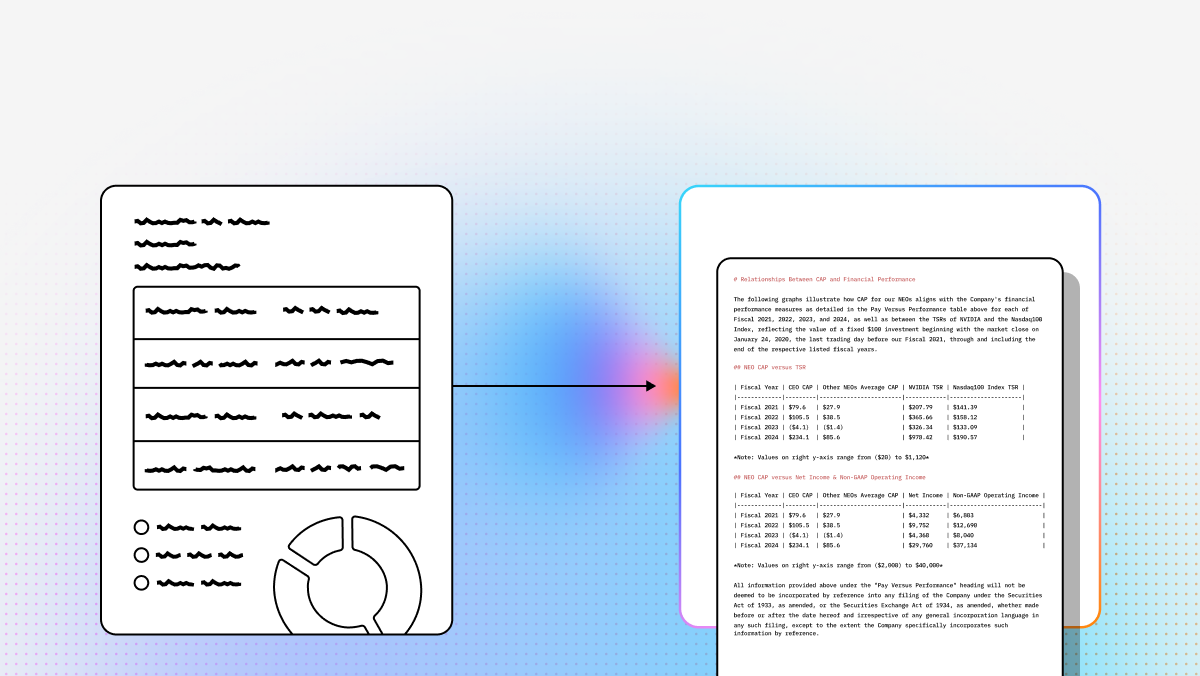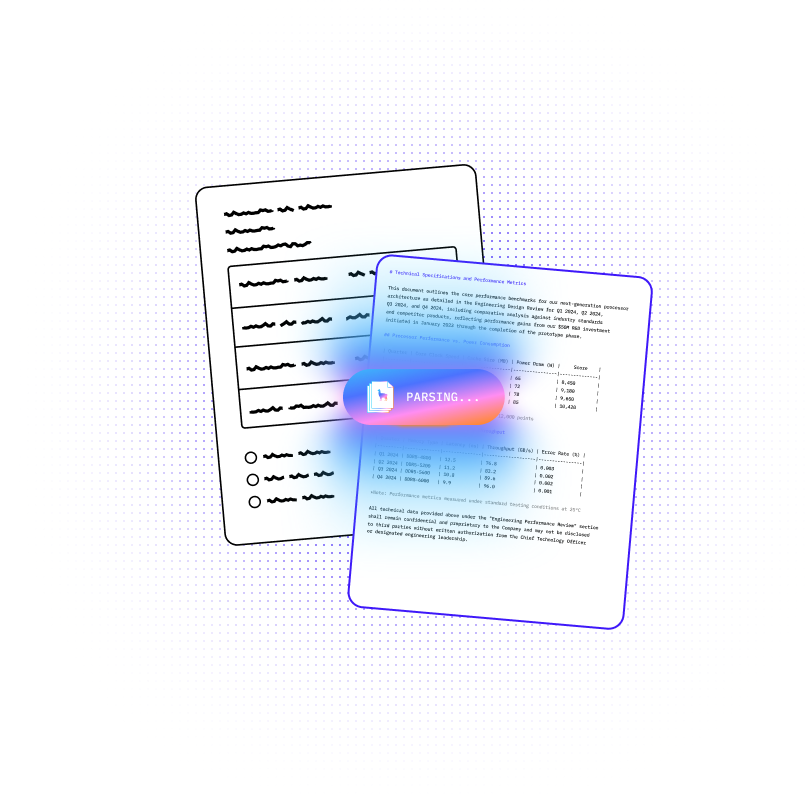
Reducto is an AI-native ingestion platform aimed at high-volume enterprise pipelines, known for multi-pass extraction and high-fidelity, LLM-ready output. It is a capable option for large-scale ingestion. But teams evaluating it often want a more developer-first, RAG-native framework, open-source or on-prem control, or a fit with their existing cloud ecosystem — so it is worth comparing the broader field before committing.
Below are the strongest alternatives to Reducto, starting with LlamaParse. We focus on accuracy on messy documents, structured output with traceability, scale, and fit for agent pipelines.
| Company | Capabilities | Use Cases | APIs / Integrations |
|---|---|---|---|
| LlamaParse | Agentic document processing, multimodal parsing, schema-based extraction, JSON output with confidence + traceability, distributed ingestion | Enterprise knowledge, finance, insurance, legal, agent workflows | Developer-first APIs + SDKs (Python/TypeScript); built for agents |
| Azure Document Intelligence | Pre-built + custom neural models, layout analysis, OCR for scanned/digital docs | Invoices, tax forms, underwriting, Microsoft-centric workflows | REST APIs + Azure SDKs; integrates with Power Platform |
| Google Document AI | Specialized processors, structured extraction, Vertex AI reasoning, HITL | Procurement, mortgage, healthcare records, GCP analytics | GCP-native APIs; integrates with BigQuery/Vertex AI |
| Amazon Textract | Managed OCR, forms + tables, handwriting, natural-language Queries | High-volume ingestion, AWS serverless pipelines, AP automation | AWS APIs (AnalyzeDocument); S3/Lambda/SageMaker |
| ABBYY Vantage | Enterprise OCR/IDP, pre-trained document skills, multilingual extraction | Enterprise document operations, archiving, compliance | Cloud + enterprise integration; low-code workflow tooling |
| Docling (IBM Research) | Open-source layout analysis, multi-format conversion, markdown/JSON output | Open-source RAG, on-prem/PHI-restricted pipelines, docs migration | Open-source library; local/on-prem deployment |
| Hyperscience | Handwriting + low-quality scans, ML extraction, human-in-the-loop exception handling | Messy/handwritten docs, enrollment/onboarding, paper digitization | Strong HITL; requires platform ops + configuration |
1. LlamaParse
Platform summary
Designed for developers and AI-powered automation, LlamaParse processes documents as structured, multimodal assets. It accurately parses challenging elements like tables, charts, layouts, and handwriting to produce normalized, AI-ready data for large-scale document operations.
Key benefits
- Semantic understanding of structure, context, and relationships across pages
- Schema-based extraction with field-level confidence and citations
- Higher straight-through processing with less manual correction
- Developer-first Python/TypeScript SDKs, cloud or self-hosted
Core features
- VLM-powered parsing of tables, charts, handwriting, and multi-column pages
- Structured extraction via LlamaExtract → JSON + confidence + traceability
- Workflow orchestration for validation, exception handling, and routing
- Distributed ingestion for high-volume pipelines; connectors for storage and vector DBs
Primary use cases
- Document-agent pipelines and intelligent automation
- Financial analysis, insurance claims, and contract review
- Enterprise knowledge management
- High-volume, schema-driven extraction
Recent updates
- LlamaAgents Builder (natural language → workflow code)
- LlamaParse v2 API and redesigned SDKs
- LlamaSheets (spreadsheet parsing → Parquet, cell-level features)
- RayIngestionPipeline integration for distributed ingestion
Limitations
- Developer-centric (Python/TS); not a no-code business tool
- Agentic processing may not map cleanly to legacy procurement categories
- VLM workloads can require more compute than basic scrapers
2. Azure Document Intelligence
Platform summary
Azure-native extraction with pre-built and custom neural models plus strong layout analysis, ideal for Microsoft-centric teams ingesting forms and structured documents at scale.
Core features
- Pre-built invoice, receipt, and tax form models
- Custom model training with labeling
- Layout analysis; Power Platform integration
Primary use cases
- Invoice, tax, and underwriting workflows
- Government and healthcare admin digitization
- Microsoft-centric enterprises
Recent updates
- Expanded pre-built models and improved layout analysis
Limitations
- Best fit inside the Microsoft ecosystem
- Can be slower on very large documents
- Tuning needed for niche layouts
3. Google Document AI
Platform summary
A processor-based extraction platform with specialized processors, human-in-the-loop review, and Vertex AI integration for reasoning — a strong managed option for high-volume, standardized ingestion.
Core features
- Specialized processors by document type
- Vertex AI integration for GenAI reasoning
- Human-in-the-loop review
Primary use cases
- Procurement and mortgage underwriting
- Healthcare records
- BigQuery analytics pipelines
Recent updates
- GenAI-powered Custom Extractor for broader document types
Limitations
- Best fit for Google Cloud organizations
- Pricing varies across processors and HITL
- Configuration can be complex
4. Amazon Textract
Platform summary
A fully managed AWS service that extracts text, handwriting, key-value pairs, and tables, with natural-language Queries. Ideal for AWS-standardized teams ingesting documents at scale.
Core features
- Forms and table extraction (key-value pairs)
- Queries to request specific fields in natural language
- Pre-trained analyzers for invoices, receipts, and IDs
Primary use cases
- High-volume ingestion and AP automation
- AWS-native serverless pipelines
- Backlog and historical document processing
Recent updates
- Improved layout analysis and handwriting recognition
Limitations
- AWS-first (less ideal for multi-cloud or on-prem)
- Limited reasoning on complex unstructured documents
- Needs custom business rules and validation logic
5. ABBYY Vantage
Platform summary
A mature enterprise IDP suite with pre-trained “skills,” strong multilingual extraction, and broad coverage for high-volume, standardized documents across departments.
Core features
- Pre-trained document skills plus low-code workflow tooling
- Broad language support and strong format retention
- Cross-department document operations
Primary use cases
- Centralized enterprise document processing
- Compliance and shared-service operations
- Archiving and digitization
Recent updates
- Expanded GenAI features in ABBYY Vantage and more pre-built skills
Limitations
- Heavier architecture than AI-native entrants
- Higher cost and complexity for smaller teams
- Slower to adapt to niche or rapidly changing layouts
6. Docling (IBM Research)
Platform summary
IBM Research’s open-source converter for PDFs, DOCX, and PPTX into Markdown/JSON. It is strong at layout analysis and reading order, and runs locally for privacy-restricted environments.
Core features
- Layout analysis for correct sequencing (multi-column)
- Multi-format support and markdown-first output
- Local and on-prem execution
Primary use cases
- Open-source RAG pipelines
- On-prem or air-gapped ingestion
- Internal documentation migration
Recent updates
- Docling v2.0: faster, better tables, improved formulas and nested lists
Limitations
- Less agentic reasoning than VLM-first platforms
- No managed service or native connectors
- Requires custom ingestion for SaaS/cloud sources
7. Hyperscience
Platform summary
Automates manual data entry with ML and human-in-the-loop review, with particular strength on messy inputs such as handwriting and low-quality scans at high throughput.
Core features
- Strong handwriting and low-resolution scan processing
- Exception handling with human review
- High-throughput back-office automation
Primary use cases
- Handwritten or messy document backlogs
- Enrollment and onboarding
- Legacy paper digitization
Recent updates
- Hypercell for on-prem and private-cloud, LLM-based document solutions
Limitations
- Requires training and tuning for best results
- HITL operations can be resource intensive
- More extraction-focused than agent or Q&A oriented
The Bottom Line
The best Reducto alternative depends on how you build and where you run. The market is converging on VLM-powered, agentic systems that handle messy inputs with less manual cleanup:
- Developer-first, agentic, scalable: LlamaParse and LlamaExtract
- Cloud-native at scale: Azure Document Intelligence, Google Document AI, or Amazon Textract
- Mature enterprise IDP: ABBYY Vantage
- Open-source / on-prem control: Docling
- Messy handwriting + HITL: Hyperscience
For teams building agentic and high-volume ingestion pipelines, LlamaParse offers the most direct path from raw documents to structured, traceable data, with distributed ingestion for scale. Book a demo or try it for free on your own documents.
FAQ
What is Reducto?
Reducto is an AI-native document ingestion platform built for high-volume enterprise pipelines, using multi-pass extraction to produce high-fidelity, LLM-ready output. Teams compare alternatives based on developer experience, RAG/agent fit, deployment options, and pricing at scale.
What should you look for in a Reducto alternative?
Accuracy on messy documents (tables, handwriting, scans), structured output with confidence and citations, strong SDKs and API ergonomics, agent integration, scalable ingestion, and flexible deployment (cloud, VPC, on-prem). Test candidates on your own documents.
Which alternatives are best for AI agents and automation?
AI-native platforms like LlamaParse are designed for agent pipelines, outputting Markdown/JSON and integrating with vector databases and downstream AI systems. Open-source options such as Docling also fit RAG pipelines when on-prem control matters.
Which options scale to high document volumes?
Managed cloud services (Azure Document Intelligence, Google Document AI, Amazon Textract) and platforms with distributed ingestion like LlamaParse are built for scale. Hyperscience targets high-throughput back-office automation with human-in-the-loop review.
Legacy OCR vs. agentic document processing — what is the difference?
Legacy OCR converts scans into text and works for clean, standardized documents. Agentic document processing adds layout analysis, schema mapping, and reasoning to understand what fields mean and how they relate — essential for complex, multi-page, table-heavy documents feeding AI systems.