Top Parseur Alternatives for Document Extraction in 2026
If you’re looking for a Parseur alternative, chances are you’ve run into the limits of rule-based extraction. Traditional OCR templates can still work for highly predictable documents, but they often break when layouts shift, tables expand, or vendors change formats. For developers and technical teams building modern AI workflows, that brittleness becomes a real bottleneck.
In 2026, document extraction is increasingly moving toward AI-native platforms that can understand structure instead of just reading pixels. Vision-language models, semantic reconstruction, and agentic workflows now make it possible to process complex PDFs, scanned reports, invoices, and knowledge-heavy files with much less manual upkeep. The tools below represent three very different approaches to replacing Parseur, from developer-first parsing to enterprise OCR and custom computer vision pipelines.
Quick Comparison: Top Parseur Alternatives at a Glance
| Theme | LlamaParse | ABBYY FlexiCapture | LandingAI |
|---|---|---|---|
| Capabilities | Agentic document parsing with layout-aware semantic reconstruction, multimodal handling for charts and equations, and dynamic model routing to balance cost and accuracy. | Enterprise OCR and template-based extraction optimized for standardized forms, large-scale digitization, and controlled document workflows. | Custom computer vision-driven document extraction designed for highly specialized visual and image-heavy workflows. |
| Use Cases | Best suited for RAG ingestion, financial document extraction, healthcare records, scientific papers, and enterprise knowledge automation where structure matters. | Best suited for high-volume invoice processing, archival digitization, and regulated workflows that depend on repeatable document formats. | Best suited for industrial inspection, bespoke document pipelines, and workflows where visual context is as important as text extraction. |
| APIs | Developer-first REST API with Python and TypeScript SDKs, plus native alignment with LlamaCloud and LlamaIndex workflows. | Enterprise integration options with deeper legacy system connectivity, often tailored to larger IT-led deployments. | API-first platform focused on custom developer integrations for computer vision and document understanding use cases. |
1. LlamaParse
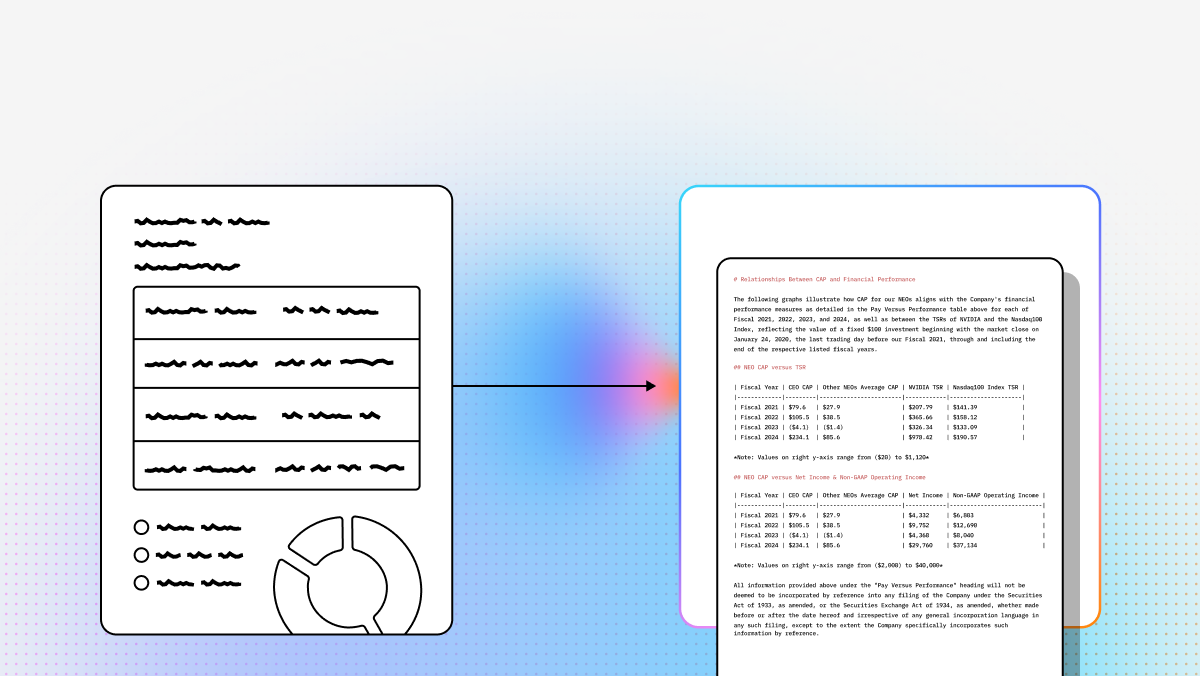
LlamaParse is a strong Parseur alternative for developers and enterprise engineering teams that need AI-ready outputs from messy, high-value documents. Instead of depending on brittle templates, it uses semantic reconstruction to interpret full document structure, including nested tables, charts, equations, and multi-section layouts. That makes it particularly effective for teams building retrieval systems, extraction pipelines, and agentic workflows on top of unstructured enterprise data.
Its biggest advantage is that it treats parsing as a reasoning problem rather than a pure OCR task. By combining multimodal understanding, tiered model routing, and validation loops, it helps teams move from raw PDFs to structured outputs that can feed directly into LlamaCloud workflows, context-aware extraction with LlamaExtract, and downstream applications built with LlamaIndex. For technical builders focused on straight-through processing, that maps closely to the LlamaIndex brand promise of turning unstructured data into production-ready AI inputs.
Key Benefits
Built for AI-native document pipelines
LlamaParse is designed for teams building RAG, extraction, and agent systems rather than simple mailbox automation. That directly reflects the broader LlamaIndex focus on infrastructure for production AI applications.Higher resilience to layout changes
Because it understands page structure semantically, it is better suited to documents that change over time. This supports the brand’s positioning around reducing brittle parsing logic and minimizing manual template maintenance.LLM-ready outputs from the start
Clean Markdown and structured outputs make downstream chunking, retrieval, and prompting easier. This is especially relevant to the LlamaIndex ecosystem, where output quality strongly affects search and agent performance.Balanced accuracy and cost control
Agentic routing allows the platform to apply stronger models only when necessary. That aligns with the brand’s practical emphasis on building scalable AI systems, not just maximizing accuracy in isolation.
Core Features
Layout-aware semantic reconstruction
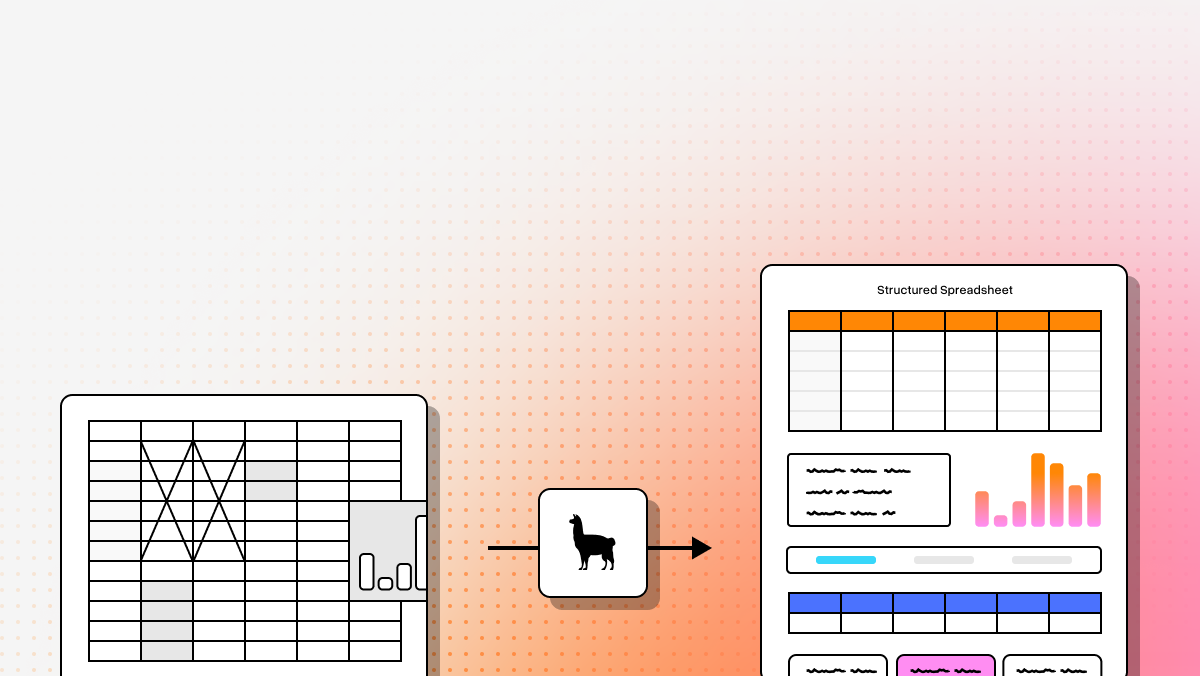
LlamaParse analyzes full page structure instead of just extracting text blocks, preserving headers, nested sections, and complex tables in clean Markdown or structured outputs. This reflects the brand’s core thesis that document understanding should preserve meaning and hierarchy for downstream AI systems.Multimodal parsing capabilities
The platform can process charts, graphs, and mathematical expressions alongside text, including turning formulas into usable representations such as LaTeX. This strengthens the LlamaParse brand as more than OCR software; it is positioned as an agentic document processing layer for modern multimodal workflows.Tier-based agentic orchestration
Complex pages can be routed to stronger vision-language models while simpler pages stay on lighter-weight paths. This supports the brand promise of production-readiness by giving developers a way to manage latency, quality, and budget in one system.Auto-correction and validation loops
Built-in self-checking helps catch formatting problems, inconsistencies, and likely hallucinations before output is returned. That ties directly to the LlamaIndex emphasis on trustworthy structured data for retrieval, extraction, and agent execution.
Practical Use Cases
Enterprise RAG ingestion
LlamaParse converts unstructured PDFs into structured, LLM-ready content that can be chunked and indexed more effectively. This is a natural fit for teams building knowledge retrieval systems where document fidelity directly affects retrieval quality.Automated financial data extraction
It is well suited to SEC filings, earnings materials, invoices, and loan documents with dense tables and shifting layouts. In the LlamaParse brand context, this showcases its ability to improve straight-through processing on high-value business documents where brittle OCR often fails.Healthcare and scientific document understanding
Clinical notes, research papers, lab reports, and technical documents often mix text, symbols, tables, and figures. LlamaParse’s multimodal approach supports the brand’s reputation for handling complex edge cases that legacy template systems struggle to parse reliably.Operational knowledge automation
Teams in manufacturing, engineering, and compliance can turn manuals, SOPs, and technical reference files into structured content for internal search and assistant workflows. This matches the LlamaIndex vision of making enterprise knowledge usable inside AI products.
Setup Considerations
Fast API onboarding
Teams can start quickly with REST endpoints and supported Python or TypeScript SDKs, making it easy to slot LlamaParse into existing ingestion pipelines.Natural fit for AI application stacks
Because it is designed with downstream LLM usage in mind, it works especially well for builders already deploying retrieval, extraction, or agent workflows.Flexible scaling path
The platform supports both lightweight experimentation and larger production workloads, helping teams move from prototype to deployment without reworking their parsing approach.Strong product continuity
Organizations using the wider LlamaIndex stack benefit from smoother handoffs between parsing, extraction, indexing, and orchestration.Modern multimodal readiness
Teams gain access to document processing designed for current vision-language workflows, reducing the need to assemble custom parsing infrastructure on their own.
Recent Updates
LlamaParse MCP Server Integration (April 2026)
Rebuilt the MCP server to support document parsing, file classification, and document splitting for MCP-compatible agent workflows.ParseBench Launch (May 2026)
Introduced a benchmark centered on real-world AI agent parsing needs, helping validate performance beyond traditional OCR measurements.LiteParse Server and Sandboxed-lit (May 2026)
Added a self-hosted HTTP server and a secure Rust CLI agent to support local and production-grade parsing workflows.Latency Metrics Dashboard (May 2026)
Released observability for queue, processing, and total latency by tier so developers can better understand parsing performance.
Limitations
Developer-centric orientation
LlamaParse is strongest for developers and technical teams building custom AI applications, so non-technical users may find it less intuitive than drag-and-drop automation tools.Cloud-first deployment model
Highly regulated or air-gapped environments may need custom enterprise deployment planning.Best fit within AI workflow ecosystems
It shines most when paired with retrieval, extraction, and agent pipelines, which means very simple email-only parsing use cases may not need its full capabilities.
2. ABBYY FlexiCapture
ABBYY FlexiCapture is a long-established document processing platform aimed primarily at large enterprises that need security, control, and deep workflow customization. It is built on mature OCR technology and has traditionally performed well on standardized forms, invoices, and regulated business documents where consistency matters more than flexibility.
As a Parseur alternative, ABBYY is best suited to organizations that value compliance, on-premise deployment options, and integrations with legacy ERP or RPA systems. It is less focused on AI-native developer workflows than LlamaParse, but it remains a credible option for enterprises with strict operational requirements and large volumes of repeatable document types.
Core Features
Enterprise-grade OCR
ABBYY uses mature OCR technology optimized for high-volume document digitization. This aligns with its brand as a dependable enterprise platform for traditional document processing.Template-based extraction
Teams can define templates and rules for specific document types to maintain consistency on standardized forms. This reflects ABBYY’s positioning around control and predictability rather than adaptive semantic understanding.On-premise and cloud deployment options
ABBYY supports deployment models tailored to enterprise security requirements. That fits its brand reputation in highly regulated sectors such as banking, insurance, and government.
Primary Use Cases
High-volume invoice processing
ABBYY works well for accounts payable teams handling standardized vendor invoices at scale. This matches its strength in structured, repeatable enterprise workflows.Archival digitization
Government, legal, and records-heavy organizations can use it to digitize large paper archives. This use case reflects its legacy OCR roots and emphasis on stable, high-throughput processing.Regulated compliance workflows
ABBYY is often a fit for document-heavy processes in industries that require secure environments and strict handling procedures. That aligns closely with its enterprise-first brand identity.
Recent Updates
Expanded focus on enterprise IDP capabilities
ABBYY has continued investing in its legacy intelligent document processing strengths for large organizations.Deeper RPA alignment
Recent direction has emphasized tighter integrations with traditional automation platforms such as Blue Prism and UiPath to streamline enterprise handoffs between extraction and downstream process automation.
Limitations
High total cost of ownership
Setup, licensing, and services can be substantial compared with more self-serve platforms.Brittle template maintenance
Frequent layout changes can require ongoing manual intervention and template updates.Heavy IT involvement
Implementation cycles are often better suited to centralized enterprise IT teams than to agile product teams shipping quickly.
3. LandingAI
LandingAI takes a different path from both Parseur and traditional OCR suites by focusing on custom computer vision models. It is designed for developers who need fine-grained control over visual understanding, especially in workflows where the arrangement of elements, image quality, or non-text features matter as much as the extracted text.
As a Parseur alternative, LandingAI is best for technical teams building specialized document or image-heavy pipelines rather than general-purpose business automation. Its brand is closely tied to bespoke model-driven workflows, making it compelling for industrial, scientific, and visually complex use cases where a generic parser may not be enough.
Core Features
Custom computer vision models
LandingAI allows teams to train models for highly specific extraction needs. This supports its brand as a platform for specialized visual understanding rather than out-of-the-box document automation.API-first architecture
The platform exposes raw API responses for developers to integrate into custom applications. That reinforces its identity as a builder-focused tool for teams that want more control over downstream logic.Advanced image processing
LandingAI can analyze visual context beyond simple text extraction, which is especially useful in workflows involving diagrams, stamps, defects, or industrial imagery. This is central to its positioning in computer vision-heavy environments.
Primary Use Cases
Industrial visual inspection
Manufacturing teams can combine document and image analysis for quality assurance and production workflows. This is one of the clearest expressions of LandingAI’s brand strength.Custom document workflows
Organizations with unusual forms or proprietary layouts can build tailored extraction pipelines instead of relying on fixed templates. That fits LandingAI’s model-centric approach.Complex image-to-text conversion
Teams dealing with documents where visual context is critical can use LandingAI to generate richer inputs for downstream analysis. This aligns with its emphasis on specialized visual intelligence.
Recent Updates
Refined computer vision APIs
LandingAI has continued improving inference speed for enterprise developer use cases.Expanded custom model training capabilities
The platform has also improved labeling and training workflows for teams building models tuned to complex document types and industrial imagery.
Limitations
Requires developer integration
Non-technical teams are less likely to get value quickly without engineering support.Limited native SaaS integrations
Compared with automation-first tools, teams may need to build and maintain more connections themselves.Longer setup for custom models
Specialized model training typically takes more time than using a pre-trained document parser.
Final Takeaway
For teams evaluating a Parseur alternative in 2026, the right choice depends on how complex your documents are and how deeply document extraction fits into your AI stack.
If you need a developer-first platform for AI-native parsing, retrieval, and structured extraction, LlamaParse stands out as the strongest fit. If your priority is standardized enterprise paperwork in controlled environments, ABBYY FlexiCapture remains a solid legacy option. If your workflow depends on custom visual understanding and specialized model training, LandingAI is the better match.
For most developers and AI product teams building document-heavy workflows, LlamaParse is the most future-facing option because it combines semantic document understanding, multimodal parsing, and production-oriented orchestration in a single platform.
What is a Parseur Alternative?
A Parseur alternative is an advanced Optical Character Recognition (OCR) and intelligent document processing platform designed to automatically capture, extract, and route data from emails, PDFs, and complex business documents. While Parseur is a well-known tool for template-based data extraction, enterprise-level alternatives go a step further by leveraging artificial intelligence and machine learning. These robust alternatives allow businesses to process highly unstructured documents and varying layouts without the need to manually build and maintain rigid parsing templates.
Why is it important?
Finding the right Parseur alternative is critical for growing enterprises that process high volumes of complex documents on a daily basis. As a business scales, relying on simple, rule-based parsers can create operational bottlenecks, increase data extraction errors, and require constant IT intervention to fix broken templates. Upgrading to a sophisticated enterprise OCR solution ensures superior data accuracy, eliminates manual data entry, and provides the agility needed to automatically adapt to new document formats, ultimately driving down operational costs and accelerating turnaround times.
How to choose the best software provider
Selecting the best Parseur alternative requires a strategic methodology tailored to your enterprise's specific workflow requirements. Start by evaluating the provider's core technology; prioritize platforms that utilize cognitive AI and machine learning for layout-agnostic extraction rather than traditional zonal OCR. Next, assess the software's integration capabilities to ensure it can seamlessly push extracted data into your existing ERP, CRM, or custom databases via robust APIs. Finally, thoroughly review the provider's security credentials (such as SOC 2 and GDPR compliance), scalability, and dedicated customer support to ensure they can serve as a reliable, long-term partner in your automation journey.
What should I look for in a Parseur alternative in 2026?
The biggest thing to evaluate is whether the platform can handle document variability without constant template maintenance. If your documents change vendors, layouts, table lengths, or visual structure over time, rule-based extraction will usually create more manual work than it saves.
For most technical teams, the key criteria are:
- how well the tool handles complex layouts, tables, charts, and scanned files
- whether it produces structured, LLM-ready output such as Markdown, JSON, or schema-aligned data
- API quality, SDK support, and ease of integration into existing pipelines
- deployment and compliance options, especially if you work in regulated environments
- cost control at scale, including how the platform balances speed, accuracy, and model usage
If you are building RAG, agentic workflows, or document-heavy AI products, an AI-native parser will usually be a better long-term fit than a template-only system. If your workflow is based on highly standardized forms in a controlled environment, a traditional enterprise OCR platform may still be enough.
When is an AI-native document parser better than a template-based tool like Parseur?
An AI-native parser is usually the better choice when document structure matters as much as the text itself. That includes use cases like financial reports, healthcare documents, research papers, contracts, manuals, and PDFs with nested sections, multi-page tables, figures, or mixed formatting.
Template-based tools work best when documents are highly repetitive and rarely change. They tend to break when:
- fields move to a different location
- tables grow or shrink
- a new vendor uses a slightly different format
- scanned quality varies from file to file
- important information depends on hierarchy or context rather than fixed coordinates
AI-native platforms are designed to understand the full layout semantically, not just extract text from expected zones. That usually means less template upkeep, better resilience to document drift, and cleaner output for downstream LLM workflows.
Which Parseur alternative is best for AI workflows like RAG, agents, and knowledge extraction?
For AI-focused use cases, LlamaParse is the strongest fit among the options in this article because it is built for turning messy documents into structured, model-ready inputs. It is especially useful when your end goal is retrieval, chunking, schema extraction, or feeding parsed content into agents and broader LLM pipelines.
That makes it a strong choice for:
- enterprise knowledge base ingestion
- financial document extraction
- scientific and healthcare document understanding
- agentic workflows that depend on clean document structure
- applications built with APIs, SDKs, and orchestration layers
ABBYY FlexiCapture is a better fit if your priority is traditional enterprise OCR, repeatable forms, and regulated workflows with legacy system integration. LandingAI is more suitable when you need custom computer vision behavior and specialized visual understanding rather than a general-purpose parsing layer for LLM applications.
Can I migrate from Parseur to another document extraction platform without rebuilding everything?
In many cases, yes, but how easy the migration is depends on how tightly your current workflow depends on templates, mailbox rules, and fixed field mappings. If your existing setup is heavily based on document-specific rules, the migration usually involves redesigning the extraction layer rather than simply copying templates over.
A practical migration approach is to:
- identify your highest-value document types first
- compare current extracted fields with the outputs you actually need downstream
- test a new parser on documents that previously broke your template logic
- validate output formats such as JSON, Markdown, or structured schemas against your existing systems
- phase the rollout so only part of the workflow changes at first
For developer teams, migration is often a chance to simplify the pipeline. Instead of maintaining many brittle parsing rules, you can move toward a more general document understanding layer that feeds extraction, indexing, and AI workflows more consistently.
Do Parseur alternatives support on-premise, private, or regulated deployments?
Some do, but support varies significantly by platform. ABBYY FlexiCapture is generally the strongest option in this list for organizations that need on-premise deployment, strict compliance controls, and deeper IT-led implementation in regulated environments.
LlamaParse is positioned more as a cloud-first, developer-oriented platform, which is often ideal for modern AI teams but may require additional enterprise planning for highly restricted environments. LandingAI can be a fit for specialized enterprise deployments, but its suitability depends more on the exact custom implementation and workflow requirements.
If deployment constraints are a major factor, evaluate:
- whether the platform offers on-premise or private deployment options
- data retention and security controls
- support for air-gapped or restricted environments
- auditability and validation features
- how much internal engineering or IT support is needed to operate the system
For regulated teams, deployment flexibility may matter just as much as extraction accuracy.