
Today, we’re releasing the open weights for OCRia-nano-1, an extremely lightweight 8.1M-parameter model that brings fast, accurate document parsing to your local CPUs. We think it should be the default first pass for all document collections within your organization, even if the hardest documents require larger VLMs. And, we are releasing the full open weights on Hugging Face!
- LiteParse on GitHub: installation and usage.
- Nano on Hugging Face: model weights and license.
- Technical report: architecture, benchmarks and methodology.
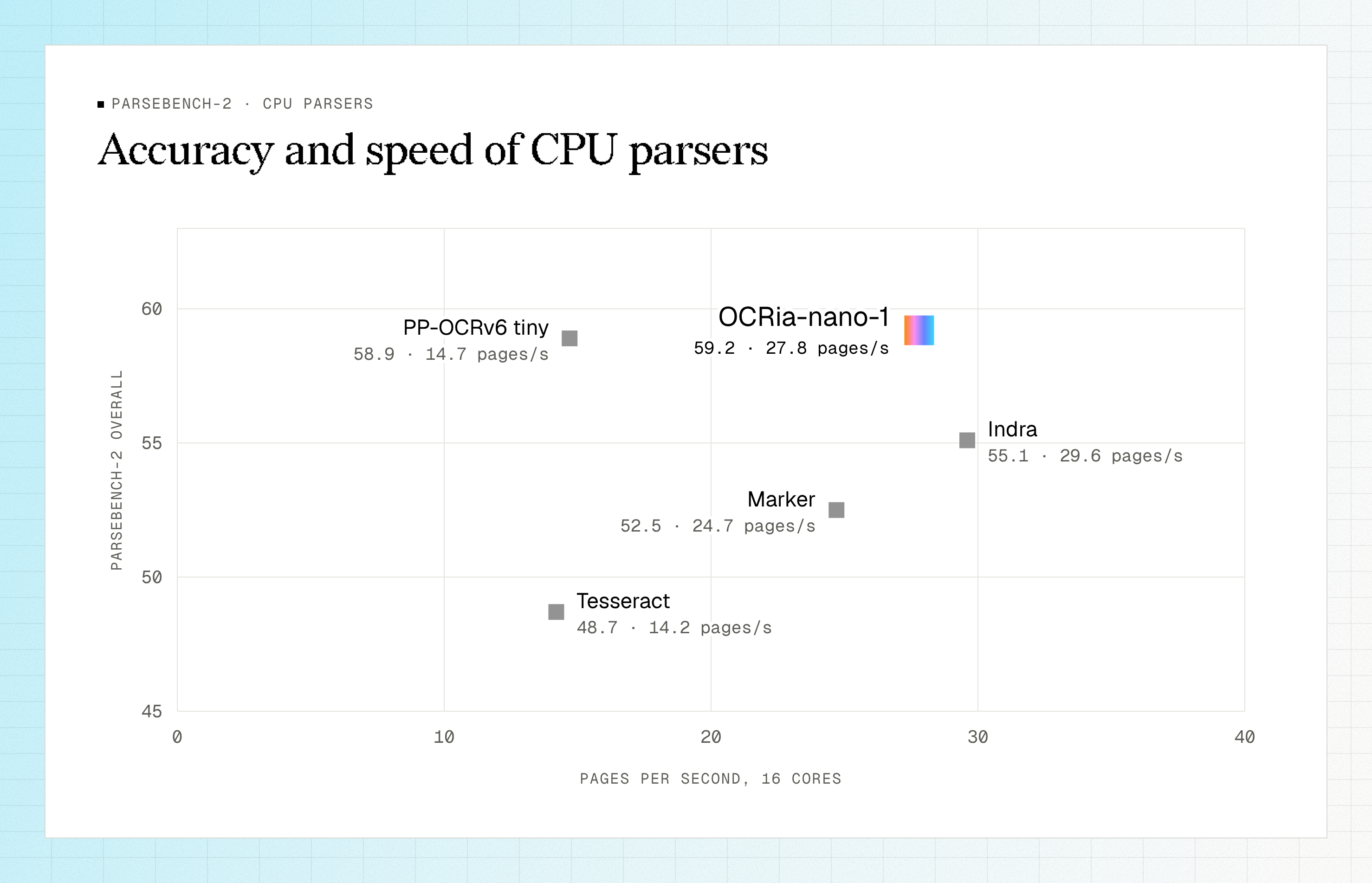
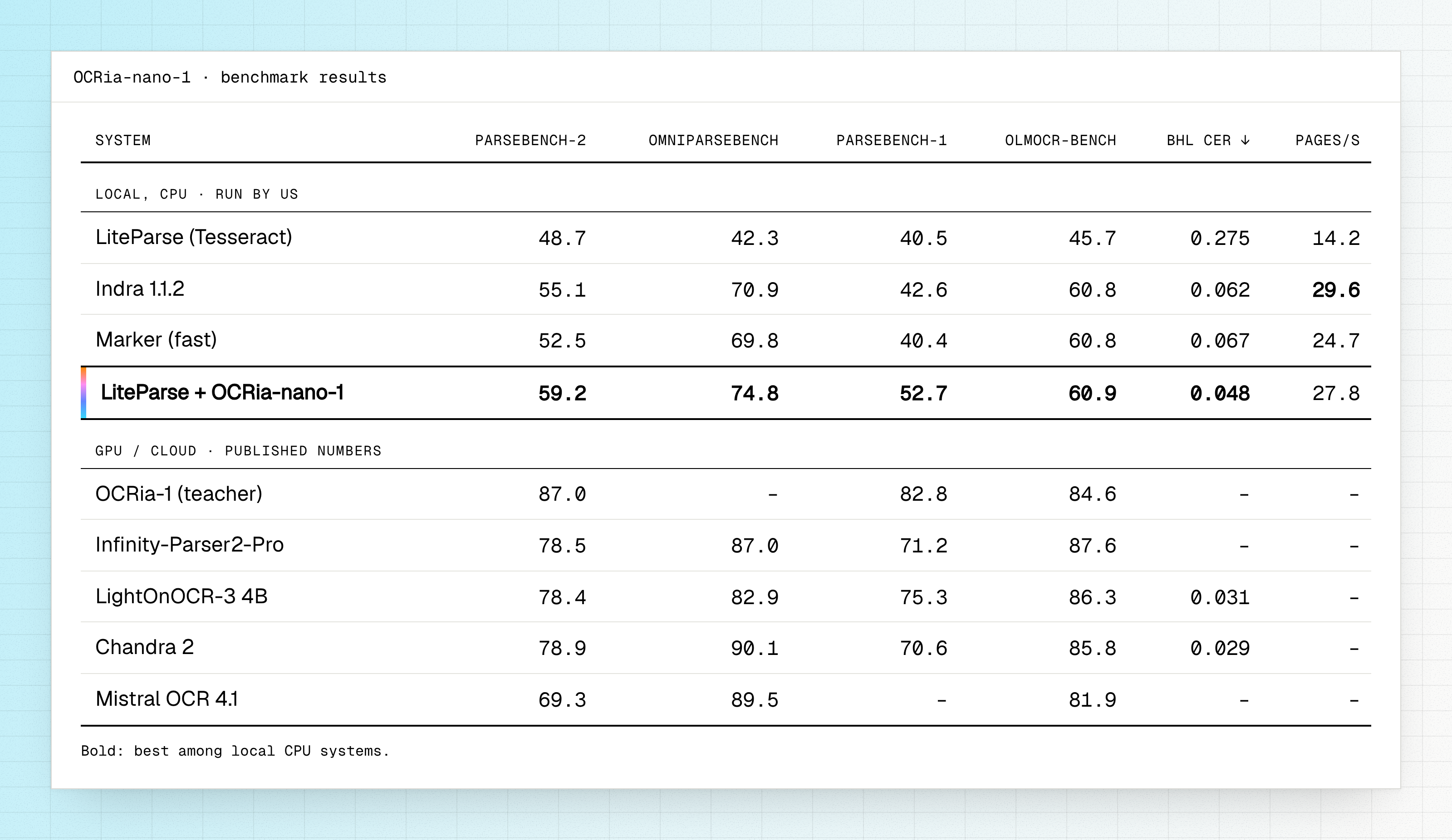
OCRia-nano-1 is more accurate at parsing tables/layouts compared to Marker, PP-OCRv6 tiny, Tesseract, while operating 2-5x+ faster than the default Tesseract OCR (426ms per page on a single core). It sets a new accuracy–speed Pareto frontier among the lightweight parsers we evaluated.
There are an estimated 100T+ document pages worldwide, from straightforward reports, contracts and invoices to dense tables, charts and difficult scans. There is a massive demand to digitalize and unlock context from these pages, so that agentic superintelligence can usefully operate across any business domain.
Yet no existing OCR tool is suited for processing all of these pages accurately and at scale. Free/OSS text parsers are fast, but fall apart on more complex tables and layouts. VLM-based approaches offer powerful one-shot performance over complex documents, but their compute and latency aren’t justified for every workload.
At LlamaIndex, we have been tackling those challenges with OCRia, a family of document-understanding models tailored to different workloads. With OCRia-nano-1, that family now includes a lightweight model built for the scale and speed of everyday document processing on CPUs, alongside our larger VLMs for the most demanding documents.
About OCRia-nano-1
OCRia-nano-1 is built for massive high-volume ingestion and agents that need fast results on everyday documents, from digitally generated reports and contracts to invoices with simple tables.
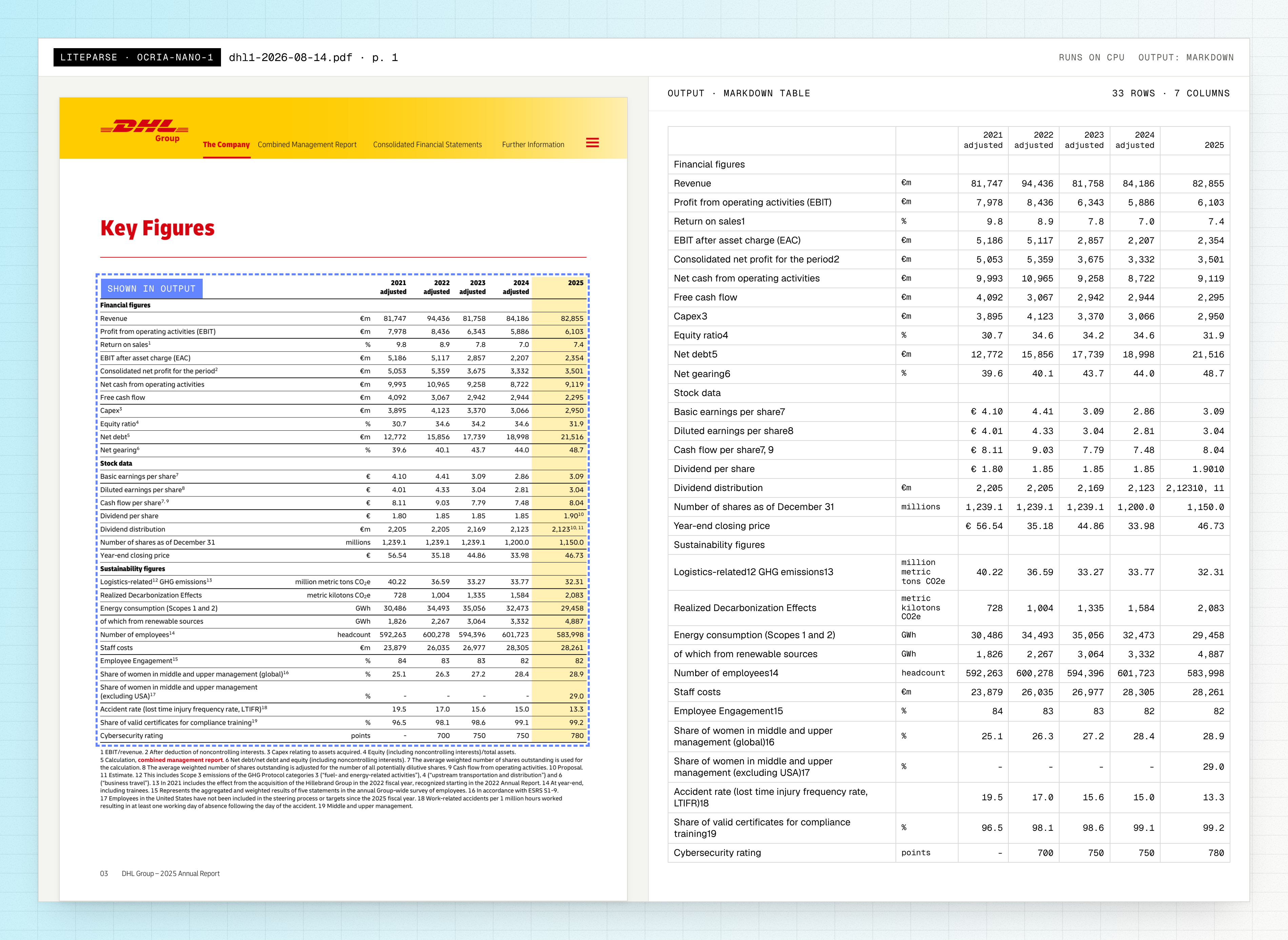
It combines seven specialized document models with 8.1 million parameters in total, bringing text recognition, table structure, and layout recovery to LiteParse, our open-source local document parser. Nano runs locally on CPUs, alongside your application. Its lightweight installation footprint lets you add it to existing pipelines without heavy dependencies.
Accuracy and speed at 8.1M parameters
Nano combines text, table and layout extraction with the speed needed for everyday document workloads. At 8.1 million parameters, it sits on the accuracy–speed Pareto frontier among the lightweight parsers we evaluated.
On ParseBench-2, Nano scores 59.2 overall, including 59.5 on tables. That parsing quality comes with an average processing time of 426 milliseconds per page on a single core, with 90% of measured pages finishing within 862 milliseconds. These timings include the complete LiteParse pipeline, from text recognition to structure recovery.
For larger collections, Nano processes 27.8 pages per second with 16 single-core workers, delivering 2x the throughput of LiteParse’s default Tesseract configuration.
Inside OCRia-nano-1
LiteParse starts with the text already available in the document. For digital PDFs, it reads usable text directly from the file. Nano’s OCR models recognize text where that text layer is missing or unreadable, including scans and embedded images.
Nano’s table and layout model then uses the text, its position on the page and visual features to recover table structure and identify content blocks. This combines native PDF text and OCR with learned structure recovery in the same local pipeline.
Click on each element in the pipeline below to see the inputs and outputs at each step. Components outlined in a gradient belong to OCRia-nano-1.
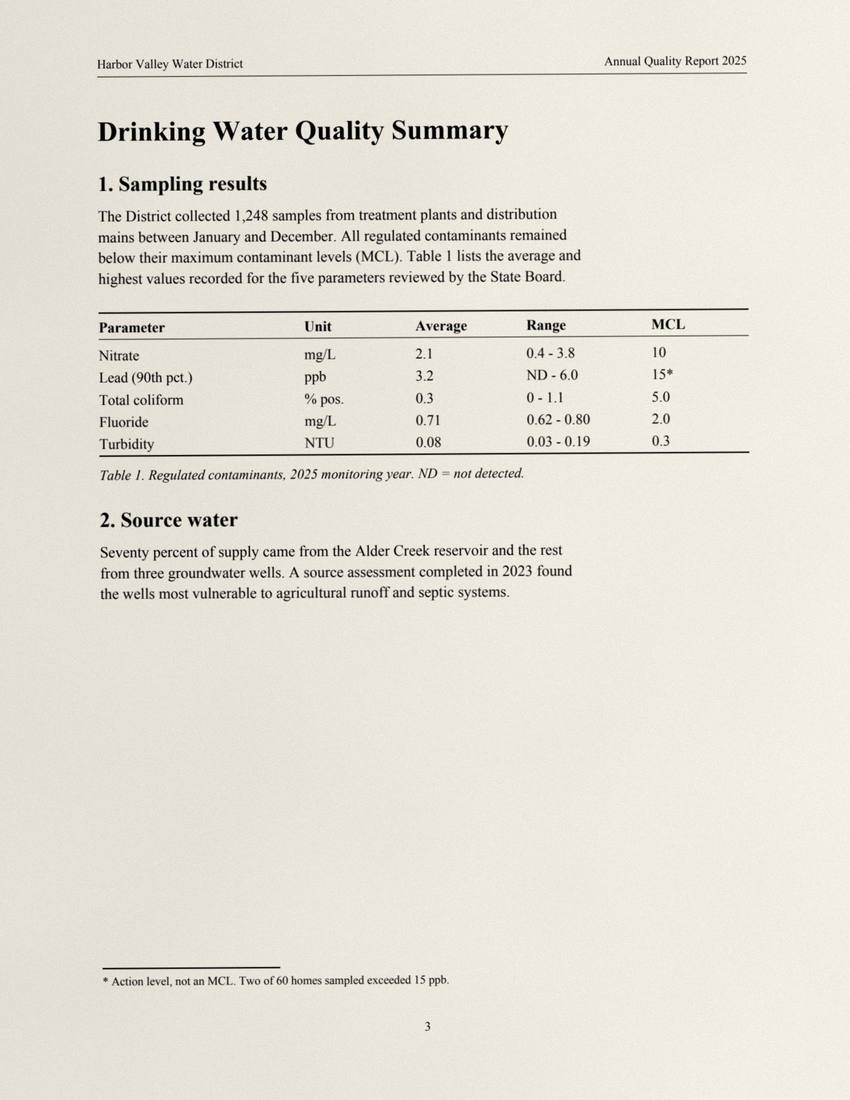
A scanned page
We made this page for the demo: a short water-quality report, rendered from a PDF, then rotated 0.35°, blurred, noised and JPEG-compressed until it looks scanned.
The interactive sample could not be loaded. Reload the page to try again.
We trained Nano through model distillation, using OCRia-1 to help generate text transcriptions, table annotations and layout labels for its training documents.
Markdown and structured output
Nano’s parsed output is available as Markdown, JSON or plain text through LiteParse. Markdown includes the document’s text, headings, lists and reconstructed tables. JSON provides extracted text and bounding boxes for applications that need to locate content on the source page.
Multilingual text recognition
Nano can read multilingual documents, including pages that mix scripts. Its OCR recognizers cover Latin, Chinese/Japanese/Korean (CJK), right-to-left, and other scripts. A tiny script router picks each page’s majority script, lets individual lines override it when it is confident, and detects upside-down pages before recognition.
Choosing a model for your documents
Nano and OCRia-1 are built for different workloads, so you can match the parser to your documents instead of overpaying for simple PDFs or compromising on complex ones.
Choose OCRia-nano-1 for everyday documents and workflows where speed and scale matter, like high-volume ingestion pipelines or agents reading uploaded files. It handles digitally generated reports, straightforward contracts, invoices with simple tables, and routine scans or image-based pages.
Choose OCRia-1 for demanding documents where accuracy takes priority over speed, including complex tables, handwriting, heavily degraded scans, and scanned mathematical notation. If your workflow requires chart-to-table extraction, use OCRia-1; Nano has no chart model and keeps charts as images.
Availability and getting started
OCRia-nano-1 runs locally through the latest version of LiteParse. Follow the commands below to parse your first document with Nano.
Parse your first document
Install LiteParse, download the Nano models and parse your first document locally.
bash
pip install liteparse
lit models pull ocria-nano
lit parse doc.pdf --format markdown
See Nano in action
Resources
- LiteParse on GitHub: installation and usage.
- Nano on Hugging Face: model weights and license.
- Technical report: architecture, benchmarks and methodology.
Model licensing: OCRia-nano-1’s model weights are governed by the modified Open RAIL-M license included with the model download. LiteParse is licensed separately under Apache 2.0. For commercial licensing or uses beyond the standard model license, contact our team.
This is a major step forward for the OCRia family, and we’re excited to see what you build with OCRia-nano-1.