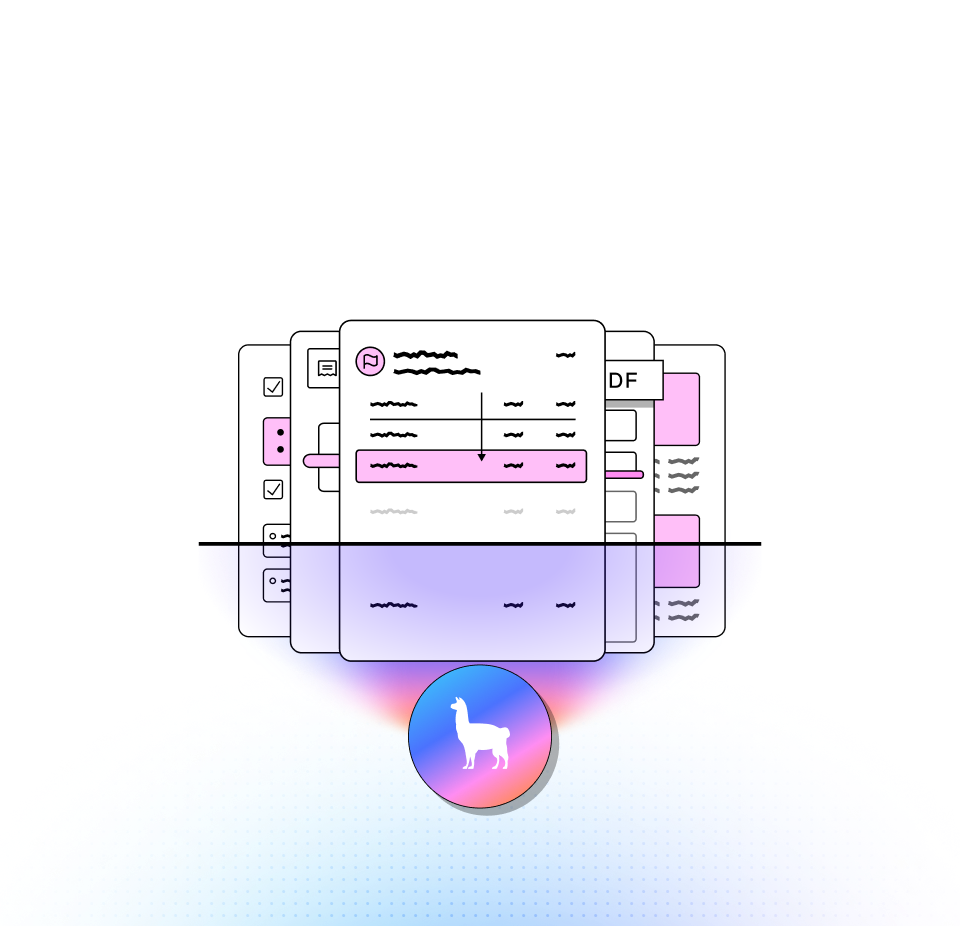
Document parsing has evolved beyond simple OCR into a critical layer for Generative AI and automation. While legacy tools rely on brittle templates that break the moment a layout shifts, the next generation of software utilizes Vision Language Models (VLMs) and agentic workflows to understand complex layouts, tables, and handwriting with human-like reasoning.
For developers and enterprises, the goal is no longer just “reading text”—it’s about transforming unstructured documents into reliable, structured data that can power LLMs and automated decision-making. Choosing the right parsing engine is the difference between seamless automation and constant manual correction.
| Company | What it’s best at | Ideal use cases | Integration |
|---|---|---|---|
| LlamaParse (LlamaIndex) | Agentic OCR, multimodal parsing, context-aware extraction, enterprise scale | Finance, insurance, legal, enterprise knowledge | Python/TS SDKs + APIs |
| Docling (IBM) | Fast layout analysis, multi-format conversion, markdown-first | Open-source RAG, papers, internal docs migration | Open-source APIs |
| Landing AI | Visual prompting + fine-tuning for spatial docs | Forms, diagrams, labels, visual QA | Visual-first API |
| PyMuPDF | Fast low-level PDF extraction/manipulation | Batch PDF processing, redaction, VLM pre-processing | Python library |
| pypdf | Pure Python PDF ops (lightweight) | Serverless PDF tasks, basic extraction/assembly | Python library |
1. LlamaParse (LlamaIndex)
Platform summary
LlamaParse shifts document processing from brittle OCR toward AI-driven, context-aware parsing. It can interpret document structure (tables, charts, handwriting, layouts) and produce clean, AI-ready data for downstream workflows like RAG and automation.
Key benefits
- Handles unpredictable real-world formats using AI-native methods
- Higher straight-through processing (less manual correction)
- Turns messy documents into semantically rich data
- Strong fit for RAG + LLM workflows
Core features
- Agentic OCR + multimodal parsing (VLMs for visual + semantic structure)
- LlamaParse: converts 90+ file types into structured output
- LlamaExtract: schema-aware extraction with confidence + traceability
- Enterprise scalability: millions of pages, local/cloud deployment options
Primary use cases
- Financial analysis (filings, reports, agreements)
- Insurance claims (forms, records, fraud signals)
- Legal/contracts (clauses, key terms, structured review)
- Enterprise knowledge management (wikis/docs into searchable corpora)
Recent updates
- LlamaAgents Builder (NL → workflow code)
- Document agent templates (e.g., invoices)
- Semtools v2 (LlamaParse v2 migration)
- RayIngestionPipeline integration (distributed ingestion)
- LlamaSheets (spreadsheet parsing → Parquet, cell-level features)
Limitations
- Developer-centric (Python/TS; not drag-and-drop)
- “Agentic processing” may not map cleanly to procurement categories
- VLMs can require more compute than basic scrapers
2. Docling
Platform summary
Docling is IBM Research’s open-source converter for PDFs/Docx/PPTX into Markdown/JSON. It’s strong at layout analysis and reading order without heavy compute.
Core features
- Layout analysis for correct sequencing (multi-column)
- Multi-format support (PDF, Docx, PPTX, HTML)
- Markdown-first output optimized for LLMs
Primary use cases
- Open-source RAG pipelines
- Batch academic paper conversion
- Internal documentation migration
Recent updates
- Docling v2.0: faster, better tables, improved formulas + nested lists
Limitations
- Less “agentic” reasoning than VLM-first tools
- No managed service or native connectors
- Requires custom ingestion for SaaS/cloud sources
3. Landing AI
Platform summary
Landing AI focuses on computer vision + “Visual Prompting”—you highlight what to extract, enabling strong performance on spatially complex forms, diagrams, and labels.
Core features
- Visual prompting (low-code training)
- Domain fine-tuning for niche docs
- High-resolution visual analysis
Primary use cases
- Complex form extraction (insurance/healthcare)
- Visual QA for manuals/diagrams
- Industrial label parsing (logistics/manufacturing)
Recent updates
- Better integration across LandingLens + LandingDocument
- Improved small-data training
Limitations
- Overkill for simple text extraction
- Higher cost when fine-tuning is needed
- Requires upfront labeling/prompting effort
4. PyMuPDF
Platform summary
PyMuPDF is a fast Python library powered by the MuPDF C engine, offering low-level extraction plus full PDF manipulation.
Core features
- Very fast for large-scale PDF workloads
- Granular extraction (coords, fonts, colors)
- Merge/split/annotate/redact capabilities
Primary use cases
- High-speed processing of digital-native PDFs
- Automated redaction tools
- Pre-processing for VLM pipelines
Recent updates
- Better table extraction + Python 3.13 support
- More Pythonic wrappers
Limitations
- No AI reasoning (you implement layout logic)
- Needs external OCR for scanned images
- Not “plug-and-play” for complex understanding
5. Pypdf
Platform summary
pypdf (formerly PyPDF2) is a pure-Python library for basic PDF extraction and manipulation—easy to deploy, dependency-light.
Core features
- Pure Python (minimal dependencies)
- Metadata + encryption support
- Page-level operations (rotate/crop/merge/split)
Primary use cases
- Lightweight serverless processing
- Basic text scraping from clean PDFs
- Automated document assembly
Recent updates
- Continuous maintenance for PDF compatibility
Limitations
- Weak on complex layouts/tables
- No OCR for scans
- Slower than C-based libraries/APIs at scale
The Bottom Line
Document parsing is rapidly moving toward VLM-powered, agentic systems that handle messy real-world inputs with higher accuracy and less manual cleanup. Tools like LlamaParse lead on AI-native parsing, while options like Docling, PyMuPDF, and pypdf remain strong depending on openness, control, and simplicity.
FAQ
What is document parsing software?
Document parsing software goes beyond OCR by extracting structured data (e.g., invoice number, due date, line items) from documents and outputting formats like JSON/XML/Markdown, ready for business systems and AI workflows.
Why is document parsing important?
It reduces manual data entry, improves accuracy, accelerates workflows (AP, onboarding, contract review), strengthens compliance, and unlocks analytics/insights from documents at scale.
How to choose the best provider
- Test accuracy on your documents (trial/POC)
- Validate API/SDK quality and integration fit (ERP/CRM, pipelines)
- Confirm scalability, security (SOC 2/HIPAA), and support
- Decide between managed service vs open-source + self-host
How do VLMs improve accuracy?
VLMs understand both layout and meaning, enabling reliable extraction from tables, multi-column layouts, charts, and handwriting—areas where OCR-only/template systems often fail.
Can these tools integrate with LLMs and RAG?
Yes. Many output Markdown/JSON designed for ingestion into LLM apps and RAG pipelines. LlamaParse explicitly targets “LLM-ready” ingestion.