Legal documents are among the most structurally complex inputs optical character recognition (OCR) has to handle. A multi-column contract with defined terms, exhibits with tables, court filings stamped and signed, and a lot more aren’t easy to read. A law firm's document library is large and messy in ways most OCR systems weren't designed for.
For law firms, OCR is an accuracy and compliance problem. A missed keyword in eDiscovery, a misread clause term in a contract, or a gap in a privilege log can lead to serious consequences.
This article covers why that’s the case, where modern agentic approaches close the gap, and what actually matters when evaluating OCR software for legal workflows.
Why Legal Documents Are the Hardest Use Case for Traditional OCR
Legal docs usually aren't clean PDFs. A single scanned document can contain printed body text alongside handwritten marginalia, Bates stamps, signature blocks, and embedded tables. These are several fundamentally different content types, and standard OCR pipelines treat them all the same way.
Historical case files and archive materials compound the problem. Low resolution, skew, and background noise cause character-level errors even in well-tuned pipelines, with no reliable way to flag which pages are affected. Legal citation format adds another layer of structural complexity. Case names, statutory references, and section cross-references follow patterns that confuse left-to-right, top-to-bottom parsing engines. The result is extracted text that's technically complete but structurally wrong.
Deposition transcripts add their own challenges. They use a page-and-line citation format (e.g., Smith Dep. 47:12) that OCR engines routinely mangle, turning a searchable citation into a string of digits with no recoverable structure. Privilege logs have their own format requirements, and errors in the log itself can create waiver risks if a log entry doesn't accurately reflect the underlying document.
The stakes are asymmetric in a way that makes accuracy thresholds feel different than in other industries. A 98% accuracy rate sounds acceptable. Across 50,000 pages of discovery material, that's 1,000 pages with errors, and any one of those could contain a missed keyword in a regulatory filing or a misread date in a contract clause.
Document processing for legal use requires structured, reliable output. The gap between "mostly accurate" and "accurate enough to trust" is wide, and the consequences of falling into it are measured in client outcomes.
The Accuracy Problem: When OCR Errors Become Legal Liability
eDiscovery and the Keyword Gap
Document review in eDiscovery is the highest-stakes environment for OCR accuracy. Keyword searches run across millions of pages, and a missed match can constitute failure to produce responsive documents. Courts have sanctioned parties for inadequate ESI processing, and poor OCR quality is a documented contributing factor in production failures.
Standard character error rates for traditional OCR on complex layouts run 3 to 8%, depending on scan quality. At scale, that's hundreds of pages of unreliable digital text. Reducing errors at the extraction stage is the only way to trust keyword hit rates in a production review workflow. Catching OCR errors after the fact requires re-reviewing documents that should have been caught the first time, which eliminates most of the efficiency argument for OCR in the first place.
The keyword gap isn't always visible. When OCR misreads "indemnification" as "indemnif1cation" or drops a character from a party name, standard keyword searches miss the match silently. No error appears in the processing log. The document looks processed. The gap only surfaces when someone manually cross-references the source, and at discovery scale that rarely happens until a production challenge or a sanctions motion forces the issue.
Contract Review: Where a Misread Number Becomes a Liability
Contract document management requires precision on defined terms, dollar amounts, dates, and obligation clauses. These are exactly the areas where OCR systems make character-level errors: 0 vs. O, 1 vs. l, commas vs. periods in currency figures.
A misread indemnification cap or termination date is more than a minor inconvenience, leading to a potential malpractice exposure. Case preparation built on bad text extraction creates errors that compound downstream across the entire matter.
Compliance with document retention policies also requires that captured text matches what's in the document. The moment captured text diverges from source content, the integrity of the document record is in question.
What Traditional OCR Gets Wrong on Legal Documents
Layout Complexity: Tables, Exhibits, and Cross-References
Most OCR systems read left-to-right, top-to-bottom. That works for prose. It breaks on multi-column contracts, side-by-side comparison tables, and schedules where structure carries legal meaning.
A standard OCR engine reading a table of representations and warranties will produce scrambled output: merged cells, reordered rows, lost column headers. That output is useless for any downstream analysis. PDF files from court filings frequently mix header and footer boilerplate into the body text flow, adding noise to keyword searches and breaking any structured extraction attempt.
Exhibits and attachments appended to contracts often have different fonts, scan quality, and formatting from the main document. Single-pass pipelines treat them identically, which is why extraction quality degrades sharply as soon as you get past the first section of most legal documents.
Mixed Content: Stamps, Signatures, and Handwritten Annotations
Discovery materials routinely include handwritten sticky notes, annotated margins, confidentiality watermarks, and signature blocks. Traditional OCR interprets these as garbled text or skips them entirely. Scanned image files from physical archives often have bleed-through, skew, or low DPI that makes character boundaries ambiguous.
Machine learning models in traditional OCR pipelines were trained on clean printed text. Performance drops sharply on anything outside that baseline. Most real legal document collections deviate substantially. A benchmark environment with clean corporate letterhead doesn't predict how a system handles a 1992 deposition with coffee stains and margin notes, which is why vendor accuracy numbers rarely hold up in production.
How Agentic OCR Changes What's Possible for Legal Document Processing
What does it actually take to get OCR right on legal documents? You have to replace the pipeline model entirely.
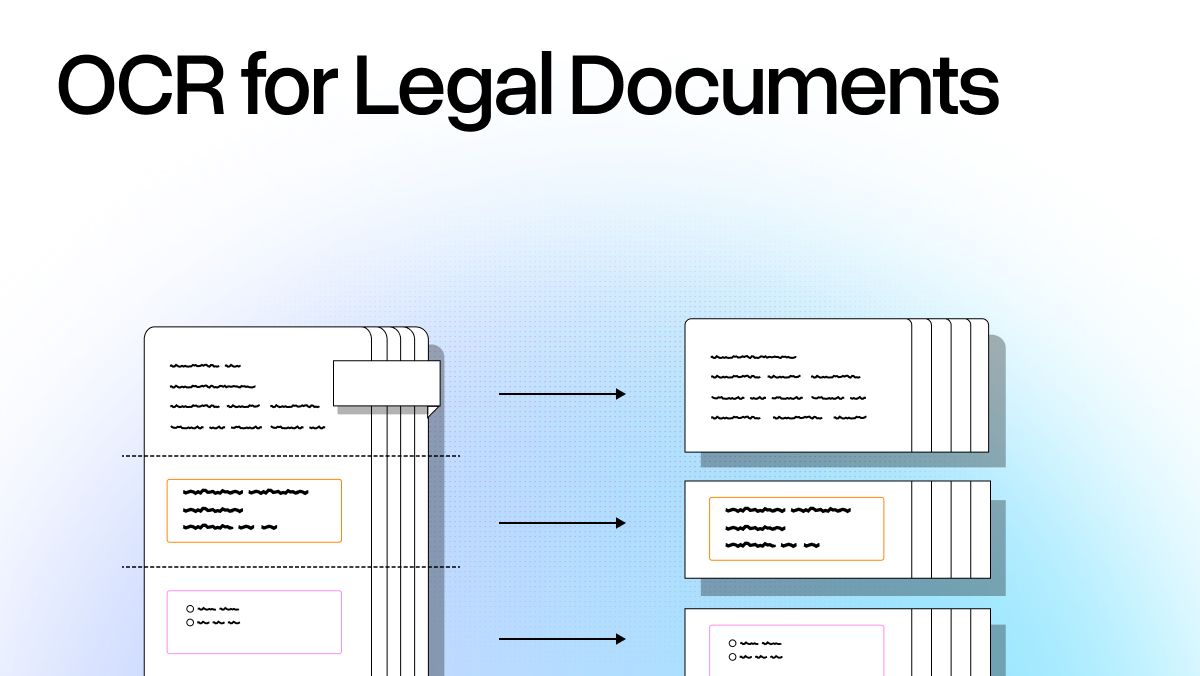
Traditional OCR applies a single pipeline to every document element. Agentic OCR uses specialized models for each task: layout detection, table extraction, handwriting recognition, image interpretation. An orchestration layer routes each component to the right model.
Layout-aware computer vision identifies document structure first, detecting whether a region is prose, a table, a header, or a signature block before passing it to the appropriate extraction model. For legal professionals, this matters because a contract schedule and a dense paragraph of defined terms require fundamentally different processing. Treating them identically is precisely where traditional OCR breaks down.
Extracting data from a table of representations and warranties requires understanding row and column relationships, not just reading pixels in sequence. Self-correction loops verify output against source material. When confidence is low on a specific region, the system flags it for human review rather than producing silent errors.
A system that can show you where it's uncertain is worth more than one that's quietly wrong on page 847. Verifiable outputs with confidence scores support the audit trails and human-in-the-loop review that high-stakes legal workflows require.
How LlamaParse Fits
LlamaParse uses this agentic orchestration approach, selecting the best combination of OCR models, vision models, and LLMs for each document. It has processed over half a billion pages across 50+ file formats without requiring custom training or manual configuration per document type. That adaptability is what matters for legal teams processing mixed document collections where no two contracts or case files look the same.
Depositions processed through LlamaParse preserve the page-and-line citation structure that legal teams rely on for cross-referencing testimony, rather than collapsing it into undifferentiated text blocks. Privilege log generation, which requires matching extracted metadata against document content with precision, benefits directly from confidence scores that flag low-certainty extractions before they create waiver exposure. The cost optimizer routes each document component to the most efficient model for that task, which matters when compute costs scale across thousands of documents in a single matter.
Where Agentic OCR Makes the Biggest Difference in Legal Workflows
eDiscovery and Document Review
Keyword search across millions of pages is only as reliable as the underlying text extraction. Agentic OCR reduces character error rates and handles mixed-format document review sets, including emails, PDF files, scanned documents, and native files, in a single pipeline.
Confidence scores let reviewers prioritize uncertain pages for manual QA rather than re-reviewing everything. For large-scale productions, that's the difference between targeted quality control and wholesale re-review.
Contract Analysis and Due Diligence
Extracting data from contracts at scale, covering defined terms, obligation dates, indemnification caps, and governing law clauses, requires structured output. A text dump isn't enough. M&A due diligence involves reviewing thousands of contracts across inconsistent formats, and table-aware extraction preserves the structure that makes bulk review tractable.
Output in Markdown, JSON, or HTML lets downstream contract analysis tools and databases consume the data directly, without additional processing steps between extraction and analysis.
Court Filing Digitization and Archive Processing
Historical court records and legacy case preparation files often have degraded scan quality. A multi-model agentic approach handles low-resolution, skewed, or noisy scanned image inputs more reliably than single-pipeline systems, because it routes degraded regions to models trained for that specific condition rather than applying a uniform extraction pass.
What to Actually Look for in OCR Software for Law Firms
Vendor benchmarks are theater. They test clean PDFs because that's what makes the numbers look good, not because that's what your document collection looks like. When evaluating OCR software for legal workflows, ask for accuracy numbers on the document types you actually process: multi-column contracts, tables of representations and warranties, handwritten annotations in discovery materials (the stuff that makes most OCR vendors squirm). If a vendor can't run their system against your messiest samples, that's your answer right there.
Confidence scores matter as much as aggregate accuracy. Any production legal OCR workflow needs the ability to flag uncertain extractions. Silent errors are the worst-case scenario in a compliance context, and a system that surfaces its uncertainty on a specific page is more useful than one that quietly produces wrong text. Make sure the system supports human-in-the-loop (HITL) review for flagged extractions.
Structured output is non-negotiable. Raw text doesn't work for contract databases, privilege logs, or eDiscovery review platforms. You need JSON or structured extraction that preserves table relationships and document hierarchy so downstream tools can consume it directly.
And think about the full cost, not just the per-page processing rate. Poor-accuracy OCR generates more manual review work than it saves. If reviewers are catching extraction errors downstream, the efficiency argument falls apart. Integration matters too: output needs to connect directly to your review platform or contract database without extra steps between extraction and use.
As courts increasingly accept AI-assisted document review, the accuracy and auditability of the underlying OCR layer is a defensibility question. Accuracy numbers that look fine in testing can produce production failures that only surface during a sanctions motion.
For legal teams processing complex documents at scale, LlamaParse provides agentic OCR built for the structural complexity and accuracy requirements of real legal workflows. No custom training required, and it’s free to try with 10k credits.